1200 Addressable LEDs Make For The Perfect First Dance

The first dance of a newly married couple at the wedding reception is both a sentimental and memorable event, so why not make it even more so with something a bit special? Hackaday alumnus [Brett Haddoak] and his wife [Rachelle] certainly achieved that, with 1200 addressable LEDs turning her wedding dress into a real-life reproduction of Princess Aurora’s color changing dress from Disney’s Sleeping Beauty.

Tradition dictates that a groom must not see the dress before the Big Day, thus the LEDs were fixed to a petticoat and bustier that go underneath. The design would need so many LEDs that it crossed the limit that an Arduino can address, thus there were two Arduinos to control the whole. Electronics and batteries were worn in a pair of polo shorts, and after some nail-biting moments involving flaky connections, the whole thing came to life. The result can be seen in the video below the break, and certainly comes with a significant wow factor!

We would like to wish the happy couple all the best for the future, and we hope that this won’t be their last such electronic collaboration. If you’re hungry for more, it’s not the first light-up wedding outfit we’ve brought you.

Continue reading “1200 Addressable LEDs Make For The Perfect First Dance”
Comparing 3D Printed Tires: Resin Vs. TPU

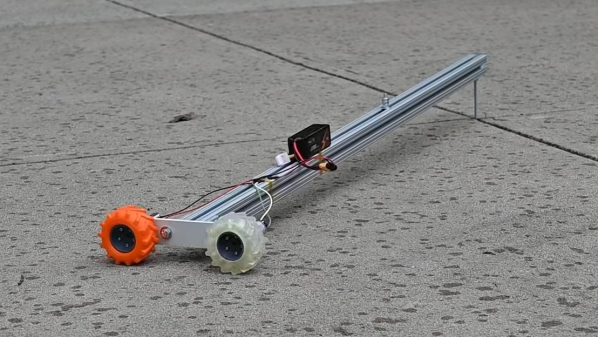
Many robot builders and RC enthusiasts find themselves turning to 3D printed tires. The benefit is you can make them in any size and style you want, and they’re as readily available for as long as your home printer is still working. [Michael Rechtin] printed some up and decided to see how long they’d actually last in use.

[Michael] printed a pair of tires for the test. One was made in TPU on a typical FDM printer, while the other was printed in flexible resin. The tires were then installed on hubs and fitted with gear motors for drive. The assembly was then fitted to the end of a test tether that would turn in circles for hours to put mileage on the tires.

After many hours and around 10 miles of testing, both tires were showing signs of wear. Notably, the resin tires showed a lot more wear than the TPU version, suggesting the latter material is a better choice for printing hard-wearing tires.

Overall, it’s reminiscent of the tether testing we saw from [rctestflight] recently. There’s something compelling about thrashing something round in circles to learn something in the process! Video after the break.

Continue reading “Comparing 3D Printed Tires: Resin Vs. TPU”

Turing Pi 2: The Low Power Cluster

We’re not in the habit of recommending Kickstarter projects here at Hackaday, but when prototype hardware shows up on our desk, we just can’t help but play with it and write it up for the readers. And that is exactly where we find ourselves with the Turing Pi 2. You may be familiar with the original Turing Pi, the carrier board that runs seven Raspberry Pi Compute boards at once. That one supports the Compute versions 1 and 3, but a new design was clearly needed for the Compute Module 4. Not content with just supporting the CM4, the developers at Turing Machines have designed a 4-slot carrier board based on the NVIDIA Jetson pinout. The entire line of Jetson devices are supported, and a simple adapter makes the CM4 work. There’s even a brand new module planned around the RK3588, which should be quite impressive.

One of the design decisions of the TP2 is to use the mini-ITX form-factor and 24-pin ATX power connection, giving us the option to install the TP2 in a small computer case. There’s even a custom rack-mountable case being planned by the folks over at My Electronics. So if you want 4 or 8 Raspberry Pis in a rack mount, this one’s for you.
Continue reading “Turing Pi 2: The Low Power Cluster”

There’s A LEGO Suspension Dyno Now

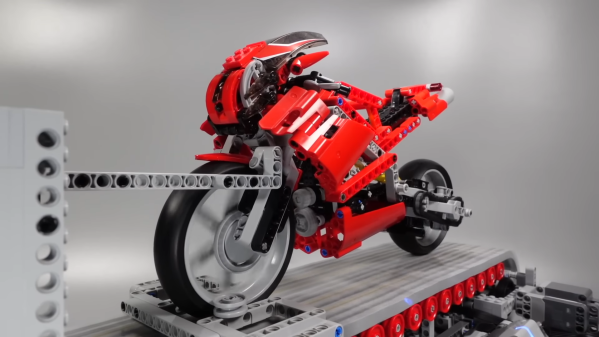
When it comes to the development and testing of performance suspension, it’s helpful to have a test apparatus that lets you recreate certain conditions reliably. This LEGO suspension dyno does just that, and it’s clearly a big help for those doing R&D on minifig motorcycle suspension.

The build relies on four motors to overcome the resistance of turning a chunky conveyor belt, which acts as a rolling road. As the belt is built out of Technic beams, various LEGO blocks can be added to the conveyor to act as bumps or perturbations for testing suspension.

The video demonstrates the use of the dynamometer, showing how a simple LEGO motorbike design deals with bumps of various sizes. It’s easy to swap out forks and springs and change the geometry to tune the suspension, and the changes can be easily seen when running it through the same test conditions.

While we don’t imagine there are too many people working in this particular field, the lessons being taught here are valuable. This setup allows one to quickly visualize how changing vehicle parameters affects handling. It’s hard to imagine a better teaching tool for vehicle dynamics than something like this that lets you see directly what’s really going on!

Continue reading “There’s A LEGO Suspension Dyno Now”

Office Life: The Old Gray Mare, She Ain’t What She Used To Be

Ding, dong; the office is dead. The real office is in your head.

This is what I tell myself when working from home gets too weird, too stale, too impossible. By now, many of you know some version what I’m talking about. Our circumstances may vary wildly, but the outcome is the same: working from home is pretty awesome, but, some small, secret part of us longs for the office. Why is that?

The answer will be different for everyone. Maybe you’re a social butterfly who misses face-time and the din of familiar voices. Maybe you just appreciate the physical separation between work and home life. If you’re lucky, the choice to go to the office is yours at this point, and if not, well, we have to wonder if you’re looking for new work. It’s 2022, we’re still in a pandemic, and of course there’s this, that, and the other multi-national Dumpster fire you haven’t heard about yet. Isn’t it time we prioritized work output over office attendance when it comes to our livelihoods?

To no one’s surprise, few major companies agree with me. Elon recently decreed that ‘remote work is no longer acceptable‘, and that those who want to work remotely may only do so as a reward after serving a minimum of 40 hours per week in the office. Apple tried to enforce three appearances a week until they received an open letter with 1,000+ signatures against.

Continue reading “Office Life: The Old Gray Mare, She Ain’t What She Used To Be”

Custom 40% Model F Keyboard Is 100% Awesome

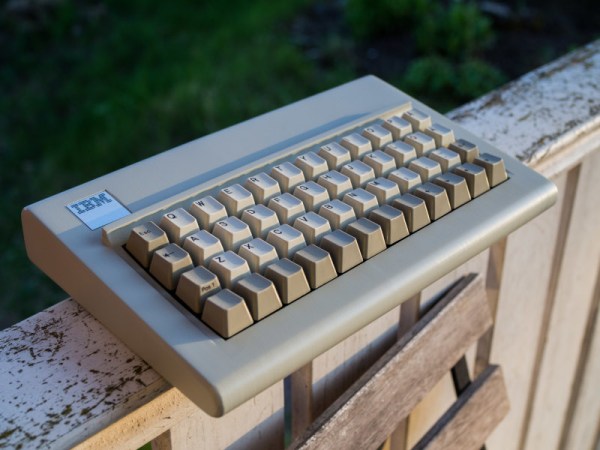
Look closely at this beauty. No, that’s not a chopped IBM Model M or anything — it’s a custom 40% capacitive buckling spring keyboard with an ortholinear layout made by [durken]. Makes it easy to imagine an alternate reality where IBM still exists as IBM and has strong keyboard game, or one where Unicomp are making dreams come true for those who don’t need anywhere near 101 or 104 keys.

Buckling what now? This lovely board uses capacitive buckling spring switches from an old IBM Model F. Basically, every time you press a key, a little spring is bent over (or buckled) in the name of connectivity. In the capacitive version, the spring pushes a hammer onto a pair of plates, causing a change in capacitance that gets recognized as a key press. In this case, those key presses are read by a TH-XWhatsit controller.

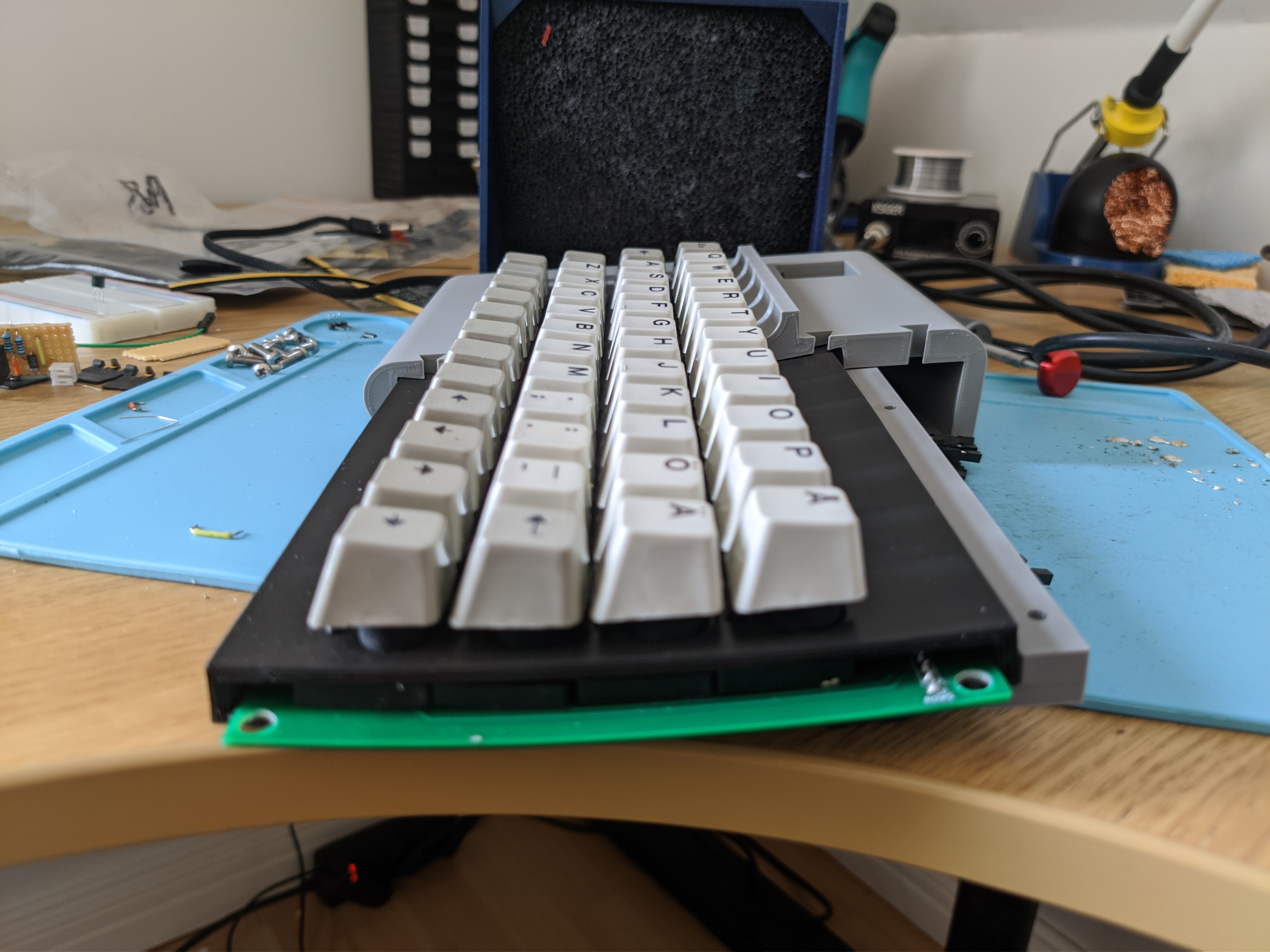
Using a Model F XT’s PCB as a guide, [durken] made a field of capacitive pads on one PCB, and made a second, ground plane PCB to avoid interference. In a true homage to these keyboards, [durken] decided to curve the PCB slightly, which naturally complicated almost everything, especially the barrel plate.

The solution was to make a separate barrel plate that slides into the case and gets screwed to the top via mounting bracket. For an extra bit of fun, [durken] mounted an SKCL lock switch under the IBM logo which enables solenoid mode. Be sure to check that out in the (updated!) video after the break.

One of the best things about a buckling spring keyboard is that each key sounds slightly different. Not so in solenoid mode, unless you were to use multiple solenoids.

Continue reading “Custom 40% Model F Keyboard Is 100% Awesome”

TRS-80 Luggable Gets Fresh Face, New Gear

It’s true that this TRS-80 Model 4P “luggable” was in better shape than many of the vintage machines that pass through the hands of [Drygol], but that doesn’t make the end result of its refurbishment and upgrade process any less impressive. After all, not every rebuild has to be a once-in-a-lifetime achievement.

No, the case didn’t have to get pieced back together by hand, and the board didn’t need to have half of its traces recreated. But the outer plastic was certainly in need of a good retrobright treatment, the keyboard was overdue for a cleaning, and the capacitors in the PSU were predictably due for retirement. After [Drygol] got through with it, the machine was back in like-new condition. But then, we can do a little better than that…

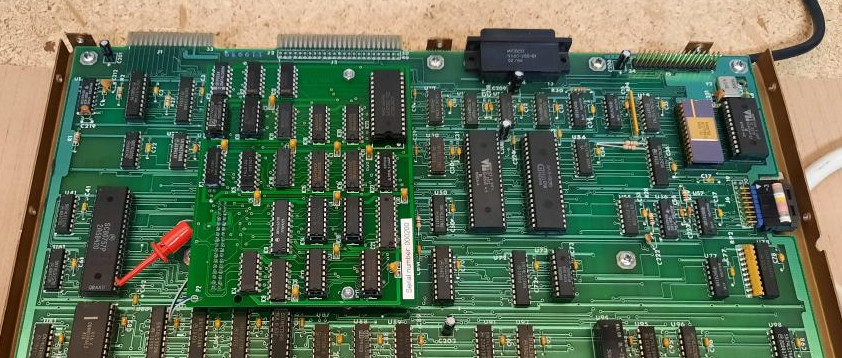
Installation of the new Grafyx board.

So into the refreshed computer went several community-developed modifications, including a M3SE expander that adds Compact Flash and Ethernet support to the TRS-80 and a high-resolution Grafyx video board. In classic [Drygol] style, every effort was made to integrate these upgrades as seamlessly as possible. After struggling for a bit to find a 5.25″ drive that would write a disk the TRS-80 would actually read, all the necessary files to get the upgrades working were transferred over, and the system was booting into TRSDOS.

We’ve covered a lot of [Drygol]’s restorations, and never get tired of seeing how these old and broken machines get a new lease on life once they come out the other end. Whether it’s a relatively easy task of swapping out some dud chips, or using every trick in the book to piece together what’s left of a computer’s case, they always show an incredible level of dedication and attention to detail that you can’t help but admire.