Remoticon 2021 // Voja Antonic Makes You A Digital Designer

[Voja Antonic] has been building digital computers since before many of us were born. He designed with the Z80 when it was new, and has decades of freelance embedded experience, so when he takes the time to present a talk for us, it’s worth paying attention.

For his Remoticon 2022 presentation, he will attempt to teach us how to become a hardware expert in under forty minutes. Well, mostly the digital stuff, but that’s enough for one session if you ask us. [Voja] takes us from the very basics of logic gates, through combinatorial circuits, sequential circuits, finally culminating in the description of a general-purpose microprocessor.

A 4-bit ripple-carry adder with additional CPU flag outputs

As he demonstrates, complex digital electronics systems really are just built up in a series of steps of increasing complexity. starting with individual active elements (transistors operating as switches) forming logic elements capable of performing simple operations.

From there, higher level functions such as adders can be formed, and from those an ALU and so on. Conceptually, memory elements can be formed from logic gates, but it’s not the most efficient way to do it, and those tend to be made with a smaller and faster circuit. But anyway, that model is fine for descriptive purposes.

Once you have combinatorial logic circuits and memory elements, you have all you need to make the necessary decoders, sequencers and memory circuits to build processors and other kinds of higher complexity circuits.

Obviously forty minutes isn’t anywhere nearly enough time time to learn all of the intricacies of building a real microprocessor like the pesky details of interfacing with it and programming it, but for getting up the learning curve from just a knowledge of binary numbers to an understanding of how a CPU is built, it’s a pretty good starting point.

Now, If you can only tear your eyes away from his slick game-of-life wall mounted LED display, you might pick up a thing or two.

Continue reading “Remoticon 2021 // Voja Antonic Makes You A Digital Designer”

A wooden xylophone with electronic contraptions for robotic playback

Robotic Xylophone Makes Music With MIDI Magic

The MIDI format has long been used to create some banging electronic music, so it’s refreshing to see how [John P. Miller] applied the standard in his decidedly analog self-playing robotic xylophone.

Framed inside a fetching Red Oak enclosure, the 25-key instrument uses individual solenoids for each key, meaning that it has no problem striking multiple bars simultaneously. This extra fidelity really helps in reproducing the familiar melodies via the MIDI format. The tracks themselves can be loaded onto the device via SD card, and selected for playback with character LCD and rotary knob.

The software transposes the full MIDI music spectrum of a particular track into a 25-note version compatible with the xylophone. Considering that a piano typically has 88 keys, some musical concessions are needed to produce a recognizable playback, but overall it’s an enjoyable musical experience.

Perhaps most remarkable about this project is the documentation. If you want to build your own, everything you need to know is available online, and the no-solder approach makes this project very accessible. Most of the write-up happened some years ago, and we’re really interested to see what improvements have been made since.

The robotic xylophone is reminiscent of these automatic tubular bells from some time ago. These musical hacks can be particularly inspiring, and we can’t wait to see more.

Continue reading “Robotic Xylophone Makes Music With MIDI Magic”

SHERLOC And The Search For Life On Mars

Humanity has been wondering about whether life exists beyond our little backwater planet for so long that we’ve developed a kind of cultural bias as to how the answer to this central question will be revealed. Most of us probably imagine that NASA or some other space agency will schedule a press conference, an assembled panel of scientific luminaries will announce the findings, and newspapers around the world will blare “WE ARE NOT ALONE!” headlines. We’ve all seen that movie before, so that’s the way it has to be, right?

Probably not. Short of an improbable event like an alien spacecraft landing while a Google Street View car was driving by or receiving an unambiguously intelligent radio message from the stars, the conclusion that life exists now or once did outside our particular gravity well is likely to be reached in a piecewise process, an accretion of evidence built up over a long time until on balance, the only reasonable conclusion is that we are not alone. And that’s exactly what the announcement at the end of last year that the Mars rover Perseverance had discovered evidence of organic molecules in the rocks of Jezero crater was — another piece of the puzzle, and another step toward answering the fundamental question of the uniqueness of life.

Discovering organic molecules on Mars is far from proof that life once existed there. But it’s a step on the way, as well as a great excuse to look into the scientific principles and engineering of the instruments that made this discovery possible — the whimsically named SHERLOC and WATSON.

Continue reading “SHERLOC And The Search For Life On Mars”

An Up-To-Date Development Environment For The Nokia N-Gage

One of the brave but unsuccessful plays from Nokia during their glory years was the N-Gage, an attempt to merge a Symbian smartphone and a handheld game console. It may not have managed to dethrone the Game Boy Advance but it still has a band of enthusiasts, and among them is [Michael Fitzmayer] who has produced a CMake-based toolchain for the original Symbian SDK. This is intended to ease development on the devices by making them more accessible to the tools of the 2020s, and may serve to bring a new generation of applications to those old Nokias still lying forgotten in dusty drawers.

In much of the public imagination, the invention of the smartphone came with the release of the first Apple iPhone in 2007. Hackaday readers will of course trace the smartphone back much further than that to an original IBM prototype, and will remind any doubters that the Nokias which the iPhone vanquished were very successful smartphones without any of Cupertino’s magic in sight. Nokia’s tragedy was that they appeared not to understand what they had in Symbian, and released a bewildering array of devices intended to satisfy every possible market without recognizing that the market they needed to serve was their customers being easily able to run the apps of their choice on the things.

Symbian itself has long ago become a piece of abandonware, but during its chequered history there was a period in which an open-source version was released. It would be nice to think that projects such as this one might revive interest in this capable yet forgotten operating system, as with the passage of a decade the cost of hardware which might run it has fallen to the point of affordability. Does anyone want to relive the 2000s?

Header image: Evan-Amos, Public domain.

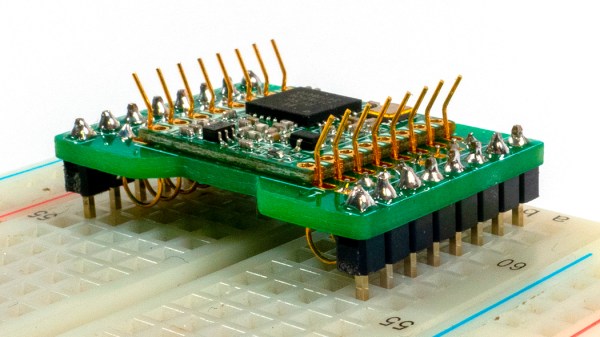
An MK-85 with a modern CPU replacement

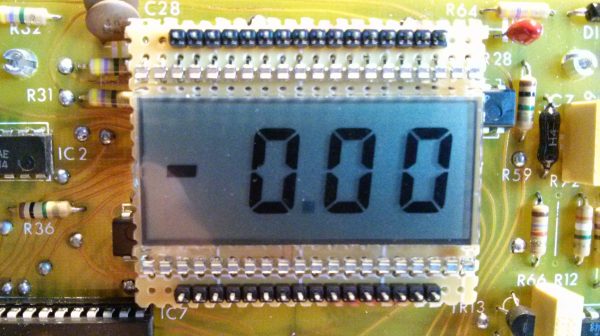
Upgrading A Soviet Calculator With A Modern CPU

Today’s supply chain issues can make it hard to buy microcontrollers, or really any kind of semiconductor. But for those keeping retrocomputers alive, this problem has always existed: ancient components might have been out of production for decades, with a dwindling supply of second-hand parts or “new old stock” as the only option. If a rare CPU breaks, you might have no option but to replace the entire computer.

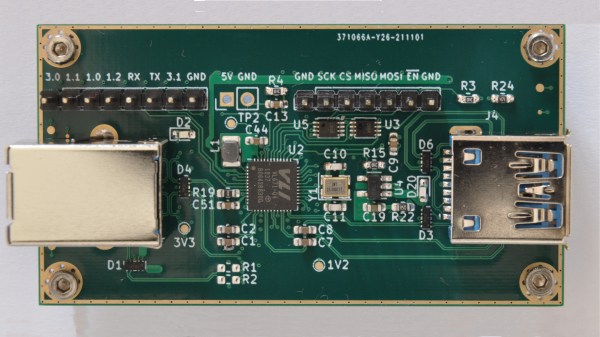
[Piotr Patek] ran into this issue when he obtained an Elektronika MK-85 programmable calculator with a broken CPU. Unable to find a replacement, he decided instead to build a pin-compatible CPU unit based on an STM32 microcontroller. Of course no modern CPU is pin-compatible with a Soviet design from the 1980s, so [Piotr] had to design a small interposer PCB to match the original pinout. This also gave him enough space to add an efficient DC/DC converter chip that generates the 2.5 V supply for the STM32.

As for the software, [Piotr] managed to port the original BASIC interpreter, which was written in PDP-11 assembly, to a modern equivalent written in C. While he was at it, he fixed a few bugs that had been sitting there for about 35 years. The updated CPU also allows the MK-85 to run circles around its contemporary siblings: [Piotr] timed it to be about thirty times faster than the original chip, while using a comparable amount of power.

If you also happen to have an MK-85 with a dodgy CPU, you’ll be pleased to find that the schematics and source code to [Piotr]’s modification are all available on his blog. This is probably the first calculator CPU update we’ve seen, although we’ve featured other ancient calculators updated with new firmware, and some completely new calculator designs based on classic hardware.

Thanks for the tip, [cmholm]!

Turn On Sarcasm With The Flip Of A Switch

Sarcasm is notoriously difficult to distinguish in online communities. So much, in fact, that a famous internet rule called Poe’s Law is named after the phenomenon. To adapt, users have adopted several methods for indicating implied sarcasm such as the /s tag, but more recently a more obvious sarcasm indicator has appeared that involves random capitalization througout the sarcastic phrase. While this looks much more satisfying than other methods, it is a little cumbersome to type unless you have this sarcasm converter for your keyboard.

The device, built by [Ben S], is based around two Raspberry Pi Pico development boards and sits between a computer and any standard USB keyboard. The first Pi accepts the USB connection from the keyboard and reads all of the inputs before sending what it reads to the second Pi over UART. If the “SaRcAsM” button is pressed, the input text stream is converted to sarcasm by toggling the caps lock key after every keystroke.

For communicating in today’s online world with rapidly changing memes, a device like this is almost necessary for making sure you aren’t misunderstood on whichever popular forum you like to frequent. We don’t know how long this trend will continue, either, but until something else replaces it to more concisely communicate sarcasm we expect it to remain relevant. The build is also a reminder of the various interesting ways that microcontrollers can be programmed to act as keyboards.

Thanks to [ted yapo] for the tip!

Better Farming Through Electricity

Chinese researchers are reporting that applying an electric field to pea plants increased yields. This process — known as electroculture — has been tested multiple times, but in each case there are irregularities in the scientific process, so there is still an opportunity for controlled research to produce meaningful data.

This recent research used two plots of peas planted from the same pods. The plants were tended identically except one plot was stimulated by an electric field. The yield on the stimulated plot was about 20% more than the control plot.

The actual paper is paywalled in the journal Nature Food, but the idea seems simple enough. If you search for the topic, you’ll find there have been other studies with similar findings. There are also anecdotal reports of electrical plant stimulation going back to 1746.

Continue reading “Better Farming Through Electricity”