Maker Faire NY: Getting Physical With Minecraft

If you’ve been hanging around Hackaday for a while, you’ve likely seen a few attempts to bridge the real world with the voxel paradise that is Minecraft. In the past, projects have connected physical switches to virtual devices in the game, or took chunks of the game’s blocky landscape and turned it into a 3D printable file. These were interesting enough endeavors, but fairly limited in their scope. They assumed you had an existing world or creation in Minecraft that you wanted to fiddle with in a more natural way, but didn’t do much for actually playing the game.
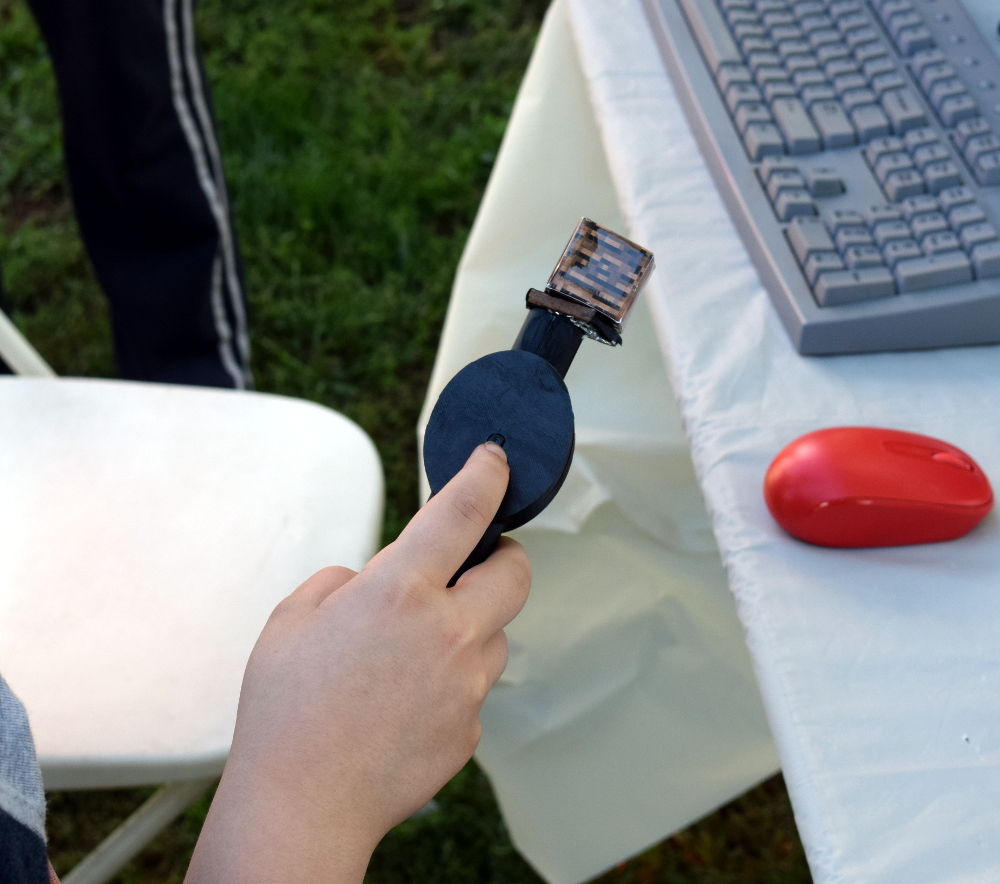
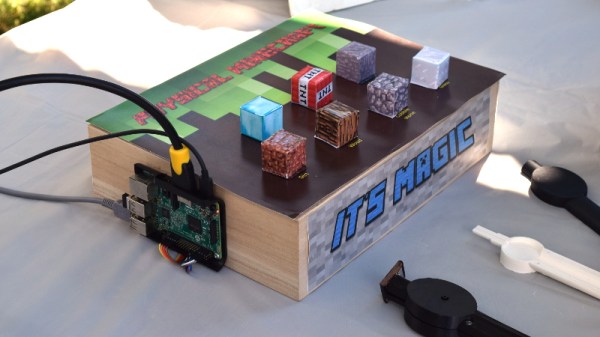
But “Physical Minecraft” presented at the 2018 World Maker Faire in New York, offered a unique way to bring players a bit closer to their cubic counterparts. Created by [Manav Gagvani], the physical interface has players use a motion detecting wand in combination with an array of miniature Minecraft blocks to build in the virtual world.

The wand even detects various gestures to activate an array of “Spells”, which are effectively automated build commands. For example, pushing the wand forward while making a twisting motion will automatically create a tunnel out of the selected block type. This not only makes building faster in the game, but encourages the player to experiment with different gestures and motions.

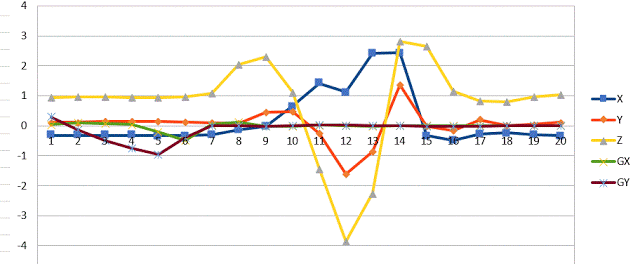
A Raspberry Pi 3 runs the game and uses its onboard Bluetooth to communicate with the 3D printed wand, which itself contains a MetaWear wearable sensor board. By capturing his own moves and graphing the resulting data with a spreadsheet, [Manav] was able to boil down complex gestures into an array of integer values which he plugged into his Python code. When the script sees a sequence of values it recognizes, the relevant commands get passed onto the running instance of Minecraft.
You might assume the wand itself is detecting which material block is attached to it, but that bit of magic is actually happening in the base the blocks sit on. Rather than trying to uniquely identify each block with RFID or something along those lines, [Manav] embedded an array of reed switches into the base which are triggered by the presence of the magnet hidden in each block.

These switches are connected directly to the GPIO pins of the Raspberry Pi, and make for a very easy way to determine which block has been removed and installed on the tip of the wand. Things can get tricky if the blocks are put into the wrong positions or more than one block are removed at a time, but for the most part it’s an effective way to tackle the problem without making everything overly complex.

We’ve often talked about how kid’s love for Minecraft has been used as a way of getting them involved in STEM projects, and “Physical Minecraft” was a perfect example. There was a line of young players waiting for their turn on the wand, even though what they were effectively “playing” was the digital equivalent of tossing rocks. [Manav] would hand them the wand and explain the general idea behind his interface, reminding them that the blocks in the game are large and heavy: it’s not enough to just lower the wand, it needs to be flicked with the speed and force appropriate for the hefty objects their digital avatar is moving around.

Getting kids excited about hardware, software, and performing physically demanding activities at the same time is an exceptionally difficult task. Projects like “Physical Minecraft” show there can be more to playing games than mindless button mashing, and represent something of a paradigm shift for how we handle STEM education in an increasingly digital world.

2017: As The Hardware World Turns

The year is almost over, and now it’s time to look back on the last fifty-odd weeks. What happened in this year in hacking? 2017 will go down as the beginning of another AI renaissance, although we’re not going to call it that; this year was all about neural nets and machine learning and advancements resulting from the development of self-driving cars and very beefy GPUs. Not since the 80s have we seen more work in ‘AI’ fields. What will it amount to this time around the hype cycle? Find out in a few years.

Biohacking was big this year, and not just because people are installing RFID tags and magnets in their hands. CRISPR is allowing for Star Trek-style genome hacking, and this year saw in vivo experiments to enable and disable individual genes in rat models. Eventually, someone is going to get a Nobel for CRISPR.

We’re going to Mars, and soon — very soon — a SpaceX Falcon Heavy is going to either lob a Tesla Roadster into solar orbit or the Atlantic Ocean. We learned about the BFR that will take dozens of people to Mars in a single launch. Boeing and Lockheed think they can compete with the Elon Musk PR powerhouse. The Bigelow Aerospace inflatable module passed its in-flight test on the ISS, giving the space station a new storage closet. Even in space, amazing stuff is happening this year.

Is that it? Not by a long shot. This year has seen some of the coolest hacks we’ve ever seen, and some of the dumbest security breaches ever. Hackaday is doing awesome. What else did 2017 have? Read on to find out.

Continue reading “2017: As The Hardware World Turns”

MakerBot Really Wants You To Like Them Again

For the last couple years, a MakerBot press release has generally signaled that more pink slips were going to be heading out to the already shell-shocked employees at their NYC factory. But just last week something that could almost pass as good news came out of the once mighty 3D printer manufacturer, the unveiling of “MakerBot Labs”. A number of mainstream tech sites heralded this as MakerBot’s first steps back into the open source community that launched it nearly a decade ago; signs of a newer and more thoughtful MakerBot.

Reading the announcement for “MakerBot Labs”, you can almost believe it. All the buzz words are there, at least. In fact, if this announcement came from anyone else, in any other field, I’d probably be on board. Sharing knowledge and listening to the community is essential if you want to connect with hackers and makers. But this is MakerBot, and they’ve dug themselves into a very deep hole over the years.

The spectacular fall from grace that MakerBot has experienced, from industry leader to afterthought, makes this hat-in-hand peace offering hard to take seriously. It reads like a company making a last ditch effort to win back the users they were so sure they didn’t need just a few years ago. There is now a whole new generation of 3D printer owners who likely have never even seen a MakerBot printer, and it’s hard to imagine there’s still enough innovation and life in the company to turn that around before they completely fade into obscurity.

Continue reading “MakerBot Really Wants You To Like Them Again”

2016: As The Hardware World Turns

Soon, the ball will drop in Times Square, someone will realize you can turn ‘2018’ into a pair of novelty sunglasses, and the forgotten mumbled lyrics of Auld Lang Syne will echo through New Year’s Eve parties. It’s time once again to recount the last 366 days, and what a year it’s been.

Arduino got into an argument with Arduino and Arduino won. We got new Raspberry Pis. Video cards are finally getting to the point where VR is practical. The FCC inadvertently killed security in home routers before fixing the problem. All of this is small potatoes and really doesn’t capture the essence of 2016. It’s been a weird year.

Want proof 2016 was different? This year, Microsoft announced they would provide a Linux ‘shim’ with every version of Windows. By definition, 2016 was the year of the Linux desktop. That’s how weird things have been in 2016.

Continue reading “2016: As The Hardware World Turns”

Crappy Robots World Championship Announced

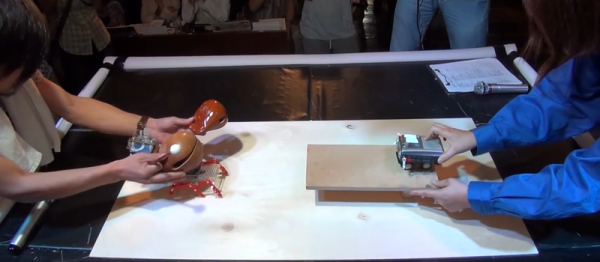
[Daiju Ishikawa] wrote us to announce that the world championship Hebocon is taking place this August in Tokyo, and the registration has just opened. When you get a mail in the tip line that reads “From all over the world, crappy robots with low technological ability will gather and fight to determine the worst made robot in the world.” you know it’s Hackaday!

“Heboi” is Japanese for clumsy or crappy. If your idea of fun is poorly made, but hilarious, robots trying to shove each other out of a sumo ring, then a local Hebocon might be for you. And if you think you’ve got what it takes to be a world champion, start looking into tickets to Japan. (It’s not coincidentally on the same day as Maker Faire Tokyo.)

Either way, you should check out the video, embedded below, which is a great introduction to the sport/pastime/whatever. It’s a fun introduction to the gentle art of robotry, for people who are more creative than technical. We think that’s awesome.

Continue reading “Crappy Robots World Championship Announced”

Denver Mini Maker Faire: Fun With Pinball

[Mark Gibson] probably has nothing against silicon. He just knows that a lot that can be done with simple switches, relays, and solenoids and wants to share that knowledge with the world. This was made abundantly clear to me during repeat visits to his expansive booth at Denver Mini Maker Faire last weekend.

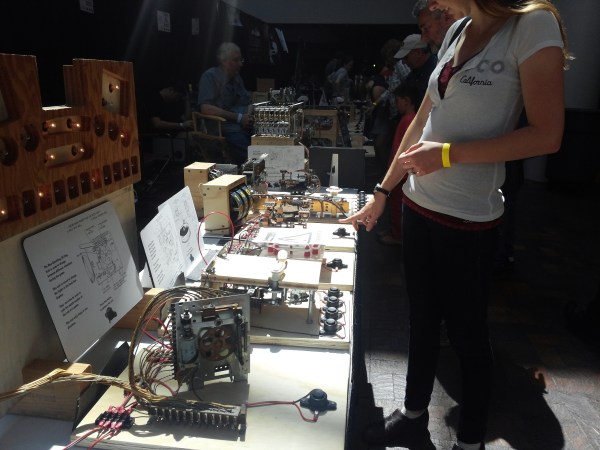
In the sunlight-filled atrium of the Museum of Nature and Science, [Mark] sat behind several long tables covered with his creations made from mid-century pinball machines. There are about two dozen pieces in his interactive exhibit, which made its debut at the first-ever Northern Colorado Maker Faire in 2013. [Mark] was motivated to build these boards because he wanted to get people interested in the way things work through interaction and discovery of pinball mechanisms.

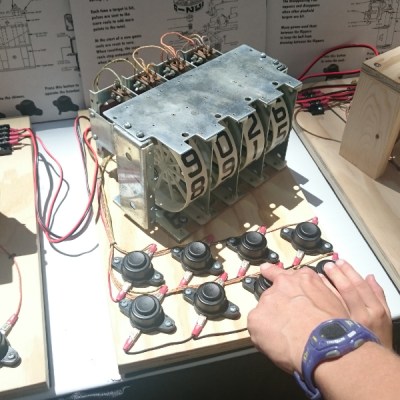
fun with pinball thumbMost of the pieces he has built are single units and simple systems from pinball machines—flippers, chime units, targets, bumpers, and so on—that he affixed to wooden boards so that people can explore them without breaking anything. All of the units are operated using large and inviting push buttons that have been screwed down tight. Each of the systems also has a display card with an engineering drawing of the mechanism and a short explanation of how it works.
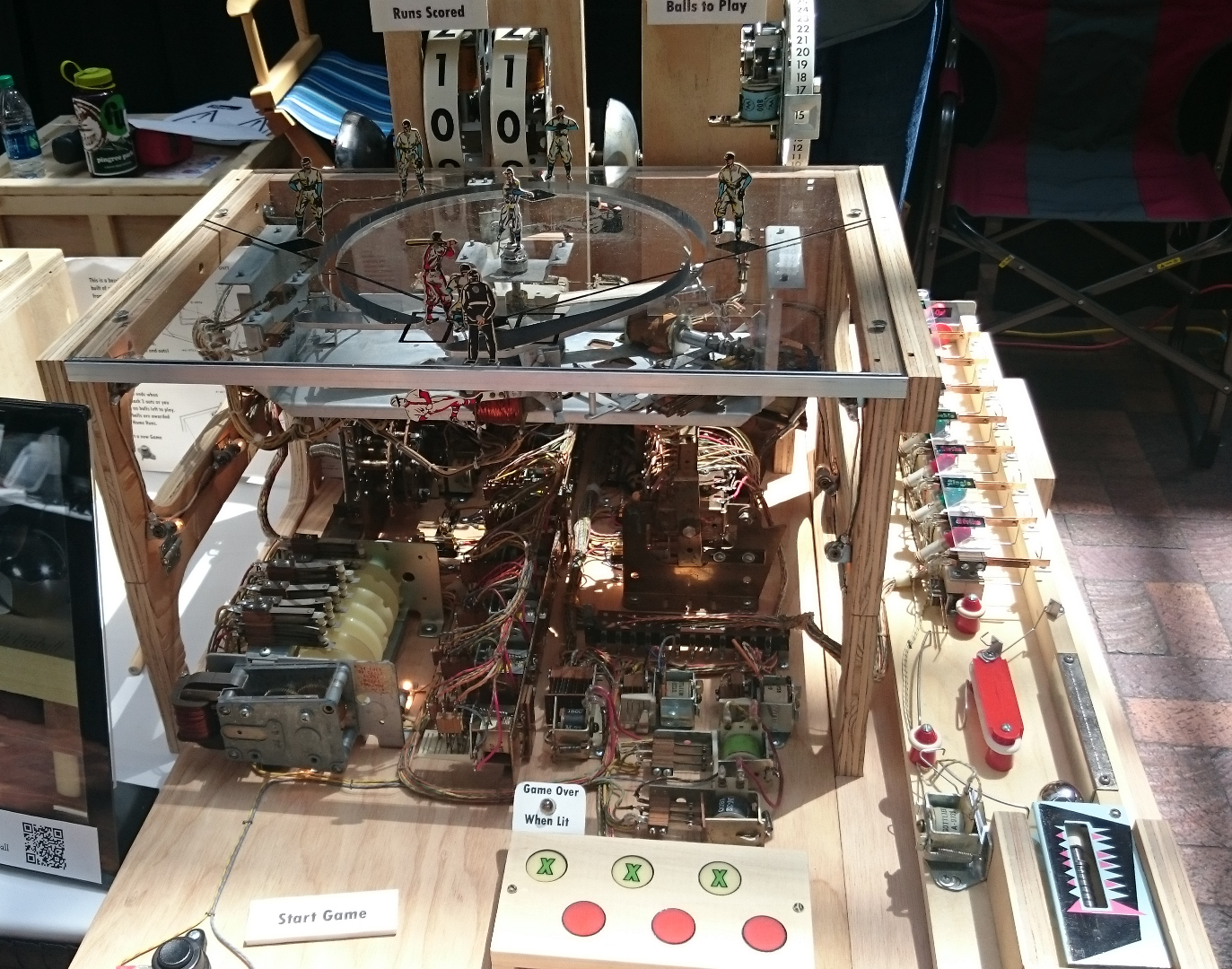

[Mark] also brought some of the original games he has created by combining several systems from different machines, like a horse derby and a baseball game. Both of these were built with education in mind; all of the guts including the original fabric-wrapped wires are prominently displayed. The derby game wasn’t working, but I managed to load the bases and get a grand slam in the baseball game. Probably couldn’t do that again in a million summers.

fun with pinball baseball game
Take me out to the Maker Faire! Click to embiggen.

About five years ago, we covered [Mark]’s build of an atomic clock from pinball machine parts. It’s about time we featured his work again. We have shared a lot of pinball-related builds over the years from the immersive to the gigantic to the dankest of the dank.

The MakerBot Obituary

MakerBot is not dead, but it is connected to life support waiting for a merciful soul to pull the plug.

This week, MakerBot announced it would lay off its entire manufacturing force, outsourcing the manufacturing of all MakerBot printers to China. A few weeks ago, Stratasys, MakerBot’s parent company, released their 2015 financial reports, noting MakerBot sales revenues have fallen precipitously. The MakerBot brand is now worth far less than the $400 Million Stratasys spent to acquire it. MakerBot is a dead company walking, and it is very doubtful MakerBot will ever be held in the same regard as the heady days of 2010.

How did this happen? The most common explanation of MakerBot’s fall from grace is that Stratasys gutted the engineering and goodwill of the company after acquiring it. While it is true MakerBot saw its biggest problems after the acquisition from Stratasys, the problems started much earlier.

Continue reading “The MakerBot Obituary”