New Part Day: ESP32-WROOM-DA

We’re always interested in the latest from the world’s semiconductor industry here at Hackaday, but you might be forgiven for noticing something a little familiar about today’s offering from Espressif. The ESP32-WROOM-DA has more than a passing resemblance to the ESP32-WROOM dual-core-microcontroller-with-WiFi  module that we’ve seen on so many projects over the last few years because it’s a WROOM, but this one comes with a nifty trick to deliver better WiFi connectivity.

The clever WiFi trick comes in the form of a pair of antennas at 90 degrees to each other. It’s a miniaturised version of the arrangement with which you might be familiar from home routers, allowing the device to select whichever antenna gives the best signal at any one time.

We can see that the larger antenna footprint will require some thought in PCB design, but otherwise the module has the same pinout as the existing WROVER. It’s not much of a stretch to imagine it nestled in the corner of a board at 45 degrees, and we’re sure that we’ll see it appearing in projects directly. Anything that enhances the connectivity of what has become the go-to wireless microcontroller on these pages can only be a good thing.

Retrotechtacular: Double For Nothing

If you are in the market for web hosting in 2021 and you sign up with one of the cloud computing providers, you’ll soon see how the different resources are priced. Storage and bandwidth are cheap, while CPU time is expensive. This reflects the state of a modern computer, in which a typical disk drive now holds a terabyte or more and rising by the year while a new processor is becoming a bottleneck whose performance hasn’t increased as much as the manufacturers would like over models from years ago.

Twice As Much Hardware From A Bit Of Software?

In the early 1990s though it was a different matter. A 486 or early Pentium processor was pretty powerful compared to the DOS or Windows 3.1 software it was expected to run, and it was the memory and disk space attached to it that limited performance… and cost an arm and a leg. There was a period in about 1995 when a supposed fire in a chip factory somewhere sent RAM prices into the hundreds of dollars per megabyte, briefly causing an epidemic of RAM raiding in which criminals would break into offices and take only the SIMs from the computers.

A solution to this problem came perhaps surprisingly from the software industry. Disk Doubler was a DOS driver that promised more disk space, achieving this seemingly impossible feat by compressing the disk to fit more data on it. Processor power swapped for disk space was a reasonable trade at the time so it became extremely popular, and eventually Microsoft incorporated their own disk compression into DOS. In some cases it could even speed up a computer with a slow disk drive, as I found out as a student with a 286 packing an MFM drive.

Something For Nothing, Perhaps It’s Too Good To Be True.

If compression could increase disk space then couldn’t it do the same for RAM? The industry came to the rescue once more with an array of RAM doubler products, first applying the disk doubling technique to on-disk virtual memory, and then doing the same with the contents of the memory itself. The first approach worked at the expense of a system slow-down, while the second, not so much. In fact it was little more than a scam, with software products promising much but delivering absolutely nothing behind the scenes.

Continue reading “Retrotechtacular: Double For Nothing”

Hackaday Podcast 119: Random Robot Writing, Slithering Snake Shenanigans, And Phased Array Phenomena

Hackaday editors Mike Szczys and Elliot Williams pick up on the neatest hacks you may have missed. We start off with another “What’s that Sound?” so put your geeky-ears to the test and win a Hackaday Podcast T-shirt. Here are a couple of classic hacks to bring you joy: music based on Markov chains, and a squiggly take on the classic Nokia game of snake. For the more hardcore science geeks we dive into the B Meson news coming out of CERN’s physics experiments. And after taking a detour in bristle-bot-based pen plotting, we unpack the hidden system of pipes that carry oil, gas, diesel, and more from the refinery to your region.

Take a look at the links below if you want to follow along, and as always, tell us what you think about this episode in the comments!

Direct download (The best 57 MB you’ll download all day!)

Places to follow Hackaday podcasts:

Continue reading “Hackaday Podcast 119: Random Robot Writing, Slithering Snake Shenanigans, And Phased Array Phenomena”

Perfecting A 3D Printed Camera Motion Control Rig

If you’ve ever watched one of those high production value YouTube videos and wondered how they’re able to get those smooth shots where the camera seems to be spinning around an object, you were probably looking at the product of an motorized camera motion system. There’s no question these rigs can produce visually striking shots, but their high cost usually keeps them out of the hands of us lowly hackers.

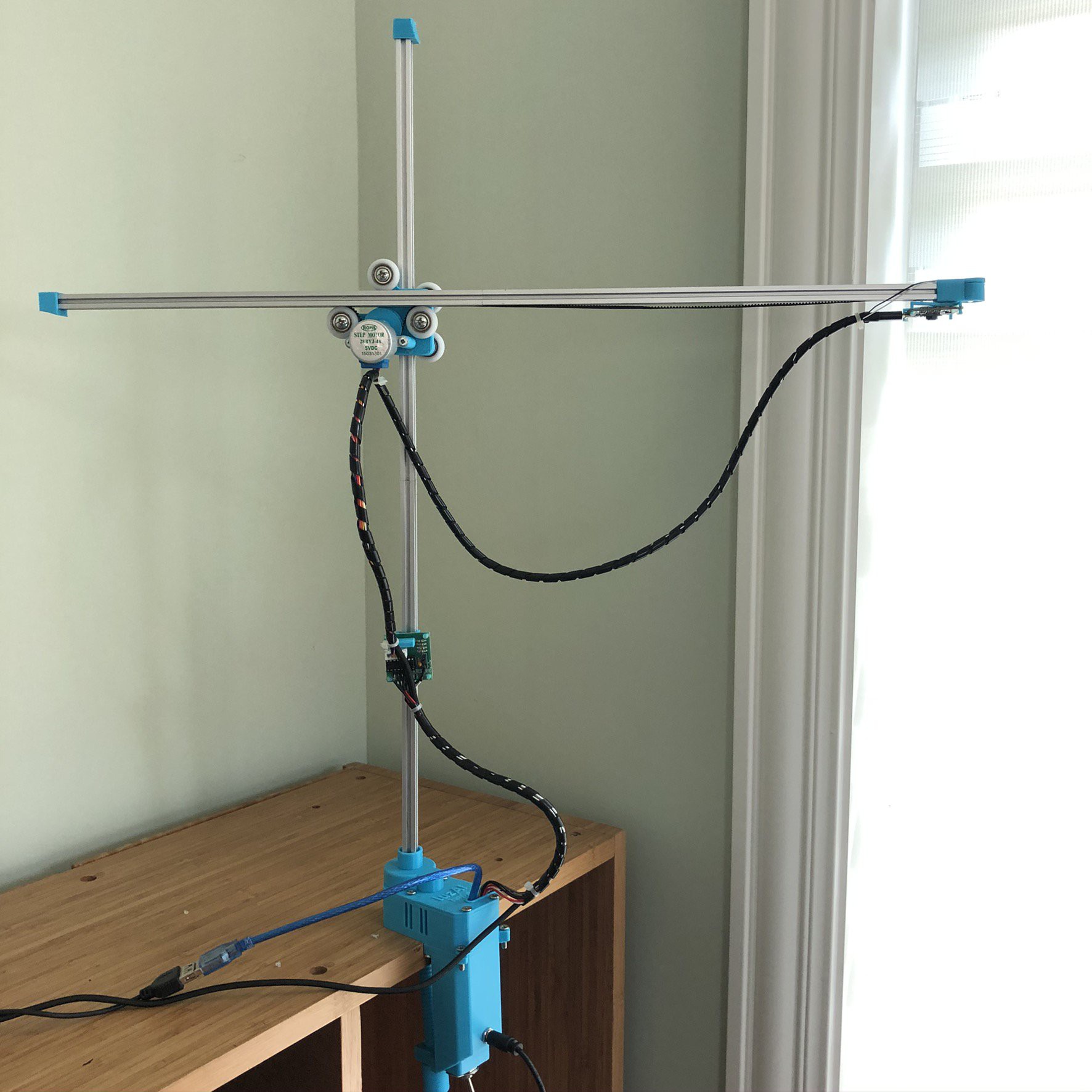
Unless of course you do like [Andy], and build your own. The latest version of this impressive rig features the ability to continuously rotate thanks to commercial 12-wire slip rings, with optical endstops so the machine can still be homed at the beginning of a move. An onboard Raspberry Pi and Arduino Uno are responsible for controlling the stepper motors, the configuration of which ends up being reminiscent of a standard 3D printer.

The MQTT remote can hold a phone for live video.

The software [Andy] has come up with lets him synchronize the camera rig with a small rotating platform he built, which allows for even more complex shots as demonstrated in the video below. It also supports a very slick MQTT-enabled remote controller that he built as a previous project, which makes taking direct control over the camera and monitoring its status much easier.

Want to add a little polish to your own project videos? [Andy] has released all of the files and information you’d need to build your own version of his motion control rig, though we wouldn’t blame you for feeling a bit intimidated by this one. It might not be the most elaborate camera motion control system we’ve seen, but it’s certainly up there. If you just want an overhead video and don’t need those fancy tracking shots, perhaps a modified VESA arm would fit the bill.

Continue reading “Perfecting A 3D Printed Camera Motion Control Rig”

This Week In Security: Watering Hole Attackception, Ransomware Trick, And More Pipeline News

In what may be a first for watering hole attacks, we’ve now seen an attack that targeted watering holes, or at least water utilities. The way this was discovered is a bit bizarre — it was found by Dragos during an investigation into the February incident at Oldsmar, Florida. A Florida contractor that specializes in water treatment runs a WordPress site that hosted a data-gathering script. The very day that the Oldsmar facility was breached, someone from that location visited the compromised website.

You probably immediately think, as the investigators did, that the visit to the website must be related to the compromise of the Oldsmar treatment plant. The timing is too suspect for it to be a coincidence, right? That’s the thing, the compromised site was only gathering browser fingerprints, seemingly later used to disguise a botnet. The attack itself was likely carried out over Teamviewer. I will note that the primary sources on this story have named Teamviewer, but call it unconfirmed. Assuming that the breach did indeed occur over that platform, then it’s very unlikely that the website visit was a factor, which is what Dragos concluded. On the other hand, it’s easy enough to imagine a scenario where the recorded IP address from the visit led to a port scan and the discovery of a VNC or remote desktop port left open. Continue reading “This Week In Security: Watering Hole Attackception, Ransomware Trick, And More Pipeline News”

Building A Quick And Dirty RC Mower With FPV

Mowing the lawn can be a tedious job. Tired of the effort involved, [i did a thing] decided to enlist the help of [Makers Muse] to build a radio controlled mower instead to make the backyard chore a little more interesting. (Video, embedded below.)

The mowing itself is done by a typical push-along garden mower with a gasoline engine. However, it’s fitted with twin DC gear motors harvested from a mobility scooter. The mowers original front wheels were also removed, replaced with casters from the same mobility scooter that donated the drive train. Off-the-shelf speed controllers were then used to run the motors, and hooked up to an RC receiver. The mower could then be steered via a radio controller set up with mixing to enable the twin-motor setup to steer and drive.

An FPV camera was then fitted on the front of the mower, sitting on a stack of kitchen sponges that act as a isolator to negate the effects of the engine vibrations on the camera. The result is a relatively smooth video feed, allowing the operator to sit at a comfortable distance and control the mower via radio and goggles.

It may not be the most effective way of trimming the lawn, but it does look like a fun project, and sometimes that’s all that matters. Of course, you could always upgrade to a fully autonomous mower instead.

Continue reading “Building A Quick And Dirty RC Mower With FPV”

With A Big Enough Laser, The World Is Your Sensor

It’s difficult to tell with our dull human senses, but everything around us is vibrating. Sure it takes more energy to get big objects like bridges and houses humming compared to a telephone pole or mailbox, but make no mistake, they’ve all got a little buzz going on. With their new automated laser, the team behind VibroSight++ believes they can exploit this fact to make city-scale sensing far cheaper and easier than ever before.

The key to the system is a turret mounted Class 3B infrared laser and photodetector that can systematically scan for and identity reflective surfaces within visual range. Now you might think that such a setup wouldn’t get much of a signal from the urban landscape, but as it so happens, the average city block is packed with retroreflectors. From street signs to road studs and license plates, the team estimates dense urban areas have approximately 7,000 reflectors per square kilometer. On top of those existing data points, additional reflectors could easily be added to particularly interesting devices that city planners might want to monitor.

Once VibroSight++ has identified its targets, the next step is to bounce the laser off of them and detect the minute perturbations in the returned signal caused by vibrations in the reflector. In the video below you can see how this basic concept could be put to practical use in the field, from counting how many cars pass over a certain stretch of road to seeing how popular a specific mailbox is. There’s a whole world of information out there just waiting to be collected, all without having to install anything more exotic than the occasional piece of reflective tape.

If this technology seems oddly familiar, it’s probably because we covered the team’s earlier work that focused (no pun intended) on using reflected laser beams for home automation in 2018. Back then they were aiming a much smaller laser at blenders and refrigerators instead of license plates and street signs, but the concept is otherwise the same. While we’ll admit the technology does give off a distinctive Orwellian vibe, it’s hard not to be intrigued by the “Big Data” possibilities afforded by the team’s upgraded hardware and software.

Continue reading “With A Big Enough Laser, The World Is Your Sensor”