Ground Effect Drone Flies Autonomously

There are a number of famous (yet fictional) sea monsters in the lakes and oceans around the world, but in the Caspian Sea one turned out to be real. This is where the first vehicles specifically built to take advantage of the ground effect were built by the Soviet Union, and one of the first was known as the Caspian Sea Monster due to the mystery surrounding its discovery. While these unique airplane/boat hybrids were eventually abandoned after several were built for military use, the style of aircraft still has some niche uses and can even be used as a platform for autonomous drones.

This build from [Think Flight] started off as a simple foam model of just such a ground effect vehicle (or “ekranoplan”) in his driveway. With a few test flights the model was refined enough to attach a small propeller and battery. The location of the propeller changed from rear-mounted to front-mounted and then back to rear-mounted for the final version, with each configuration having different advantages and disadvantages. The final model includes an Arudino running an autopilot program called Ardupilot, and with an air speed sensor installed the drone is able to maintain flight in the ground effect and autonomously navigate pre-programmed waypoints around a lake at high speed.

For a Cold War technology that’s been largely abandoned by militaries in favor of other modes of transportation due to its limited use case and extremely narrow flight tolerances, ground effect vehicles are relatively popular as remote controlled vehicles. This RC ekranoplan used the same Ardupilot software but paired with a LIDAR system instead of GPS to navigate its way around its environment.

Thanks to [TTN] for the tip!
Continue reading “Ground Effect Drone Flies Autonomously”

Optical Sensor Keeps Eye On Wandering Saw Blade

Over the last year or so, we’ve been checking in on the progress [Andrew Consroe] has been making with his incredible CNC scroll saw project. While we were already impressed with his first prototype version, he somehow manages to keep pushing the envelope forward with each new upgrade, and we’re always excited when one of his progress reports hits the inbox.

Recently he’s been struggling with the fact that the considerable flexing of the scroll saw’s ultra-thin blade introduces positional errors while cutting. To combat this, he’s developed an ingenious sensor that can track the movement of the blade in two dimensions without actually touching it. Utilizing the Raspberry Pi HQ camera, a 3D printed framework, and some precisely placed mirrors, [Andrew] says his optical sensor is able to determine the blade’s position to within 10 microns.

In the video below [Andrew] goes over how his “Split Vision Periscope” works, complete with some ray traced simulations of what the Pi camera actually sees when it looks through the device. After experimenting with different lighting setups, the final optical configuration presents the camera with two different perspectives of the saw blade set on a black background. That makes it relatively easy to pick out the blade using computer vision, and turn that into positional information.

The periscope arrangement is particularly advantageous here as it allows the camera and lens to be placed under the work surface and well away from the actual cutting, though we’re interested in seeing how it fares against the dust and debris that will inevitably be produced as the saw cuts. While he hit all of his design goals, [Andrew] does note that his mirrors do leave some room for improvement; but considering he hand cut them out of old hard drive platters we think the results are more than acceptable.

An incredible amount of progress has been made since the first time we saw the CNC scroll saw, and we’re eager to see this new sensor fully integrated into the next version of [Andrew]’s impressive long-term project.

Continue reading “Optical Sensor Keeps Eye On Wandering Saw Blade”

Persistent Displays With UV Light

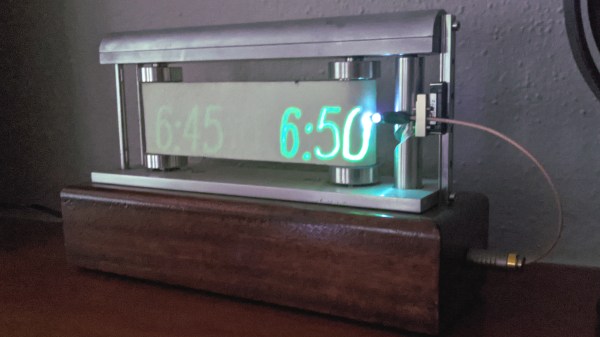
This year’s Hackaday Prize has “Rethink Displays” as one of its first theme, and [Tucker Shannon] has given us his best shot on that subject with a set of impressive displays that “write” on glow-in-the-dark material using ultra-violet light. These materials glow for a while after UV illumination, so moving a light source like a UV LED over the surface draws glowing text or simple graphics which can be readily consumed.

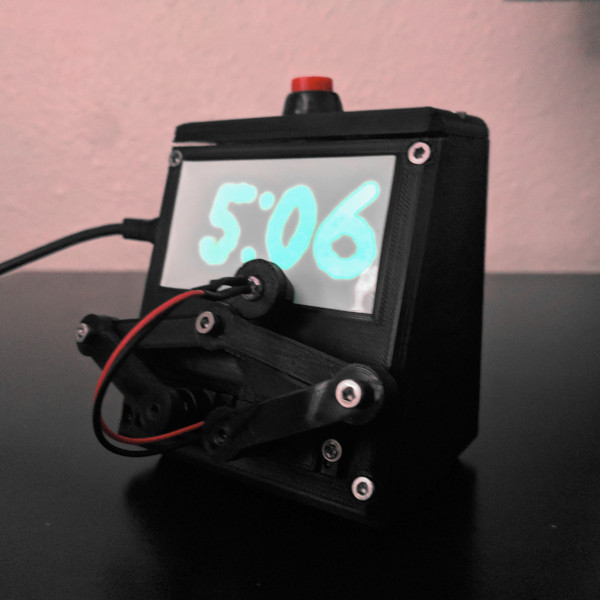
One of the examples this a clock we were first smitten with back in 2018. It is a rather attractive 3D-printed affair with those servos mounted below the screen that moves a UV LED through a pair of linkages. Other offerings that play on the same UV stylus medium include a laser on an az-el mount controlled by a Raspberry Pi Zero. It’s a neat idea very effectively done, and we can see it has a lot of potential.

But the most impressively advanced so far is the model shown in the image at the top of the article and the demo video at the bottom. A loop of phosphorescent material is the display surface itself. This one moves that loop with two rollers to make up the X axis, and moves the UV source up and down for the Y axis. As with all of these designs, whatever is written will soon fade, leaving the surface ready for the next bit of information.

Interested in this project and think you could do a display of your own? The Hackaday Prize 2021 is live, and we’d love to see you enter it!

Continue reading “Persistent Displays With UV Light”

Starlink: A Review And Some Hacks

I could probably be described as a SpaceX enthusiast. I catch their launches when I can, and I’ve watched the development of Starship with great interest. But the side-effect of SpaceX’s reusable launch system is that getting to space has become a lot cheaper. Having excess launch capacity means that space projects that were previously infeasible become suddenly at least plausible. One of those is Starlink.

Starlink is SpaceX’s satellite Internet service. Wireless and cellular internet have helped in some places, but if you really live out in the sticks, satellite internet is your only option. And while satellite Internet isn’t exactly new, Starlink is a bit different. Hughesnet, another provider, has a handful of satellites in geostationary orbit, which is about 22,000 miles above the earth. To quote Grace Hopper, holding a nearly foot-long length of wire representing a nanosecond, “Between here and the satellite, there are a very large number nanoseconds.”

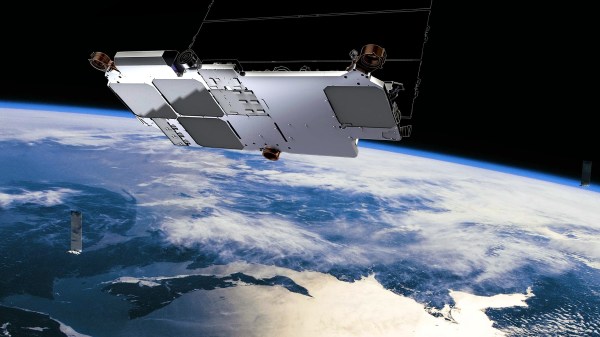
SpaceX opted to do something a bit different. In what seemed like an insane pipe dream at the time, they planned to launch a satellite constellation of 12,000 birds, some of them flying as low as 214 mile altitude. The downside of flying so low is that they won’t stay in orbit as long, but SpaceX is launching them significantly faster than they’re coming down. So far, nearly 1,600 Starlink satellites are in orbit, in a criss-crossing pattern at 342 miles (550 km) up.

This hundred-fold difference in altitude matters. A Hughesnet connection has a minimum theoretical latency of 480 ms, and in reality runs closer to 600 ms. Starlink predicts a theoretical minimum of under 10 ms, though real-world performance isn’t quite that low yet. In the few weeks I’ve had the service, ping times have fallen from mid-60s down to 20s and 30s. The way Starlink works right now, data goes up to the closest satellite and directly back to the connected ground station. The long-term plan is to allow the satellites to talk directly to each other over laser links, skipping over the ground stations. Since the speed of light is higher in a vacuum than in a fiber-optic cable, the fully deployed system could potentially have lower latency than even fiber Internet, depending on the location of the endpoint and how many hops need to be made.

I got a Starlink setup, and have been trying out the beta service. Here’s my experience, and a bonus hack to boot.

Continue reading “Starlink: A Review And Some Hacks”

A High Torque 3D Printed Harmonic Drive

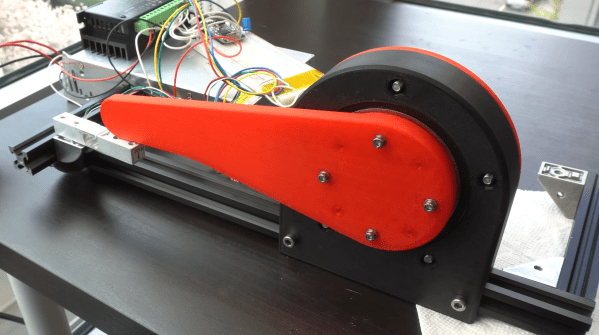
Actuators that are powerful, accurate, compact, and cheap are like unicorns. They don’t exist. Yet this is what [3DprintedLife] needed for a robotic camera arm, so he developed a custom 3D printed high torque strain wave gearbox to be powered by a cheap NEMA23 stepper motor.

Strain wave gears, otherwise known as harmonic drives, are not an uncommon topic here on Hackaday. The work by deforming a flexible toothed spline with a rotating elliptical part, which engages with the internal teeth of an outer spline. The outer spline has a few more teeth, causing the inner spline to rotate slowly compared to the input, achieving very high gear ratios. Usually, the flexible spline is quite long to allow it to flex at one end while still having a rigid mounting surface at the other end. [3DprintedLife] got around this by creating a separate rigid output spline, which also meshes with the flexible spline. Continue reading “A High Torque 3D Printed Harmonic Drive”

Ask Hackaday: How Is The Chip Shortage Affecting You?

Some friends of mine are designing a new board around the STM32F103 microcontroller, the commodity ARM chip that you’ll find in numerous projects and on plenty of development boards. When the time came to order the parts for the prototype, they were surprised to find that the usual stockholders don’t have any of these chips in stock, and more surprisingly, even the Chinese pin-compatible clones couldn’t be found. The astute among you may by now have guessed that the culprit behind such a commodity part’s curious lack of availability lies in the global semiconductor shortage.

A perfect storm of political unintended consequences, climate-related crises throttling Taiwanese chip foundries and shutting down those in the USA, and faulty pandemic recovery planning, has left the chipmakers unable to keep up with the demand from industries on the rebound from their COVID-induced slump. Particularly mentioned in this context is the automotive industry, which has seen plants closing for lack of chips and even models ditching digital dashboards for their analogue predecessors.

Chips on order everywhere on the Mouser website.

The fall-out from all this drama in the world’s car factories has filtered down through all levels that depend upon semiconductors; as the carmakers bag every scrap of chip fab capacity that they can, so in turn have other chip customers scrambled to keep their own supply lines in place. A quick scan for microcontrollers through distributors like Mouser or Digi-Key finds pages and pages of lines on back-order or out of stock, with those lines still available being largely either for niche applications, unusual package options, or from extremely outdated product lines. The chances of scoring your chosen chip seem remote and most designers would probably baulk at trying to redesign around an ancient 8-bit part from the 1990s, so what’s to be done?

Such things typically involve commercially sensitive information so we understand not all readers will be able to respond, but we’d like to ask the question: how has the semiconductor shortage affected you? We’ve heard tales of unusual choices being made to ship a product with any microcontroller that works, of hugely overpowered chips replacing commodity devices, and even of specialist systems-on-chip being drafted in to fill the gap. In a few years maybe we’ll feature a teardown whose author wonders why a Bluetooth SoC is present without using the radio functions and with a 50R resistor replacing the antenna, and we’ll recognise it as a desperate measure from an engineer caught up in 2021’s chip shortage.

So tell us your tales from the coalface in the comments below. Are you that desperate engineer scouring the distributors’ stock lists for any microcontroller you can find, or has your chosen device remained in production? Whatever your experience we’d like to know what the real state of the semiconductor market is, so over to you!

Custom Keyfob Fixes Mazda Design Mistake

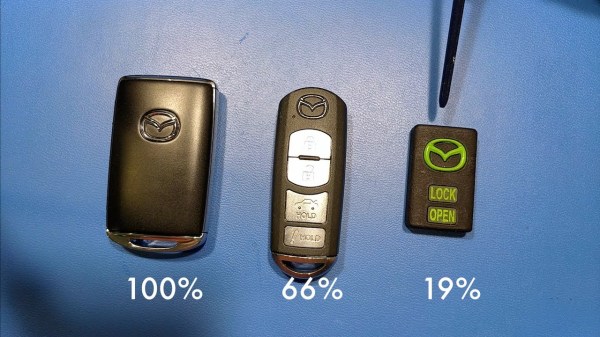
While Mazda has made some incredible advances in fuel efficient gasoline engines over the past few years, their design group seems to have fallen asleep at the wheel in the meantime, specifically in regards to the modern keyfob design. The enormous size and buttons on the side rather than the face are contrary to what most people need in a keyfob: small size and buttons that don’t accidentally get pressed. Luckily, though, the PCB can be modified with some effort.

This particular keyfob has a relatively simple two-layer design which makes it easy to see where the connections are made. [Hack ‘n’ Tink] did not need the panic button or status LED which allowed him to simply cut away a section of the PCB, but changing the button layout was a little trickier. For that, buttons were soldered to existing leads on the face of the board using 30-gage magnet wire and silicone RTV. From there he simply needed to place the battery in its new location and 3D print the new enclosure.

The end result is a much smaller form factor keyfob with face buttons that are less likely to accidentally get pressed in a pocket. He also made sure that the battery and button relocation wouldn’t impact the antenna performance. It’s a much-needed improvement to a small but crucial part of the car; the only surprise is that a company that’s usually on point with technology and design would flop so badly on such a critical component.

Thanks to [Brian] for the tip!

Continue reading “Custom Keyfob Fixes Mazda Design Mistake”