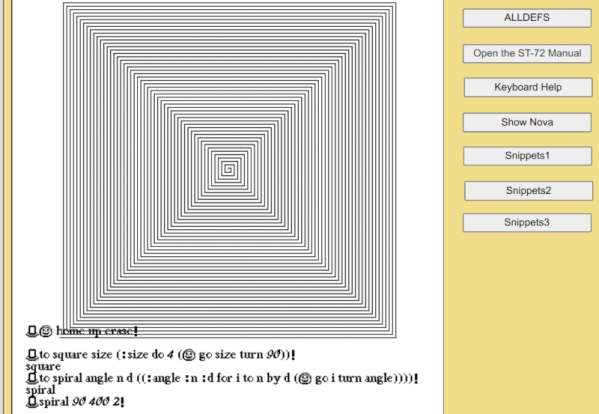
While things like object oriented computing and model-view-controller are old hat these days, when Smalltalk burst on the scene, many people had never heard of these new ideas. While the little language with roots at Xerox and based on Simula never caught fire, it was very influential in a number of ways. Now Smalltalk luminary [Dan Ingalls] has the Smalltalk Zoo, a collection of Smalltalk-related items including several historical simulations you can run in your browser.
We were especially impressed with the AltoSmalltalk-72 simulation since our chances of running a real Alto are pretty slim. The JavaScript behind it actually implements the Alto’s Nova instruction set. The emulator then runs a 45-year old memory dump from a real Alto. According to [Dan], there’s no file system and the microcoded music and animation instructions are missing, but he hopes someone will add them as a spare-time project.
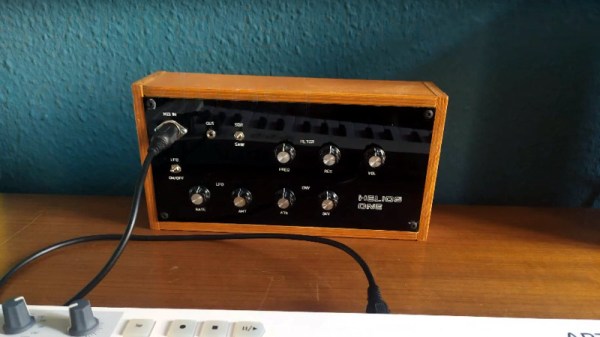
Despite the lingering reality that most of us don’t have what it takes to make it to the upper reaches of the Hit Parade, there remain many who still harbour a secret desire to make music. What better way to realise this dream, than by making [Blog Hoskins’] $20 MIDI synth project!
The write-up goes into a staggering level of detail to ensure that it’s accessible at all levels, to the extent that a complete beginner could probably assemble a working synth by following it. For some of the fancier parts of front panel there’s a reliance on a laser cutter, but even without such wizardry the Average Joe with an electric drill could still do a pretty good job.
Behind the panel though it’s not short on features it’s a surprisingly simple design. At its heart is an Arduino Nano, surrounded by potentiometers and switches for user control, and an opto-coupler for the MIDI lines. Sadly for analogue synth fans there’s not much else in the way of circuitry, but the point of a build such as this one is to create a playable instrument with the shortest path to usability. A video full fo those glorious synth sounds is below the break.
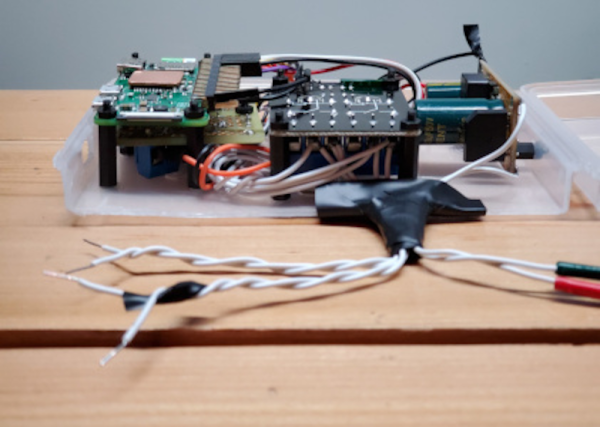
A smart thermostat is nothing new. But making one built a decade or more ago takes a few tricks. If you want to upgrade your thermostat without replacing it, [geektechniquestudios] shares their solution using a Raspberry Pi Zero to smarten up that dumb controller.
The hardware is decidedly simple: just a Pi Zero and a pair of relays. The relays act as button presses to the old thermostat. The software, though, is decidedly complex. There’s a React server and a Redis database along with some other bits and pieces.
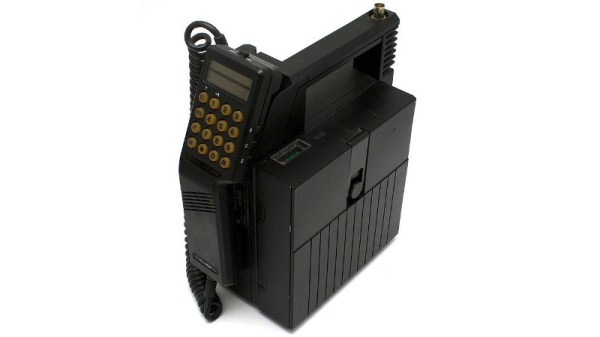
The SDR revolution has completely changed the way radio enthusiasts pursue their hobby, but there is still a space for the more traditional scanning receiver. If you are an American, have you ever noticed that it has a gap in its coverage between 800 and 900 MHz? The curious reason for this is explored by [J. B. Crawford], and it’s a tale of dusty laws relating to a long-gone technology, remaining on the books only because their removal requires significant political effort.
What we might today refer to as “1G” phones used an entirely analogue transmission scheme, with an easily-receivable FM carrier for the voice and extremely low-bandwidth bursts of serial data only for the purposes of managing the call. Listening to these calls was an illegal activity, but for those with the appropriate scanners it became a voyeuristic hobby within a hobby. It even made the world news via the pages of the gossip sheets, when (truthfully or not) it was credited for the leak of a revealing and controversial conversation involving Diana Princess of Wales.
This caused significant worry to the cellular phone companies who understandably didn’t want their product to become associated with insecurity. Thus they successfully petitioned the US Congress to include a clause restricting the capabilities of scanning receivers into another telecoms-related Act, and here we are three decades later with analogue phones a distant memory and the law still on the books. It may be ancient and unnecessary but there is neither the will nor the resources to remove it, so it seems destined to become one of those curious legal oddities that remains on the books for centuries. Whether an RTL-SDR breaks it is something we’ll leave for the lawyers, but the detail in the write-up makes it well worth a read.
Header image: krystof.k (Twitter) & nmuseum, CC BY-SA 3.0.
Humans often like to monitor their exercise habits with the use of a pedometer, which tracks steps taken during a walk. Such devices are a little cumbersome for smaller creatures however, but no matter. Hamsters tend to get most of their workouts done on a wheel anyway, so it’s simple enough to instrument the equipment instead.
The build is a simple tachometer, using an infrared emitter and sensor pair to read the rotation speed of the hamster wheel. The wheel itself is light-colored plastic, so a strip of black felt is used to create a non-reflective section, creating a pulse one per revolution that can be read by the Adafruit Feather 32U4 running the show. Data on peak speed and total rotations is available for tracking the exercise habits of the hamster in question, output on a set of 14-segment displays.
It’s a fun project, and one that would be a great way to teach kids about pet care and basic embedded systems. Hamster performance could even be uploaded to the cloud with a more advanced build, and training milestones linked to rewards a la Premier League footballers. At the end of the day, a hamster wheel is just an exercise bike for our four-legged friends, and we’ve seen those hacked too. Video after the break.
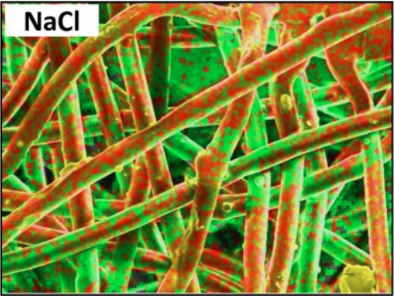
Masks are proven tools against airborne diseases, but pathogens — like the COVID-19 virus — can collect in a mask and survive which complicates handling and disposal. [Ilaria Rubino], a researcher at the University of Alberta, recently received an award for her work showing how treating a mask’s main filtration layer with a solution of mostly salt and water (plus a surfactant to help the wetting process) can help a mask inactivate pathogens on contact, thereby making masks potentially re-usable. Such masks are usually intended as single-use, and in clinical settings used masks are handled and disposed of as biohazard waste, because they can contain active pathogens. This salt treatment gives a mask a kind of self-cleaning ability.
How exactly does salt help? The very fine salt coating deposited on the fibers of a mask’s filtration layer first dissolves on contact with airborne pathogens, then undergoes evaporation-induced recrystallization. Pathogens caught in the filter are therefore exposed to an increasingly-high concentration saline solution and are then physically damaged. There is a bit of a trick to getting the salt deposited evenly on the polypropylene filter fibers, since the synthetic fibers are naturally hydrophobic, but a wetting process takes care of that.
The salt coating on the fibers is very fine, doesn’t affect breathability of the mask, and has been shown to be effective even in harsh environments. The research paper states that “salt coatings retained the pathogen inactivation capability at harsh environmental conditions (37 °C and a relative humidity of 70%, 80% and 90%).”
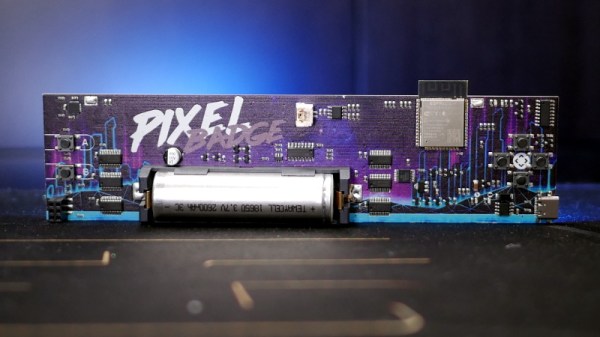
One of the Holy Grails in the world of electronic badges has been full-colour PCB art as a logical progression from the limited palette of traditional PCB artwork. In the progression towards achieving this goal there have been a variety of techniques applied, and it’s become an expensive commercial possibility rather than an unachievable dream. Has it become practical for mere mortals then? [Tom Clement] has put together a write-up of his progression towards achieving full-colour PCB artwork on a limited production run , and it makes for a fascinating read.
The board in question is the Pixel badge, an improved commercial version of the CampZone 2019 I-Pane badge we reviewed last year. It’s a very bright large multicolour LED matrix that has caught the eye of campgoers at events ever since the original, and has generated enough demand for a new production run. As well as a few electronic enhancements it replaces the original’s dithered monochrome silkscreen rear art with a full-colour design, and it is that with which the write-up is concerned.
It starts with UV printing, and goes through the various iterations of the process until a satisfactory result is achieved. We learn about the effect of reflow temperatures on UV printing inks, it seems that white ink discolours with temperature and the inventive solution is to transfer all the whites to the PCB silkscreen layer. He closes with a discourse on alignment, and we start to appreciate the achievement behind producing this badge. A colour print isn’t necessary for the Pixel’s eye-searing light show, but the point of badges is as much to show off the cutting edge of the art.