If you read the scientific literature, you see the familiar subatomic particles you learned about in school: protons, neutrons, and electrons. If you are young enough, you see others you probably heard about, too, like quarks and gluons. But recently there has been a lot of buzz about excitons and even some transistor circuits demonstrated that use them. But what is an exciton?
It actually sounds like a subatomic particle, but it is a little more complicated than that. An exciton is a bound state of an electron and an electron hole and is technically a boson. You are probably familiar with the idea of an electron hole from semiconductor physics. Technically, it is a quasiparticle. The reason scientists are interested in the beast is that it can transport energy without transporting net electric charge. That is, the state itself is neutral, but also contains energy. Continue reading “What’s An Exciton?”→
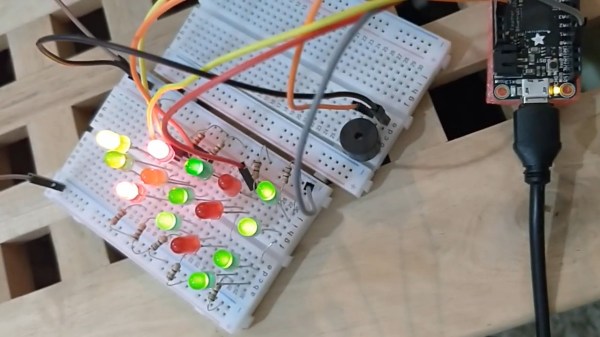
If you’re one of the lucky ten thousand today who still haven’t tried programming electronics with the Arduino platform, this detailed guide by [Dafna Mordechai] should hopefully give you enough incentive to pick it up now and make a simple bit of Christmas-themed decoration with it.
The guide isn’t exactly aimed at complete ground-up beginners but it does give some pointers on where to look up whatever information you don’t have in order to follow along. Other than that, it’s very simple and has well-detailed steps, showing you how to turn a breadboard into a simple animated arrangement of LEDs in the shape of a Christmas tree, along with a piezo buzzer playing “Jingle Bells”. If you’ve never done this sort of stuff before, [Dafna] explains in pretty good detail which part of the code does what, making it pretty simple if you want to play around with it and customize it to your taste.
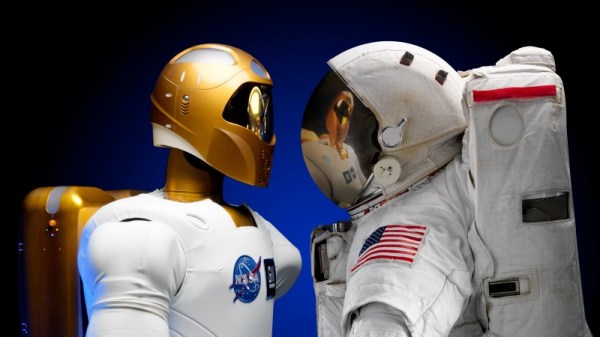
When Isaac Asmiov was writing I, Robot, the field of robotics was still in its infancy. As he notes in The Complete Robot, as the field began to mature, it started showing signs of conforming to the popular ideas held by science fiction writers about what robotics ought to be. Notions of humanoid robots, the functions that robots would have in domestic settings, even the ethical quandaries that AI ethicists face today were all themes of early sci-fi writers.
The idea of a robot – at least of automata – predates the field of robotics. The idea of an independent automata may have existed as early as the ancient Egyptians Chinese, and Greeks, who attempted to build self-operated machines that resembled animals and humans. Myths of clay golems in Jewish legends and clay giants in Norse legends perpetuated the idea of an artificial being that could mimic the actions of living creatures. A 400 BC myth from Crete spoke of a man of bronze who guarded their island from pirates.
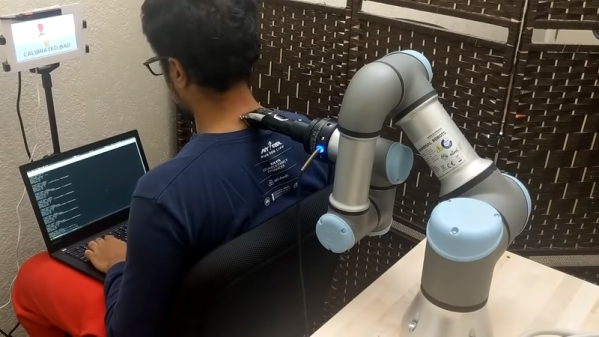
Although it is getting more common to have self-driving cars on the road, we have to admit we are still a bit uneasy. After all, we know first hand how hard it is to think of every case and how unreliable things can be. But what about having your hair cut by a robot? At least a car can have airbags and automatically stop at any sign of trouble. But letting a robot hold a sharp instrument up to your head? That’s what Buzz Robotics wants to do and they are starting with a neck trim that you can see in the video below.
Honestly, since the trimmers are probably not that dangerous, we feel a little better. But the fact that the screen says “Calibrated Bad” doesn’t install confidence. While the robobarber might not be able to cut your head off, it could certainly ruin your coiffure.
As soon as a project involves other assemblies, parts, or modules, things get more complicated. Devices like fans, cooling units, probes, pumps, or lighting might have simple electrical requirements, but they are rarely identical. As a result, one’s tidy project ends up having to deal with, for example, a pump that is controlled with 5 V active high logic, a sensor that outputs 5 V active low, lights that expect to be switched with 24 VDC, and a fan that needs a relay right now. But that might change in the future.
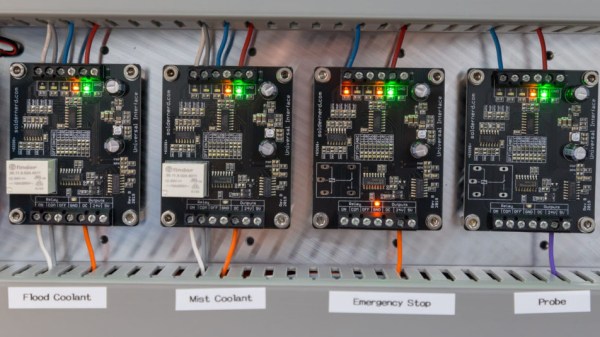
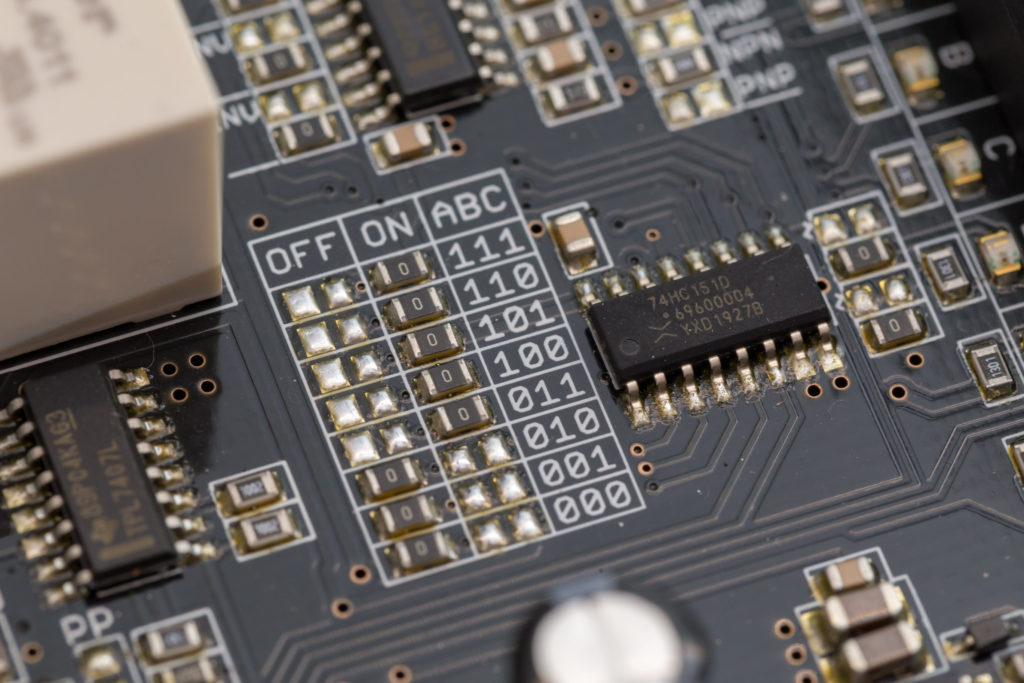
That’s exactly what led [Lukas Fässler] to design and build the Universal Interface, a board intended to be a kind of universal translator and interface for all such devices. The idea is to have one Universal Interface board for every external device. For each board, a wide variety of input combinations controls a single output. The boards are “hardware programmable” in the sense that jumpers (zero-ohm resistors) are used to spell out in black and white exactly what combinations of inputs result in which output state. In this way, some standardization and clarity of control can be enforced while still being flexible enough to accommodate changes.
Jumper-configured logic table defining with utter clarity which combination of inputs results in an OFF or ON.
Each Universal Interface board has three inputs and an enable line, each with their own indicator LED visually confirming its state. The inputs are 24 V tolerant and each can be configured with a pull-up, a pull-down, and as an active high or active low. There is one output, but it takes several forms: a sturdy relay, a powerful open-collector output, a 5 V logic output, and a 24 V logic output. Configuring which output state corresponds to what combination of inputs is set by jumpers, so the board is very much WYSIWYG.
[Lukas] is currently using four of these devices with his CNC mill project, all in different configurations, and they’re working reliably. Interested? The GitHub repository for the project has all the board design files.
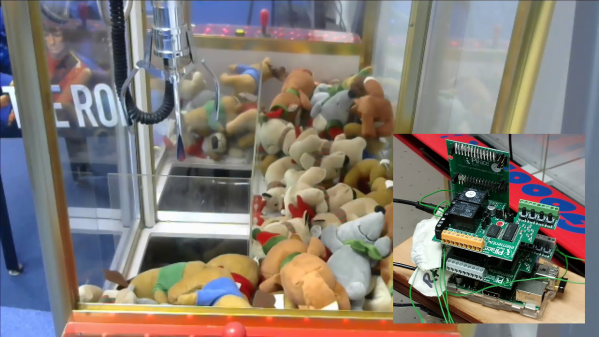
Want to do a bit of good this holiday season without leaving your couch or battle station? Well step right up and try your hand at Santa Claws, the charitable claw machine created by UK-based firm Liberty Games. For every toy you can maneuver to the chute, Liberty Games will donate money to Crisis, a national charity devoted to ending homelessness.
The machine is filled with special Christmas-themed stuffed animals that represent different cash values from £1 to £5. And these toys are doing double duty — after the holiday, they’ll all be donated to a good cause. In order to make this playable worldwide, Liberty used a Raspberry Pi, two Pi Face boards to interface the claw machine’s controls, and a Pi Face rack to everything together. They have the machine set on ‘generous’, so go have fun.
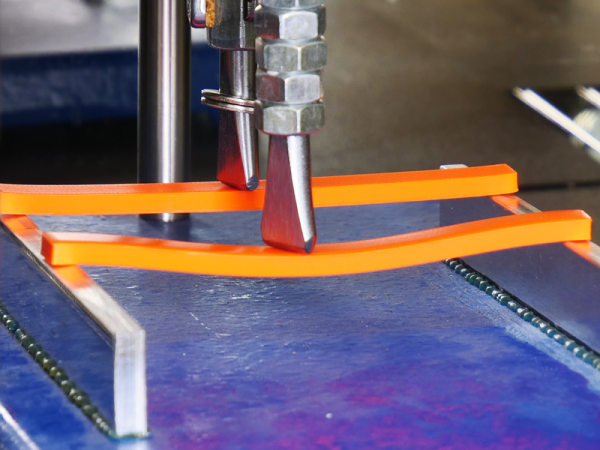
We’ve all been taught the scientific method: Form a hypothesis, do some experiments, gather some data, and prove or disprove the hypothesis. But we don’t always do it. We will tweak our 3D prints a little bit and think we see an improvement (or not) and draw some conclusions without a lot of data. Not [Josef Prusa], though. His team printed 856 different parts from four different materials to generate data about how parts behaved when annealed. There’s a video to watch, below.
Annealing is the process of heating a part to cause its structure to reorganize. Of course, heated plastic has an annoying habit of deforming. However, it can also make the parts firmer and with less inner tension. Printed parts tend to have an amorphous molecular structure. That is to say, they have no organization at all. The temperature where the plastic becomes soft and able to reorganize is the glass transition temperature.