Breathing LED Done With Raw Logic Synthesized From A Verilog Design

Breathing LEDs are an attractive adornment on many electronic devices. These days they’re typically controlled by software but of course there were fading effects back in the days of analog too. [Pepijn de Vos] mixes a little of the new and the old by building a hardware-based fader from a Verilog design and even too the time to explain the process in depth.

Rather than using a microcontroller and software, [Pepijn] wrote the logic required to make the LED “breathe” in the hardware description language, Verilog. You may be familiar with this for FPGAs, but using it to plan out a build with logic chips is just as apt a use. The Verilog was synthesized into a circuit using 74-series logic chips, with the help of work by [Dan Ravensloft] who has made a library for the Yosys Open Synthesis Suite. With the addition of a basic clock circuit, the LED is made to breathe and the rate can be controlled by changing the clock speed.

It’s a fun way to experiment with both Verilog and old-school logic, albeit one that may not scale well. An interesting side note from the Twitter thread, [Dan] estimates that with current settings the PicoRV32 CPU would require over 2000 chips to build. Regardless, it’s an interesting tool and one that likely has further scope for experimentation.

First patented by Apple way back in 2002, the breathing LED has been a popular project for those learning electronics. We’ve even seen it on motorbikes. Video after the break.

Continue reading “Breathing LED Done With Raw Logic Synthesized From A Verilog Design”
A Multi-Layered Spin On Persistence Of Vision

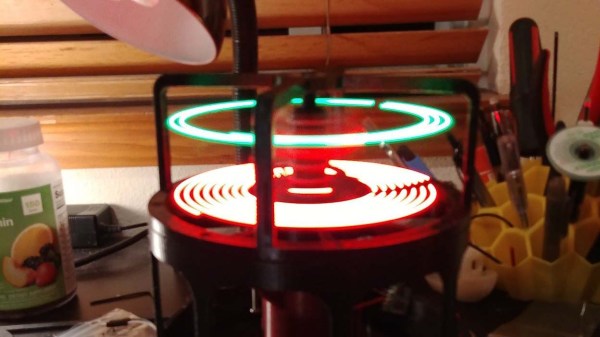
By taking advantage of persistence in human vision, we can use modest bits of hardware to create an illusion of a far larger display. We’ve featured many POV projects here, but they are almost always an exploration in two dimensions. [Jamal-Ra-Davis] extends that into the third dimension with his Volumetric POV Display.

Having already built a 6x6x6 LED cube, [Jamal] wanted to make it bigger, but was not a fan of the amount of work it would take to grow the size of a three-dimensional array. To sidestep the exponential increase in effort required, he switched to using persistence of vision by spinning the light source and thereby multiplying its effect.

The current version has six arms stacked vertically, each of which presents eight individually addressable APA102 LEDs. When spinning, those 48 LEDs create a 3D display with an effective resolution of 60x8x6.

We saw an earlier iteration of this project a little over a year ago at Bay Area Maker Faire 2018. (A demo video from that evening can be found below.) It was set aside for a while but has now returned to active development as an entry to Hackaday Prize 2019. [Jamal-Ra-Davis] would like to evolve his prototype into something that can be sold as a kit, and all information has been made public so others can build upon this work.

We’ve seen two-dimensional spinning POV LED display in a toy top, and we’ve also seen some POV projects taking steps into the third dimension. We like where this trend is going.

Continue reading “A Multi-Layered Spin On Persistence Of Vision”

Create A Low-Cost, High-Accuracy LCR Meter With An STM32 MCU

Having a good LCR meter was something which [Adil] had wanted for his personal lab, so as any good university student (and former Hackaday contributor) does, he ended up building his own. Using a Nucleo-F446RE board for the MCU side and a custom PCB for the side that does the actual measuring, he created a meter that reportedly comes pretty close to commercial meters, and for the low price of £55.

Running through some of the theory behind the design as well some design choices, the resulting product is then presented. The choice to not using a standard current shunt, but instead a transimpedance amplifier (TIA) is explained as well. Unfortunately there are no schematics or source code, and the text is somewhat unclear on some points, failing to explain some acronyms that’d make it hard for someone who is not active in this field to understand the full design.

We hope that [Adil] can address those points and provide design files and source code, as it does look like a very interesting project!

Designing Compact Gasoline Generator Prototype For Drone Use

Lithium batteries and brushless motors helped make multirotor drones possible, but batteries only last so long. Liquid fuels have far greater energy densities, but have not  been widely applied in these roles. [Tech Ingredients] has been experimenting with a compact gasoline-fueled generator, with the aim to extend drone flight times well beyond what is currently possible with batteries (Youtube link, embedded below).

The build began with a single-cylinder, four stroke engine. However, torque spikes and vibration made things difficult. After some iteration, the design settled on employing two single-cylinder two stroke engines, fitted with a timing belt to keep them 180 degrees out of phase. In combination with a pair of balanced flywheels, this keeps vibration to a minimum. Brushless motors are used as generators, combined with rectifier diodes and capacitors to smooth the voltage output. The generator is intended to be used in parallel with a lithium battery pack in order to ensure the drone always has power available, even in the event of a temporary malfunction.

This is a build with plenty of promise, and we can’t wait to see what kind of flight time can be achieved once the system is finished and flight ready. We’ve seen others experimenting with hybrid drones, too.

Continue reading “Designing Compact Gasoline Generator Prototype For Drone Use”

The Case Of The Vintage Computer, The Blown Fuse, And The Diode

If you are the operator of a vintage computer, probably the only one of its type remaining in service, probably the worst thing you can hear is a loud pop followed by your machine abruptly powering down. That’s what happened to the Elliott 803B in the UK’s National Museum Of Computing, and its maintainer [Peter Onion] has written an account of his getting it back online.

The Elliott is a large machine from the early 1960s, and because mains supplies in those days could be unreliable it has a rudimentary UPS to keep it going during a brownout. A hefty Ni-Cd battery is permanently hooked up to a charger that also serves as the power supply for the machine, ensuring that it can continue to operate for a short while as the voltage drops. A spate of fuses had blown in this power supply, so we’re taken through the process of fault-finding. Eventually the failure is found in a rectifier diode, the closest modern equivalent is substituted, and after testing the machine comes back to life.

We’re used to reading these stories from the other side of the Atlantic, so we welcome TNMOC saying that this is the first of a series of technical posts on their work. We visited the museum back in 2016, and also featured its famous recreated Colossus.

A Microwave Kiln, From Scratch

We are normally told that microwave ovens are strictly for food only, and that anything else will cause all sorts of bad things to come our way. There can be few readers who haven’t at some time seen the shower of sparks when an inadvertent metallic object finds its way onto the turntable.

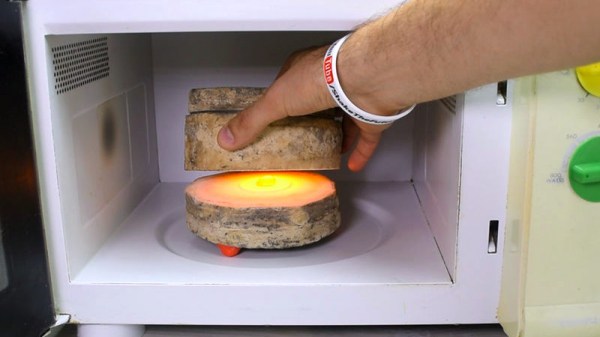
A particularly useful non-food application for a microwave oven comes in the form of the small kilns sold for glass fusing. These are ceramic cylinders coated internally with silicon carbide, and [ShakeTheFuture] shows us how to make your own.

Key to the process is ceramic fibre insulation, which is bonded both to itself and to the fused silicon carbide grit by a cured solution of waterglass, sodium silicate. The result can easily reach the required temperature for fusing glass, but also has an application in burning out surplus wax or PLA from a plaster mould. It’s particularly interesting to see the technique with the waterglass in action, and you can see a run-down of the whole thing in the video below the break.

Continue reading “A Microwave Kiln, From Scratch”

Use A Digital Key To Deter Lockpicking

Spending an hour or two around any consumer-level padlock or house deadbolt lock with a simple lockpicking kit will typically instill a good amount of panic and concern about security. While it’s true that any lock can be defeated, it’s almost comically easy to pick basic locks like this. So, if you’re looking for a level of security that can’t be defeated in two minutes with a tiny piece of metal, you might want to try something a little more advanced.

This project stemmed from an idea to use a YubiKey, a USB hardware token typically used for two-factor authentication, for physical locks instead. The prototype was built around an Arduino UNO, and all of the code and build instructions are available on the project’s site. The creator, [rprinz08], does not have one built inside of a secure enclosure so that would remain an exercise for the reader, but the proof-of-concept is interesting and certainly useful.

While digital keys like this can have their own set of problems (as all locks do), this would be a great solution for anyone needing to lock up anything where physical keys are a liability or a nuisance, where logging is important, or where many people need access to the same lock. The open source code and well-known platform make it easy for anyone to build, too.