Friday Hack Chat: LED Diffusion

A decade ago, the first Arduino projects featuring addressable RGB LEDs came on the scene, and the world hasn’t been the same since. Now we have full wall video displays with WS2812s and APA102s, wearable blinky, and entire suits of armor made of LEDs. The future is bright, and in RGB.

For this week’s Hack Chat, we’re going to be talking all about how to maintain the blinky without eye-searing brightness. It’s the LED Diffusion Hack Chat, full of tips and tricks on how to get the glowey without it being imprinted on your retina.

Our guest for this week’s Hack Chat is the incredible Becky Stern. Becky is one of the most prolific makers around and has a long history of fabricating some really, really cool stuff. She’s published hundreds of tutorials on everything from microcontrollers to computerized knitting machines, and has been featured by dozens of media outlets including the BBC, CNN, The Late Show with Colbert, VICE, and Forbes. Right now, she’s working at Autodesk with Instructables.

During this Hack Chat, we’re going to be talking all about diffusing LEDs, with topics including:

  • Taking some sandpaper to LEDs
  • Light pipes
  • 3D printed LED enclosures
  • Looking into a bright blue LED with your remaining eye

You are, of course, encouraged to add your own questions to the discussion. You can do that by leaving a comment on the Hack Chat Event Page and we’ll put that in the queue for the Hack Chat discussion.join-hack-chat

Our Hack Chats are live community events on the Hackaday.io Hack Chat group messaging. This week is just like any other, and we’ll be gathering ’round our video terminals at noon, Pacific, on Friday, August 17th. Need a countdown timer? Here ‘ya go.

Click that speech bubble to the right, and you’ll be taken directly to the Hack Chat group on Hackaday.io.

You don’t have to wait until Friday; join whenever you want and you can see what the community is talking about.

Arcade Inspired Halloween Candy Dispenser

The days are getting shorter and the nights are a little cooler, which can only mean one thing: it’s officially time to start devising the trials you’ll put the neighborhood children through this Halloween. For [Randall Hendricks], that means building a new candy dispensing machine to make sure the kids have to work for their sugary reward. After all, where’s the challenge in just walking up and taking some candy from a bowl? These kids need to build character.

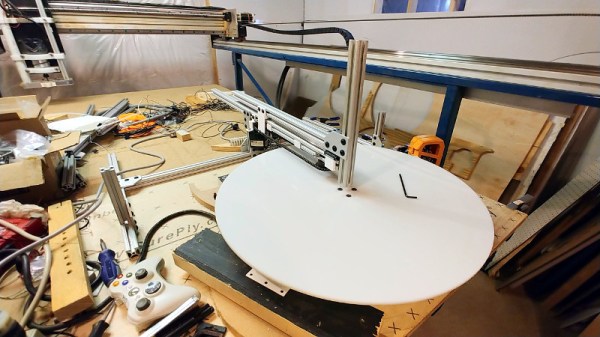
[Randall] writes in to share his early work on this year’s candy contraption which he’s based on a popular arcade game called “Goal Line Rush”. In this skill based game a disc with various prizes spins slowly inside the machine, and the player has a button that will extend an arm from the rear of the disc. The trick is getting the timing right to push the prize off the disc and into the chute. Replace the prizes with some empty calorie balls of high fructose corn syrup, and you get the idea.

There’s still plenty of time before All Hallows’ Eve, so the machine is understandably still a bit rough. He hasn’t started the enclosure yet, and at this point is still finalizing the mechanics. But this early peek looks very promising, and in the video after the break you can see how the machine doles out the goodies.

The disc is rotated by a high torque motor, and the aluminum extrusion arm is actuated with a gear motor and custom chain drive. Some 3D printed hardware, a couple limit switches, and a pair of relays make for a fairly straightforward way of pushing the rod out when the player presses the button on the front of the cabinet.

Considering how his previous Mario-themed candy dispenser came out, we doubt this new machine will fail to impress come October. The neighborhood kids should just count themselves lucky he’s not using his creativity to terrorize them instead.

Continue reading “Arcade Inspired Halloween Candy Dispenser”

Stop Using Python 2: What You Need To Know About Python 3

Though Python 3 was released in 2008, many projects are still stuck on Python 2.

It’s understandable that porting large existing codebases to a new version is a prospect which sends a shiver down many a developer’s spine. But code inevitably needs to be maintained, and so when all the shiny new features that would fix everything are in a new version, is it really worth staying rooted in the past?

We’ll take you through some of the features that Python 2 programs are missing out on, not only from 3.0 but up to the current release (3.7).

Continue reading “Stop Using Python 2: What You Need To Know About Python 3”

A Remotely Controlled Kindle Page Turner

One of the biggest advantages of e-readers such as the Kindle is the fact that it doesn’t weigh as much as a traditional hardcover book, much less the thousands of books it can hold in digital form. Which is especially nice if you drop the thing on your face while reading in bed. But as light and easy to use as the Kindle is, you still need to hold it in your hands and interact with it like some kind of a baby’s toy.

Looking for a way to operate the Kindle without having to go through the exhaustive effort of raising their hand, [Alex Mikes] designed and built a clip-on device that makes using Amazon’s e-reader even easier. At the press of a button, the device knocks on the edge of the screen which advances the book to the next page. Going back a page will still require you to extend your meaty digit, but that’s your own fault for standing in the way of progress.

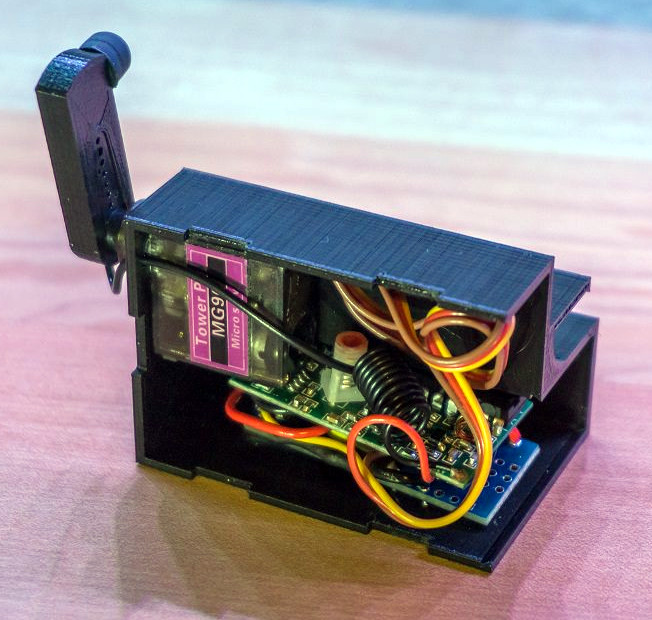
The 3D printed case holds an Arduino and RF receiver, as well as a small servo to power the karate-chop action. There’s no battery inside, meaning the device needs to stay plugged in via a micro USB connection on the back of the case. But let’s be honest: if you’re the kind of person who has a remote-controlled Kindle, you probably aren’t leaving the house anytime soon.

To fool the Kindle into thinking a human finger is tapping the screen, the page turner’s arm has a stylus tip on the end. A channel is designed into the 3D printed arm for a wire to run from the tip to the Arduino’s ground, which triggers the capacitive screen to register a touch.

All joking aside, the idea holds promise as an assistive technology for individuals who are unable to lift an e-reader or operate its touch screen controls. With the Kindle held up in a mount, and this device clipped onto the side, anyone who can push a button (or trigger the device in whatever method they are physically capable) can read a book on their own. A simple pleasure that can come as a huge comfort to a person who may usually be dependent on others.

In the past we’ve seen physical buttons printed for touch screens, and an Arduino used to control a touch screen device. But this particular combination of physical and electrical interaction is certainly a unique way to tackle the problem without modifying the target device.

Replacement Audi Plastics Thanks To 3D Printing

Old cars can be fun, and as long as you drive something that was once moderately popular, mechanical parts can be easy enough to come by. Things like filters, spark plugs, idle air solenoids – they’re generally available for decades after a car is out of production as long as you know where to look. However, plastics can be much harder to come by. 20 to 30 years into a car’s lifetime, and you’ll be hard pressed to find a radio surround or vent trim in as-new condition – they’ve all long ago succumbed to the sun and air like the cracked and discoloured piece in your own car. What is a hacker to do? Bust out the 3D printer, of course!

[Stephen Kraus] has developed a series of parts for his Audi, ready to print on the average home 3D printer. There’s the triple gauge mount which fits in the radio slot for that classic tuner look, to the printed wheel caps which are sure to come in handy after you’ve lost the originals. There are even useful parts for capping off the distributor if you’re switching to a more modern ignition setup. [Stephen] also reports that his replacement shifter bushing printed in PLA has lasted over a year in normal use.

This is an excellent example of what 3D printers do best – obscure, bespoke one-off parts with complex geometries are no trouble at all, and can be easily made at home. We’ve seen this done to great effect before, too – for example with this speedometer correction gear in an old truck.

Reinforce Happy Faces With Marshmallows And Computer Vision

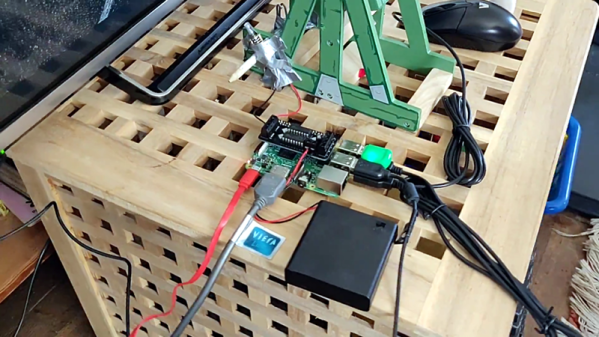
Bing Crosby famously sang “Just let a smile be your umbrella.” George Carlin, though, said, “Let a smile be your umbrella, and you’ll end up with a face full of rain.” [BebBrabyn] probably agrees more with the former and used a Raspberry Pi with Open CV to detect a smile, a feature some digital cameras have had for a long time. This project however doesn’t take a snapshot. It launches a marshmallow using a motor-driven catapult. We wondered if he originally tried lemon drops until too many people failed to catch them properly.

This wouldn’t be a bad project for a young person — as seen in the video below — although you might have to work a bit to duplicate it. The catapult was upcycled from a broken kid’s toy. You might have to run to the toy store or rig something up yourself. Perhaps you could 3D print it or replace it with a trebuchet or compressed air.

Continue reading “Reinforce Happy Faces With Marshmallows And Computer Vision”

A Radar Module Teardown And Measuring Fan Speed The Hard Way

If you have even the slightest interest in microwave electronics and radar, you’re in for a treat. The Signal Path is back with another video, and this one covers the internals of a simple 24-GHz radar module along with some experiments that we found fascinating.

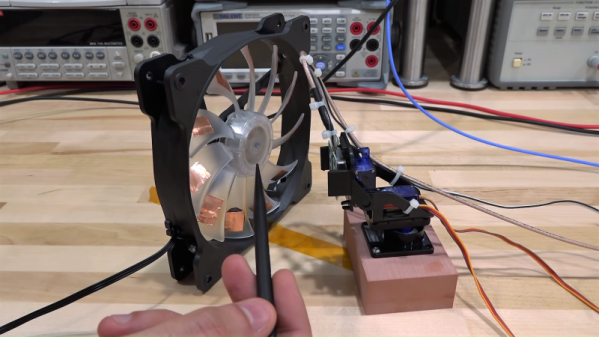
The radar module that [Shahriar] works with in the video below is a CDM324 that can be picked up for a couple of bucks from the usual sources. As such it contains a lot of lessons in value engineering and designing to a price point, and the teardown reveals that it contains but a single active device. [Shahriar] walks us through the layout of the circuit, pointing out such fascinating bits as capacitors with no dielectric, butterfly stubs acting as bias tees, and a rat-race coupler that’s used as a mixer. The flip side of the PCB has two arrays of beam-forming patch antennas, one for transmit and one for receive. After a few simple tests to show that the center frequency of the module is highly variable, he does a neat test using gimbals made of servos to sweep the signal across azimuth and elevation while pointing at a receiving horn antenna. This shows the asymmetrical nature of the beam-forming array. He finishes up by measuring the speed of a computer fan using the module, which has some interesting possibilities in data security as well as a few practical applications.

Even though [Shahriar]’s video tend to the longish side, he makes every second count by packing in a lot of material. He also makes complex topics very approachable, like what’s inside a million-dollar oscilloscope or diagnosing a wonky 14-GHz spectrum analyzer.

Continue reading “A Radar Module Teardown And Measuring Fan Speed The Hard Way”