Classroom Gadget Turned Arduino Compatible

Cheap second-hand hardware is usually a fertile ground for hacking, and by looks of this project, the digital classroom aids that were all the rage a few years back are no exception. [is0-mick] writes in to tell us how he managed to hack one of these devices, a SMART Reponse XE, into an Arduboy compatible game system. As it turns out, this particular gadget is powered by an ATmega128RFA, which is essentially an Arduino-compatible AVR microcontroller with a 2.4GHz RF transceiver tacked on. This makes it an extremely interesting platform for hacking, especially since they are going for as little as $3 USD on eBay.

There’s no USB-Serial converter built into the SMART Response XE, so you’ll need to provide your own external programmer to flash the device. But luckily there’s a labeled ISP connector right on the board which makes it pretty straightforward to get everything wired up.

Of course, getting the hardware working was slightly more complicated than just flashing an Arduino Sketch onto the thing. [is0-mick] has provided his bootloader and modified libraries to get the device’s QWERTY keyboard and ST7586S controlled 384×160 LCD working.

Playing games is fun, but when his friend [en4rab] sent him the SMART Response XE to fiddle with, the goal was actually to turn them into cheap 2.4 GHz analyzers similar to what was done with the IM-ME. It seems they’re well on their way, and [is0-mick] invites anyone who might be interested in filling in some of the blanks on the RF side to get involved.

Continue reading “Classroom Gadget Turned Arduino Compatible”
A 3D-Printed Bowl Feeder For Tiny SMD Parts

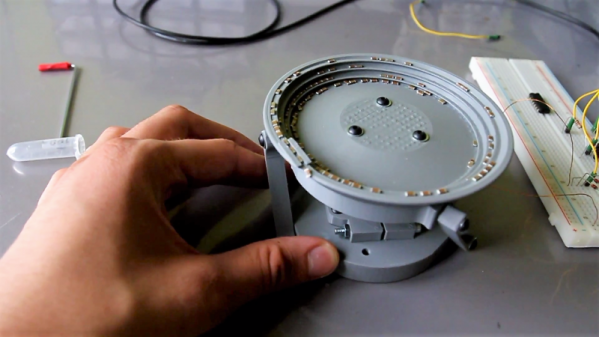
[Andrzej Laczewski] has something big in mind for small parts, specifically SMD resistors and capacitors. He’s not talking much about that project, but from the prototype 3D-printed bowl feeder he built as part of it, we can guess that it’s going to be a pretty cool automation project.

Bowl feeders are common devices in industrial automation, used to take a big pile of parts like nuts and bolts and present them to a process one at a time, often with some sort of orientation step so that all the parts are the right way around. They accomplish this with a vibratory action through two axes, which [Andrzej] accomplishes with the 3D-printed ABS link arms supporting the bowl. The spring moment of the arms acts to twist the bowl slightly when it’s pulled down by a custom-wound electromagnet, such that the parts land in a slightly different place every time the bowl shifts. For the parts on the shallow ramp spiraling up the inside of the bowl, that means a single-file ride to the top. It’s interesting to see how changing the frequency of the signal sent to the coil impacts the feed; [Andrzej] used a function generator to find the sweet spot before settling on a dedicated circuit. Watch it in action below.

We’re really impressed with the engineering that went into this, even if we wonder what the vibration will do to the SMD components. Still, we can’t wait to see this in a finished project – perhaps it’ll be integrated like this Arduino-fied bowl feeder.

Continue reading “A 3D-Printed Bowl Feeder For Tiny SMD Parts”

Out Of Batteries For Your Torch? Just Use A Mini Nitro Engine

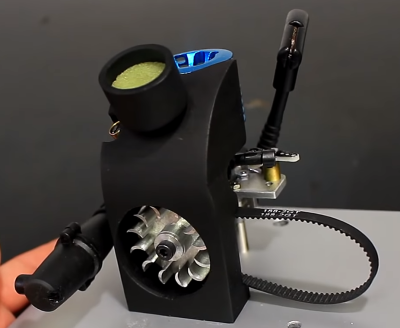
We can certainly relate to an incomplete project sowing the seed for a better one, and that’s just what happened in [JohnnyQ90]’s latest video. He initially set out to create an air compressor powered by a nitro engine, and partially succeeded – air was compressed, but not nearly enough to be useful.

Instead, he changed tack and decided to use the 1 cc engine to make a small electric generator. [JohnnyQ90] is, of course, no stranger to the nitro engine, having previously brought us the micro chainsaw conversion, and nitro powered rotary tool. This time round, the build is a conceptually simple task: connect an engine to a DC motor and you’re done. But physically implementing it in an elegant way is a different story, and this is always where [JohnnyQ90] shines; we never get tired of watching him produce precision parts on the lathe. A fuel tank is made from a modified Zippo can and, courtesy of a CNC milled fan and 3D printed shroud, the motor air cools itself.

Towards the end of the video, [JohnnyQ90] plays with the throttle a little, causing the bulb connected to the generator to brighten accordingly. It might be fun to control the throttle with a servo and try to regulate the voltage on the output under different load conditions.

We love novel ways of creating electricity; previously we’ve written about how to generate power from a coke can, as well as this 120 W thermoelectric generator (TEG) setup.

Continue reading “Out Of Batteries For Your Torch? Just Use A Mini Nitro Engine”

Repairing A Capacitor Inside A Potted Transformer

We always enjoy watching [Mr. Carlson’s] videos because he looks like he is taping in a rocket ship set from a 1950s drive-in movie. In a recent video, he identified an old oscilloscope that had a transformer assembly that is potted with a pair of capacitor inside. The capacitor failed so [Carlson] decided he would repair it. The problem? The transformer and capacitor are potted together with some sort of tar compound. You can see the result in the video below.

He actually didn’t know for sure the capacitor was really in the transformer, but they were in the schematic and by process of elimination, it had to be inside. Once he liberated the transformer, he did some tests to identify the capacitor before the depotting. The depotting takes a lot of heat and could damage the transformer, so he wanted to make sure it was really in there.

Continue reading “Repairing A Capacitor Inside A Potted Transformer”

Recycle LCDs Into LEDs

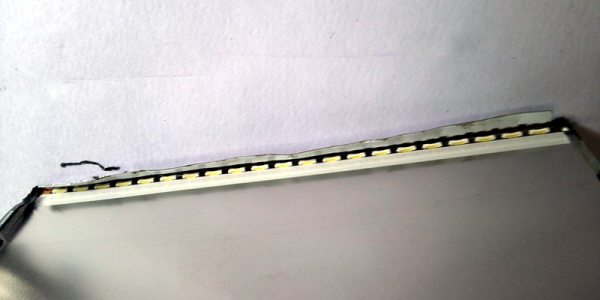
We always find it funny when we see ads for modern LED TVs. These TVs don’t use LEDs to show the picture. They are nothing more than LCD screens with LED backlighting instead of cold cathode fluorescent lamps. [Akshaylals] had a few LCD laptop and phone panels that were defunct and decided to recycle them to get to the LEDs within.

Most panels are lit from one or two edges with a bar of LEDs. You only have to peel off some tape and plastic. If you wonder what all those plastic sheets do, see the [Engineer Guy’s] video, below.

Continue reading “Recycle LCDs Into LEDs”

Old Phone, New Remote Switch

With mobile phones now ubiquitous for the masses in much of the world for over two decades, something a lot of readers will be familiar with is a drawer full of their past devices. Alongside the older smartphone you’ll have a couple of feature phones, and probably at the bottom a Nokia candybar or a Motorola flip phone. There have been various attempts over the years to make use of the computing power the more recent ones contain through using their smartphone operating systems, but the older devices remain relatively useless.

[Vishwasnavada] has a neat plan though, using an ancient phone as a remote trigger device, by interfacing it with an Arduino. There are many ways this could be achieved depending on the model of the phone in question, but one thing common to nearly all devices is a vibration motor. Removing the motor and taking its power line to a GPIO allows the Arduino to sense when the phone is ringing. The idea then is that a call can be placed to the phone which is not picked up, but because it triggers the vibration motor it can be used to make the microcontroller do something remotely. A hack with limited capabilities then, but one that is cheap and simple, uses a recycled device, and should work almost anywhere populated on the planet given the global reach of 2G networks.

This isn’t the first respin of a classic Nokia we’ve brought you, they will also talk data.

Wire Wound Resistors On Your Own

In all kinds of engineering, we build on abstractions in a kind of inverted pyramid. Lots of people can, for example, design a system using ready-made building blocks on printed circuit boards. Fewer people can do the same design using ICs. Fewer still can design with components. But who designs the components? Even fewer people. Then there are the people designing the constituent elements of those components. [Learnelectronics] wanted to break one of those abstraction layers so he shows how to make your own wire-wound resistors.

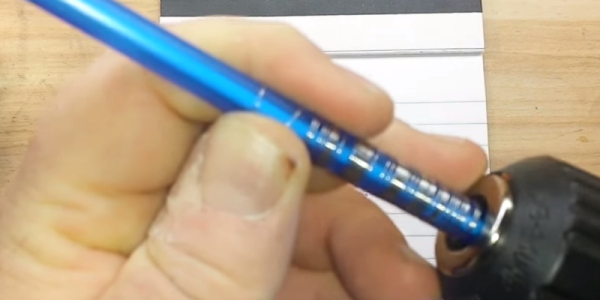
Wire-wound resistors are often used when you need resistance with a higher power dissipation than a common film or composition resistor. Using nichrome wire makes this more practical since a meter of it has nearly 20 ohms of resistance. A regular wire has much less resistance.  The video shows a drill winding a coil of wire neatly, but this also highlights one of the problems with wire wound resistors.

Continue reading “Wire Wound Resistors On Your Own”