The Engineering Analysis Of Plastic-Dissolving Lubricant

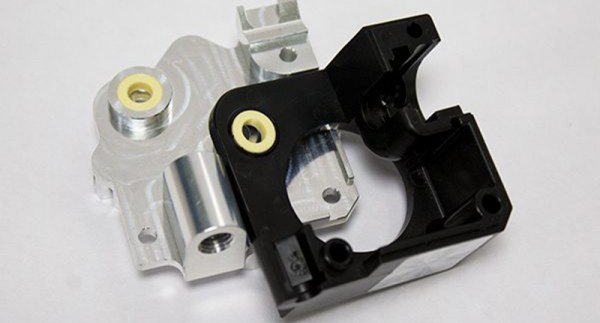
Over the years, E3D has made a name for themselves as a manufacturer of very high-quality hotends for 3D printers and other printer ephemera. One of their more successful products is the Titan Extruder, a compact extruder for 3D printers that is mostly injection-molded plastic. The front piece of the Titan is a block of molded polycarbonate, a plastic that simply shouldn’t fail in its normal application of holding a few gears and bearings together. However, a few months back, reports of cracked polycarbonate started streaming in. This shouldn’t have happened, and necessitated a deep dive into the failure analysis of these extruders. Lucky for us, E3D is very good at doing engineering teardowns. The results of the BearingGate investigation are out, and it’s a lesson we can all learn from.

The first evidence of a problem with the Titan extruders came from users who reported cracking in the polycarbonate case where the bearing sits. The first suspect was incorrectly manufactured polycarbonate, perhaps an extruder that wasn’t purged, or an incorrect resin formulation during manufacturing. A few whacks with a hammer of each production run ruled out that possibility, so suspicion turned to the bearing itself.

After a few tests with various bearings, the culprit was found: in some of the bearings, the lubricant mixed with the polycarbonate to create a plastic-degrading toxic mixture. These results were verified by simply putting a piece of polycarbonate and the lubricant in a plastic bag. This test resulted in some seriously messed up plastic. Only some of the bearings E3D used caused this problem, a lesson for everyone to keep track of your supply chain and keep records of what parts went into products when.

The short-term fix for this problem is to replace the bearing in the Titan with IGUS solid polymer bushings. These bushings don’t need lubricant, and therefore are incapable of killing the polycarbonate shell. There are downsides to this solution, namely that the bushings need to be manufactured, and cause a slight increase in friction reducing the capability of the ‘pancake’ steppers E3D is using with this extruder.

The long-term solution for this problem is to move back to proper bearings, but changing the formulation of the polycarbonate part to something more chemical resistant. E3D settled on a polymer called Tritan from Eastman, a plastic with similar mechanical properties, but one that is much more chemically resistant. This does require a bit more up-front work than machining out a few bearings, but once E3D gets their Tritan parts in production, they will be able to move back to proper bearings with the right lubrication.

While this isn’t a story of exploding smartphones or other disastrous engineering failures, it is a great example of how your entire supply chain goes into making a product, and how one small change can ruin an entire product. This is real engineering right here, and we’re glad E3D finally figured out what was going on with those broken Titan extruders.


Quantum Communications In Your Browser

Quantum computing (QC) is a big topic, and last time I was only able to walk you through the construction of a few logic gates, but you have to start somewhere. If you haven’t read that part, you probably should, because you’ll need to understand the simulator I’m using and some basic concepts.

I like to get right into practice, but with this topic, there’s no avoiding some theory. But don’t despair. We’ll have a little science fiction story you can try by the end of this installment, where we manage to pack two bits of information into a single physical qubit. Last time I mentioned that qubits have 1 and 0 states and I hinted that they were really |1> and |0> states. Why create new names for the two normal binary states? Turns out there is more to the story.

What’s the Vector, Victor?

In Dirac notation, |1> is a vector. So is |hackaday> and |123>. You can get into a lot of math with these, but I’m going to try to avoid most of that. This is also called ket notation (the last part of the word bracket) so you’ll hear people say “one ket” or “hackaday ket.” Either way, the vector can represent one or more qubits and there are several ways to represent them.

Continue reading “Quantum Communications In Your Browser”

Friday Hack Chat: Circuit Python

Back in the olden days, if you wanted to learn how to program a computer, you used the BASIC interpreter stored in ROM. This is how an entire generation of devs learned how to program. Now, home computers do not exist, there is no programming language stored in ROM, and no one should inflict JavaScript on 8-year-olds. What is the default, My First Programming Language™ today? Python. And now it’s on microcontrollers.

For this week’s Hack Chat on hackaday.io, we’re going to be talking all about Circuit Python. Circuit Python is based on the Open Source MicroPython, a Python 3 interpreter that implements a subset of the Python language on microcontrollers and other constrained environments. It is the spiritual successor of BASIC on every computer: MicroPython has an interactive prompt, arbitrary precision integers, closures, lists, and more. All of this fits on a microcontroller with 256 kB of code space and 16 k of RAM.

Our guests for this week’s Hack Chat will be [Scott Shawcroft] and [Dan Halbert] from Adafruit. [Scott] started working on MicroPython with Adafruit in September 2016 and has led the renamed CircuitPython effort ever since. [Dan] started working on CircuitPython in early 2017 and joined Adafruit in August of that year. [Dan], by the way, is the original author of the ‘more’ command in UNIX.

For this Hack Chat, we’re going to be talking about CircuitPython, its history, current boards that support the project, and the end goals for CircuitPython. We’ll be talking about future plans, what will be supported in the future, and asking any technical questions about CircuitPython.

join-hack-chat

Our Hack Chats are live community events on the Hackaday.io Hack Chat group messaging. This Hack Chat is going down Friday, February 2nd at noon, Pacific time. Time Zones got you down? Here’s a handy countdown timer!

Click that speech bubble to the left, and you’ll be taken directly to the Hack Chat group on Hackaday.io.

You don’t have to wait until Friday; join whenever you want and you can see what the community is talking about.

Repairs You Can Print: The Zipper Box

Picture it: winter, a few years ago. [Ted Yapo]’s son is sent to the front lines of a snowball war. He rises to the task, pelting kid after kid with ease and taking down the Johnson twins with a two-fisted trebuchet maneuver. As he hunkers down to form the last snowball needed to claim victory, the unthinkable happens: the zipper box on his coat breaks and falls silently into the snow. Unaware, he leaps to his feet to take his final shot and the whole zipper unfurls, exposing him to both the cold and the enemy. They won the war, but at what cost?

[Ted] figured the coat was done for. He thought about replacing the zipper entirely, but that was going to be a lot of work. He cast a forlorn look around his workshop and his gaze fell upon the 3D printer in the corner. I can rebuild it! He thought. I have the technology! He was off to design a new box in OpenSCAD and had sturdy ABS replacement zipper box in no time. He installed it with dab of Duco cement, and the rest is history. That coat saw two more winters and countless snowball wars before [Private Yapo] presumably grew out of the thing.

Zippers are the unsung heroes of clothing. If you don’t know much about zippers, sink your teeth into [Dan Maloney]’s recent ode to the quickest fastener we’ve got.

Global Resistor Shortage, Economics, And Consumer Behavior

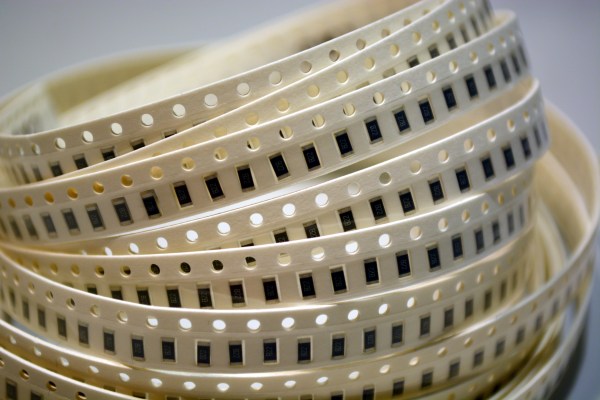
The passive component industry — the manufacturers who make the boring but vital resistors, capacitors, and diodes found in every single electronic device — is on the cusp of a shortage. You’ll always be able to buy a 220 Ω, 0805 resistor, but instead of buying two for a penny like you can today, you may only get one in the very near future.

Yageo, one of the largest manufacturers of surface mount (SMD) resistors and multilayer ceramic capacitors, announced in December they were not taking new chip resistor orders. Yageo was cutting production of cheap chip resistors to focus on higher-margin niche-market components for automotive, IoT, and other industrial uses, as reported by Digitimes. Earlier this month, Yaego resumed taking orders for chip resistors, but with 15-20% higher quotes (article behind paywall, try clicking through via this Tweet).

As a result, there are rumors of runs on passive components at the Shenzhen electronics market, and several tweets from members of the electronics community have said the price of some components have doubled. Because every electronic device uses these ‘jellybean’ parts, a decrease in supply or increase in price means some products won’t ship on time, margins will be lower, or prices on the newest electronic gadget will increase.

The question remains: are we on the brink of a resistor shortage, and what are the implications of manufacturers that don’t have the parts they need?

Continue reading “Global Resistor Shortage, Economics, And Consumer Behavior”

Strumbot: The Guitar That Strums Itself

[Clare] isn’t the most musically inclined person, but she can strum a guitar. Thanks to a little help from an Arduino, she doesn’t even have to do that.

She built the strumbot, which handles the strumming hand duties of playing the guitar. While [Claire] does believe in her strumbot, she didn’t want to drill holes in her guitar, so hot glue and double-sided foam tape were the order of the day.

The business end of the strumbot is a micro servo. The servo moves two chopsticks and draws the pick across the strings. The tiny servo surprisingly does a great job getting the strings ringing. The only downside is the noise from the plastic gears when it’s really rocking out.

Strumbot’s user interface is a 3D-printed case with three buttons and three LEDs. Each button activates a different strum pattern in the Arduino’s programming. The LEDs indicate the currently active pattern. Everything is powered by a USB power pack, making this a self-contained hack.

[Clare] was able to code up some complex strum patterns, but the strumbot is still a bit limited in that it only holds three patterns. It’s good enough for her rendition of “Call Me Maybe”, which you can see in the video after the break. Sure, this is a simple project, not nearly as complex as some of the robotic guitar mods we’ve seen in the past. Still, it’s just the ticket for a fun evening or weekend project – especially if you’re introducing the Arduino to young coders. Music, hacking, and modding – what more could you ask for?

Continue reading “Strumbot: The Guitar That Strums Itself”

What Is This, A Controller For Ants?!

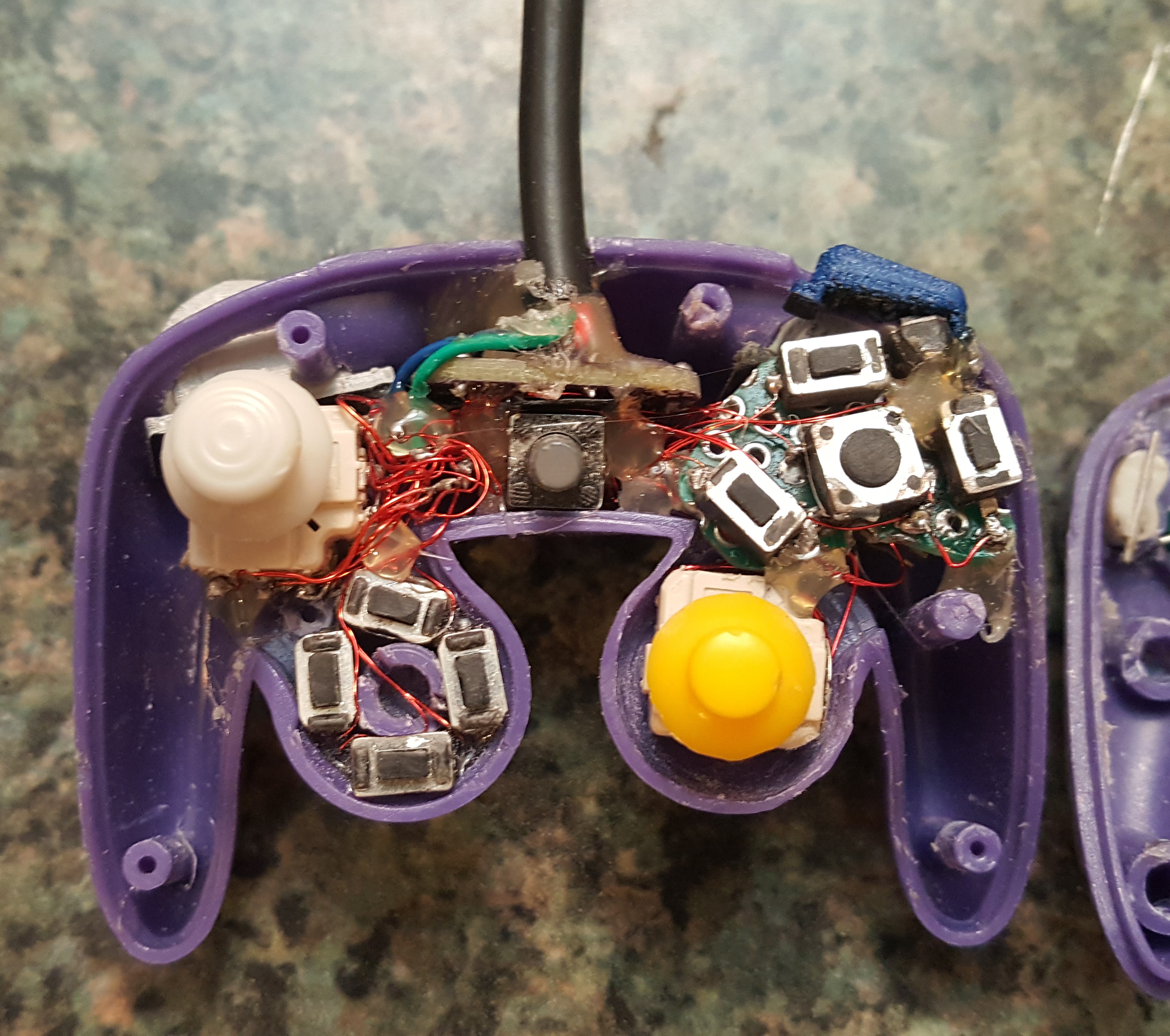
What’s the smallest controller you’ve ever used? [BitBuilt] forum user [Madmorda] picked up a cool little GameCube controller keychain with semi-working buttons at her local GameStop. As makers are wont to do, she figured she could turn it into a working controller and — well — the rest is history.

This miniaturized controller’s original buttons were essentially one piece of plastic and all the buttons would depress at once — same goes for the D-pad. Likewise, the original joystick and C-stick lacked springs and wouldn’t return to a neutral position after fidgeting with them. To get the ball rolling, [Madmorda] picked up a GC+ board — a custom GameCube controller board — just small enough to fit this project, eleven hard tact switches for the various buttons, and two squishy tact switches to replicate the original controller’s L and R button semi-analog, semi-digital functionality.

Continue reading “What Is This, A Controller For Ants?!”