Hacked Furby Knows When You’re Near

One of the classics of circuit bending is to mess around with the clock chip that drives the CPU in simple noise-making toys. [Goran] took this a step further with his Furby hack. Skip down to the video embedded below if you just want to see the results.

After first experiments modifying the Furby’s clock with a string of resistors (YouTube), [Goran] decided to opt for more control, overriding the clock entirely with a square wave coming out of an Arduino. And then, the world became his oyster.

The Furby’s eyes were replaced with ultrasonic distance sensors, and what looks like a speaker was hot-glued into its mouth. Since this particular Furby only “talks” when you pull its tail, he naturally wired in tail-switch control to boot. As [Goran] suggests, a light show is the obvious next step.

If you haven’t pulled apart an electronic toy and played around with glitching it, you don’t know what you’re missing. We’ve got a classic intro to circuit bending, as well as projects that range from the simple to the ridiculously elaborate. It’s a fun introduction to electronics for the young ones as well. Grab a toy noisemaker and get hacking.


Continue reading “Hacked Furby Knows When You’re Near”

Building A DIY Heat Pipe

Once the secret design tool for aerospace designers, the heat pipe is a common fixture now thanks to the demands of PC CPU cooling. Heat pipes can transfer lots of energy from a hot side to a cold side and is useful when you need to cool something where having a fan near the hot part isn’t feasible for some reason. Unlike active cooling, a heat pipe doesn’t require any external power or pumps, either.

[James Biggar] builds his own heat pipes using copper tubing. You can see a video of one being made, below. There’s not much to it, just a copper pipe with some water in it. However, [James] gets the water boiling to reduce the pressure in the tube before sealing it, which is an interesting trick.

One limitation of his technique is that there is no internal wick. That means the tube can only be installed vertically. If you haven’t looked at heat pipes before, most of them do have a wick. The idea is that some working fluid is in the pipe. You select that fluid so that it boils at or below the temperature you want to handle. The hot vapor rushes to the cool side of the pipe (carrying heat) where you have a large heatsink that may have a fan or active cooling system. The vapor condenses and–in this case–drops back to the bottom of the tube. However, if there is a wick, capillary action will return the fluid to the hot end of the tube.

You might think that using water as the working fluid would limit you to 100°C, but remember, [James’] technique lowers the pressure in the tube. At a lower pressure, the water will boil at a lower temperature.

We’ve seen heat pipes and wine chillers used to cool a PC before. In fact, we’ve even seen them in builds of completely fanless PCs.

Continue reading “Building A DIY Heat Pipe”

Bare-bones Musical Tesla Coil Is Tiny And Tinny

We’ve seen musical Tesla coils aplenty on these pages before, and we’ll be the first to point out that [Kedar Nimbalkar]’s musical high-voltage rig doesn’t quite qualify as a Tesla coil. But it’s dirt cheap, and might make a pretty cool rainy-afternoon-with-the-kids project.

Chances are good you have the parts needed for this build lying around the house. All that’s needed is an audio power amplifier and a high-voltage source. [Kedar] used a Class D amp board and a 3V to 7kV high-voltage module sourced from eBay for a couple of bucks; if you really want to go cheap, tear down that defunct electronic fly swatter gathering dust on top of your fridge and harvest the high-voltage module inside. The output of the amp feeds the high-voltage module, the HV leads are placed close together to get an arc, and the glorious high-fidelity sound will wash over you. Or not – sounds pretty awful to us. Still, it looks like a fast, fun build.

If this project gets you in the mood to go the full Tesla, check out this coil big enough to produce 12-foot arcs, or even this musical Tesla hat.

Continue reading “Bare-bones Musical Tesla Coil Is Tiny And Tinny”

Fly With A Game Boy Classic

How many grown-up hardware hackers whiled away their youth playing Tetris or Mario on their Game Boy? Fond memories for many, but unless you are lucky your Game Boy will probably be long gone. Not for [Gautier Hattenberger] though, he had an unexpected find at his parents’ house; his Game Boy Classic, unloved and forgotten for all those years. Fortunately for us his first thought was whether he could use it as a controller for a drone, and better still he’s shared his work for all of us to see.

How to connect a drone and a Game Boy

Back in the day a would-be Game Boy hacker would have been deterred by Nintendo’s legal defences against game piracy, but with the benefit of a couple of decades the handheld console’s hardware is now an open book. Unfortunately for [Gautier], he seems to be the first to use one as a flight controller, so he had to plough his own furrow. His Game Boy Game Link serial port feeds an Arduino/FTDI combination that converts Game Link  to USB, which is then sent to his laptop on which a small piece of software converts them to commands for the drone through the Paparazzi UAV framework.

All his code is in a GitHub repository, and he’s posted a video of his work which you can see below the break. For a child of the early ’90s, the mere thought that their handheld console could do this would have been mindblowing!

Continue reading “Fly With A Game Boy Classic”

Using Robotics To Film The Perfect Hamburger Shot

It’s no secret that a lot of time, money, and effort goes into photographing and filming all that delicious food you see in advertisements. Mashed potatoes in place of ice cream, carefully arranged ingredients on subs, and perfectly golden french fries are all things you’ve seen so often that they’re taken for granted. But, those are static shots – the food is almost always just sitting on a plate. At most, you might see a chef turning a steak or searing a fillet in a commercial for a restaurant. What takes real skill – both artistic and technical – is assembling a hamburger in mid-air and getting it all in stunning 4k video.

That’s what [Steve Giralt] set out to do, and to accomplish it he had to get creative. Each component of the hamburger was suspended by rubber bands, and an Arduino timed and controlled servo system cut each rubber band just before that ingredient entered the frame. There’s even a 3D printed dual-catapult system to fling the condiments, causing them to collide in the perfect place to land in place on the burger.

Continue reading “Using Robotics To Film The Perfect Hamburger Shot”

Hackaday Prize Entry: A CNC Plasma Table

CNC routers and 3D printers are cool, but the last time I checked, cars and heavy machinery aren’t made out of wood and plastic. If you want a machine that will build other machines, you want a CNC plasma cutter. That’s [willbaden]’s entry for the Hackaday prize. It’s big, massive, and it’s already cutting.

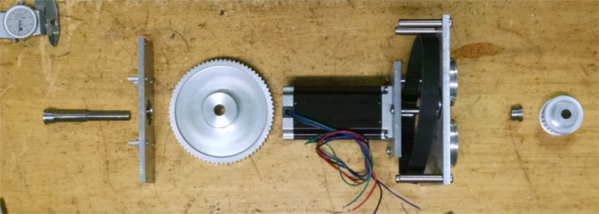
A plasma CNC machine isn’t that much different from a simple CNC router. [will]’s table controller is just a GRBL shield attached to an Arduino, the bearings were stolen from many copy machines, and your motors and drivers are fairly standard, barring the fact they’re excessively huge for a simple 3D printer.

The real trick up [will]’s sleeve is the controller interface. For this, he’s mounted a Raspberry Pi display, a big, shiny, red button, and all the associated electronics behind a beautifully rusty welded enclosure. This part of the build just sends gcode over to the GRBL shield, and is doing so reliably. Right now [will] is looking for some way to save, arrange, and queue jobs on the Pi, a problem that is almost – but not quite – the same job Octoprint does. A software for big, mean CNCs that spew exotic states of matter is an interesting project, and we can’t wait to see where [will] goes with this one.

Bachelor Builds Enormous Laser Cutter, Nobody Complains

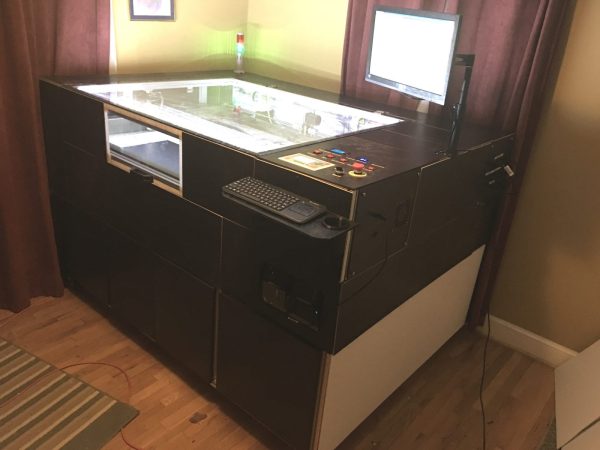
Nothing says swinging 21st-century bachelor pad better than a laser cutter. To really make a statement, you want a custom-built, 100 Watt, 1200mm x 900mm laser cutter.

The bachelor in question, [drandolph], rightly points out that a $6,000 build that takes up a significant fraction of the floor space in one’s apartment is better attempted without the benefit of spousal oversight. Still, what spouse couldn’t love the finished product? With a custom aluminum extrusion frame (which barely made the trip from China intact) it’s a sturdy affair, and who could deny the appeal of the soft glow of an LED-illuminated work chamber? A custom exhaust system with sound-deadening, a water chiller for laser cooling, an Arduino-controlled status beacon – there’s even a 3-D printed beer holder on the control panel! And think of all the goodies that will come off the enormous bed of this thing. Note to self: make sure wife sees this post.

There are cheaper and smaller laser cutters, but what’s the point if you have the freedom to go big?

[via r/DIY]