Raspberry Pi As A PIC Programmer

[Giorgio Vazzana] turned his Raspberry Pi into a PIC programmer using a rather small collection of common parts. It supports about a dozen different chips from the 16F family. But we’d guess that software is the limiting factor when it comes to supporting more chips.

Generally the problem with PIC programming is the need for a 12V supply. He chose to use an external 12V supply and a 78L05 linear regulator to derive the 5V rails from it. With the power worked out there are some level conversion issues to account for. The RPi provides 3.3V on the GPIO header pins, but 5V logic levels are needed for programming. He built transistor and voltage divider circuits to act as level converters. The programming software bit bangs the pins with a write time of less than eight seconds per 1k words of program data. So far this does not work with ICSP, but he plans to add that feature in a future version.

Turning [M. C. Escher] Prints Into Real Objects

September is coming, and soon college freshmen the world over will be decorating their dorm room walls with Dark Side of the Moon posters and [M.C. Escher] prints. Anyone can go out and simply buy a prism, but what if you wanted a real-life version of objects and buildings from [Escher]’s universe? Professor [Gershon Elber] at the Technion at the Israel Institute of Technology decided to turn [Escher]’s prints into reality.

First beginning with simple shapes such as a Penrose Triangle and a Necker Cube, [Elber] decided to branch out into much more impossible shapes such as [Escher]’s Waterfall, Belvedere, and Relativity. These buildings are extremely hard to visualize in any traditional computer design program, so [Elber] wrote a plugin for his IRIT computer modeling program to design the buildings before committing them to a 3D printer.

In the video after the break, you can see a few rotating views of the resulting [Escher] buildings. Of course they only work from exactly one point of view – and even then, only with one eye closed – but it’s amazing to see these famous architectural studies brought into the real world.

Continue reading “Turning [M. C. Escher] Prints Into Real Objects”

Femto-photography: Taking Pictures Of Bullets Made Of Light

Femto-photography is a term that derives its name from the metric scale’s prefix for one-quadrillionth. When combined with photography this division of time is small enough to see groups of light photons moving. The effect is jaw-dropping. The image seen above shows a ‘light bullet’ travelling through a water-filled soda bottle. It’s part of [Ramesh Raskar’s] TED talk on imaging at 1 trillion frames per second.

The video is something of a lie. We’re not seeing one singular event, but rather a myriad of photographs of discrete events that have been stitched together into a video. But that doesn’t diminish the spectacular ability of the camera to achieve such a minuscule exposure time. In fact, that ability combined with fancy code can do another really amazing thing. It can take a photograph around a corner. A laser pulses light bullets just like the image above, but the beam is bounced off of a surface and the camera captures what light ‘echos’ back. A computer can assemble this and build a representation of what is beyond the camera’s line of sight.

You’ll find the entire talk embedded after the break.

Continue reading “Femto-photography: Taking Pictures Of Bullets Made Of Light”

Prototyping With Very, Very Small ICs

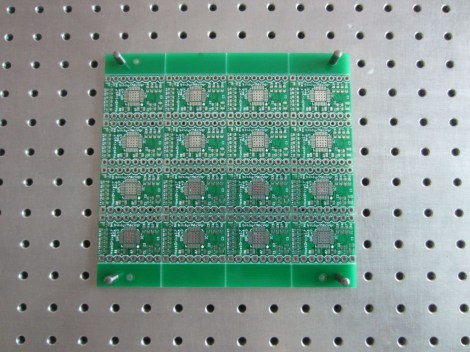
Gone are the days when all the cool chips are able to be thrown into a breadboard very easily. [starlino] was working with a circuit that uses an accelerometer, but unfortunately these chips come in hard to solder LGA-16 packages. [starlino] figured out a way to prototype with these packages that doesn’t require a custom breakout board or spending any time watching a reflow oven.

[starlino]’s LGA-16 adapter board began with a piece of perf board drilled out to form a space that perfectly fits his accelerometer. A piece of tape is placed over the pads of the chip and perf board, and the gap between the chip and board is filled in with a two-part plumbers putty.

Once the putty has cured, the leads on the acclerometer are connected to the pads on the board with a silver conductive pen. After putting a few header pins in the corners of the board, [starlino] soldered the pads to the pins and had a permanent breakout board for a very small accelerometer.

It’s not by any means a pretty build, but after [starlino] sealed the entire build in liquid electrical tape and installed it in a DIP socket, he had a completely functional accelerometer in an easy to prototype package. Not bad for a breakout board that can be built from stuff just lying around a workbench.

Toorcamp: The Lock Picking Village

The Open Organization Of Lockpickers (TOOOL) ran the lock picking village at Toorcamp. They gave great workshops on how lock picking works, provided a lot of examples of security flaws in popular locks, and let everyone practice with their locks and tools. Lock picking is a bit addictive, and I spent quite a bit of time at the village.

TOOOL is an international organization that aims to advance the general public knowledge about locks and lockpicking. If you’ve ever wanted to know more about locks, you can check out their list of chapters to see if there’s one in your area, or send them an email to see if there’s other lock picking enthusiasts near you. Their detailed slides that were used for the village are also available.

[Eric] from TOOOL worked on building a lock picking installation called the Labyrinth of Locks. The first prototype of this consists of locks enclosed in 3D printed enclosures, and lit by LEDs. The goal was to string them up in the woods and challenge people to find and pick the locks. MakerBot Industries printed the orange and flower shaped enclosures that the LEDs and locks were mounted into.

This is a first prototype, and [Eric] plans to expand on the idea and use it at other lock picking events he attends. It’s a neat way to mix lock picking and an art installation into an interactive activity.

We’re Getting An Oculus Rift Dev Kit

Before you get jealous of the massive amount of sway that hackaday must’ve tossed at these guys to get a dev kit, don’t be. We just funded the kickstarter like everyone else. This is exciting news though since, as you probably know, I’m very fond of immersive gaming and have always craved a strong VR rig.

We are expecting our dev kit some time in December. I have no idea exactly what we’ll do with it. Right now [John Carmak] has made the iD engine work with it and it ships with Doom3. They’ve stated that it will work with the Unreal engine as well. Even though I saw [Gabe Newell] from valve in the video, I don’t see any source engine compatibility in the list. I really would love to see that one added, especially since Valve released the source film maker for free.

So, who has ideas about what to do with this? I’d like to build a telepresence rig with stereo vision, possibly mounted on a radio controlled car chassis.

An In Depth Interview With [Jeri Ellsworth] About Everything

Here’s an interesting interview with [Jeri Ellsworth] over at the Jenessee Network. Usually the interviews I see popup with people are fairly short and sweet but this one really delves into many subjects and takes its time to explore. They start off talking about how [Jeri] began with hacking, which was literally smashing toys “with rocks” to see what was inside. They move on to discuss her adventures in building a race car, and then racing it as a teen… as an act of defiance.

In case you didn’t know, [Jeri] has been full time at Valve for about a year. Much of the discussion focuses on this from about 20 minutes in. She doesn’t hold back on information about what her daily life is like at valve as well as her experience during the hiring process. An interesting fact is that she didn’t initially recognize the name “Valve” and ignored them for a while. She does admit that if they had mentioned portal she would have paid a little more attention.

I was unaware that she had a side job putting the overflow of pinball machines she aquires into bars. When she moved to valve, she shut down that business, but she’s been flooding the halls with pinball machines, much to the enjoyment of the older folks.