Coating Technique Makes Glass You Can’t See

Some of the deep thinkers over at MIT have come up with an interesting hack for ordinary glass. If you coat it in a special way it becomes nearly invisible. This is only one of the effects of the coating, but brings images of people walking through glass walls to our minds.

Joking aside, this is really very useful. The images above show a microscopic view of the cones that are applied during the coating process. They prevent the surface tension on a drop of water from being broken, and you can see the clip of water actually bouncing right off the glass in the video after the break. This also means it acts as a non-stick coating for dirt, grime, and even fog. Anyone who’s taken a tropical vacation will know that taking a picture outside with a camera that’s been in an air-conditioned room results only in a snapshot of a foggy lens. This coating could change that. But it’s also got a lot of potential with the glass panes covering solar cells. If they can’t get dirty, and there’s virtually no glare, you should see a performance boost. It’ll be interesting to see how long this takes to come to market and what the first products to use it might be.

Continue reading “Coating Technique Makes Glass You Can’t See” →

Giant Space Invaders With Road Barriers And No Moving Parts

This is space invaders on the large-scale. To give you an idea of just how big this is, that’s a street lamp to the left. It’s being played on the side of a building, but it’s not really done the easy way. We’ve seen gaming on the sides of buildings by using projectors, but this one is more like a classic LCD handheld game… just really really big.

Each of the game pieces is hung in place on a black backdrop. The invaders themselves are molded-plastic road construction barricades. The shield area on the bottom is made op of center-lane dividers. All of the pieces are wired with lights that can be addressed by a central controller. As you can see after the break, just one button gets the action under way.

This is along the same line as the Christmas Light game we saw several years back. If you’ve got some extra strings of lights and don’t mind building a controller we think you should add a little fun to the neighborhood with your own giant installation. Just don’t forget to send in some pictures.

Continue reading “Giant Space Invaders With Road Barriers And No Moving Parts” →

Zen Rock Garden Table Uses Magnets And Sand

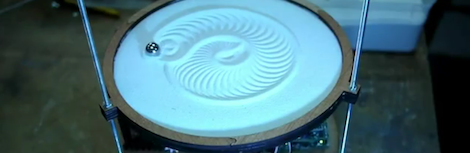
[Nick] is working on a prototype of a coffee table sand plotter that draws patterns in sand a lot like a zen rock garden.

[Nick]’s zen rock garden uses a magnet to draw a ball bearing across the sand in interesting patterns. The build uses 3D printed gears and laser cut parts to rotate the table around and move the magnet along a radius of the circle. During the first test of the prototype, the ball bearing jerked around but this problem was solved by adding a piece of foam under the sand. Power is supplied through a slip ring in the base, and the table is controlled through Bluetooth.

Speaking of magnet-and-ball-bearing zen coffee tables, we ran across this video of a more professional-looking prototype that was the basis for a successful Kickstarter campaign. Like [Nick]’s prototype, the entire build relies on magnets and a ball bearing to move sand around in patterns. Because this zen table uses an XY axis instead of [Nick]’s polar setup, drawing logos is a lot easier math-wise, lthough it doesn’t look quite as cool as a circular rock garden.

After the break you can see these zen rock garden coffee tables in action.

Continue reading “Zen Rock Garden Table Uses Magnets And Sand” →

[David] Hand Soldered A Blinky Ball… And You Can Too!

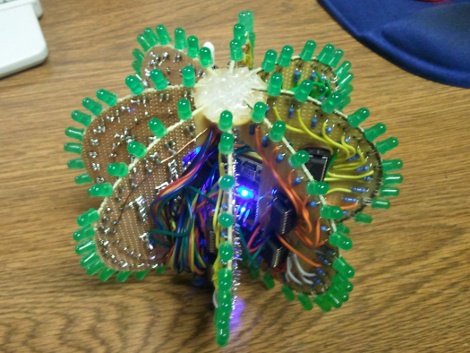
This is a blinky ball that [David] designed, built, and programmed himself. Does it look familiar? It should, he took his inspiration from the original prototype, and the Hackerspace-produced derivative. [David’s] version is not as small, or as blinky, but in our minds the development process is the real reason for building something like this. He took a great idea and figured out how he could pull it off while pushing his skill set, staying within his time and budget constraints.

The project is powered by an Arduino nano which resides in the core of the ball. [David] used protoboard sourced locally for each of the slices, soldering green LEDs along the curved edges, and added shift registers to drive them. The ball is driven by a LiPo battery which can power it for about 45 minutes. You can see the animation designs he coded in the clip after the break.

Continue reading “[David] Hand Soldered A Blinky Ball… And You Can Too!” →

3D Whiteboard Without The Whiteboard

This one is so simple, and works so well, we’d call it a hoax if April 1st hadn’t already passed us by. But we’re confident that what [William Myers] and [Guo Jie Chin] came up with exists, and we want one of our own. The project is a method of drawing in 3 dimensions using ultrasonic sensors.

They call it 3D Paint, and that’s fitting since the software interface is much like the original MS Paint. It can show you the movements of the stylus in three axes, but it can also assemble an anaglyph — the kind of 3D that uses those red and blue filter glasses — so that the artists can see the 3D rendering as it is being drawn.

The hardware depends on a trio of sensors and a stylus that are all controlled by an ATmega644. That’s it for hardware (to be fair, there are a few trivial amplifier circuits too), making this an incredibly affordable setup. The real work, and the reason the input is so smooth and accurate, comes in the MATLAB code which does the trilateration. If you like to get elbow deep in the math the article linked above has plenty to interest you. If you’re more of a visual learner just skip down after the break for the demo video.

Continue reading “3D Whiteboard Without The Whiteboard” →

Modeling An Object With Internal IMUs

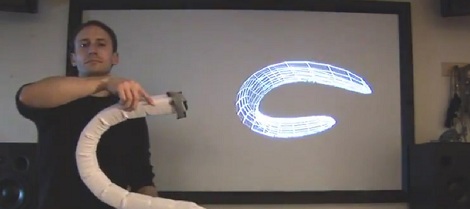
[Joseph Malloch] sent in a really cool video of him modeling a piece of foam twisting and turning in 3D space.

To translate the twists, bends, and turns of his piece of foam, [Joseph] used several inertial measurement units (IMUs) to track the shape of a deformable object. These IMUs consist of a 3-axis accelerometer, 3-axis gyroscope, and a 3-axis magnetometer to track their movement in 3D space. When these IMUs are placed along a deformable object, the data can be downloaded from a computer and the object can be reconstructed in virtual space.

This project comes from the fruitful minds at the Input Devices and Music Interaction Lab at McGill University in Montreal. While we’re not quite sure how modeled deformable objects could be used in a user interface, what use is a newborn baby? If you’ve got an idea of what this could be used for, drop a note in the comments. Maybe the Power Glove needs an update – an IMU-enabled jumpsuit that would put the Kinect to shame.

Continue reading “Modeling An Object With Internal IMUs” →

Micro Star Wars Arcade Game Is A Work Of Art

No, it’s not just another MAME cabinet build. [Le Chuck] over on the arcadecontrols.com forum built a fully functioning 1/6 scale replica of the classic 1983 Atari arcade game Star Wars.

The hardware is a CAANOO Linux-based portable media player running an emulation of the classing 1983 Star Wars video game. When [Le Chuck] turns his cabinet on, MAME4All boots up and goes directly into the game.

Because there are no 1/6 scale arcade parts, [Le Chuck] needed to fabricate most of his build from scratch. The case is basswood, along with the very-accurate light up coin slot doors. The joystick for the game was a bit tricky; the Star Wars game used an X Z joystick modeled after the yoke in the cockpit of an X-wing. To build this joysitck, [Le Chuck] took apart a few pots and crafted the joystick out of thin sheet metal. The controls operate exactly like the original, only in 1/6 scale.

After the break you can see the video of this incredible build in action.

Continue reading “Micro Star Wars Arcade Game Is A Work Of Art” →