USB And PS/2 Key Loggers And Mess With Your Grammar

[Irongeek] is up to his old tricks once again with this new key logger prototype. It’s in the early stages, as attested by the breadboard built circuit, but [Adrian] still gives us a demo video after the break showing where he’s at right now. It comes in two flavors, the USB pass through seen above, or another that still connects to the computer via USB but functions with a PS/2 keyboard.

Aside from the obvious issue of a key logger stealing everything you type, there’s some prank value in this device too. The Teensy has more than enough processing power to watch what you typing and make changes as it goes. He shows off blatant rewrites, like changing “has” to “haz” or “you” to “U”. We think it would be better to change things like “they’re” to “their” or “it’s” to “its”. These would be very difficult to see happening and if you added randomness to how often the replacements occur, your victim would sooner come to the conclusion that they’re going crazy than that they’re the target of a little hazing. In fact, that’s probably the reason for our own grammar errors though the years; blast!

Continue reading “USB And PS/2 Key Loggers And Mess With Your Grammar”

Cheap OLED Display For Your TI Launchpad

The guys over at the 43oh forums have been working on an OLED display booster pack for the TI Launchpad. The booster pack is now available in the 43oh store and is pretty cheap to boot.

The TI Launchpad is an awesome little dev board with a ravenous fan base. We’ve seen a lot of projects on Hack a Day use a Launchpad – everything from intervalometers to chicken coops. Unfortunately, the MSP430 doesn’t have the market penetration of the ‘board that shall remained unnamed,’ so it’s not very common to see a new Launchpad “shield.”

[bluehash] on the 43oh forums has been hard at work for the past month to put together his OLED booster pack. The display is 128×64 pixels with an incredible amount of brightness that we would expect from an OLED display. The software for the display is based on the SSD1306 driver with two font packs – Courier New large and small. Not a bad little piece of kit for an under appreciated dev board.

ChipKIT Temperature Shield Supports A Dozen Sensors

chipkit_temp_board

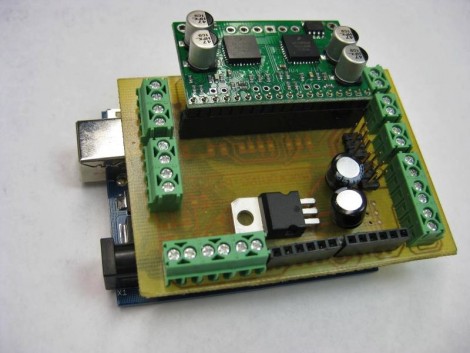
[Will] wrote in to share a useful add-on he designed for the ChipKIT UNO 32, a 12-port temperature sensor board.

Constructed for one of his customers, the shield accepts any 2-wire 10k thermistor sensors, outputting the readings to a small LCD screen. The screen is supported by some code put together by his associate [crenn], but you are not limited to solely displaying the temperatures there. Since this module piggybacks on top of the ChipKIT the same fashion as any standard shield, you clearly have the ability to use and manipulate the data at will. With 12 ports on board this would work well for a house-wide temperature monitoring system, or perhaps in a complex brewing setup.

Both the temperature shield and LCD boards have been released under the Open Source Hardware License, so you can easily build your own if you have the means, though [Will] has a few extras he’s willing to sell if you need one quickly.

Occupy Rigs Up Human-power After Generators Are Confiscated

Looks like New York’s fire brigade confiscated all of the gas (or bio-diesel) generators from Occupy Wall Street protesters in Zuccotti Park. Apparently the Fire Chief cites the generators as a fire hazard. This seems a dubious claim. One of the shots in the video after the break clearly shows fire extinguishers close at hand, but we’re no experts on fire code. We’d bet the concern is having combustibles around if the scene turns violent… or just wanting to pressure the group with the loss of a heat source.

Instead of going without, the movement received help from a neighboring protest group in Boston. Bicycle power replaces the missing generators as volunteers pedal to produce electricity. Students from MIT plied their skills to help design multiple charging stations that can be used by the community. It won’t be enough to provide heat for the ongoing occupiers, but it does let them charge their electronic devices which helps ensure that current information is still flowing out of this epicenter of activity.

Does anyone have any ideas for hacking up a heat source that won’t ruffle the feathers of local officials? If so, leave a comment. And if you’ve already got a post written up on the topic don’t be afraid to send in a tip about it. Continue reading “Occupy Rigs Up Human-power After Generators Are Confiscated”

Here’s Your Flying Car

We’ve seen quadrocopters galore over the past few years. We’ve never seen one big enough to lift a person until now.

[Thomas], [Stephan], and [Alexander] of e-volo have been working on a gigantic, human-lifting multicopter for a few years now. A few days ago, their prototype took to the air carrying a fully human pilot. There aren’t a whole lot of details on their build, but from what we can tell the flight was powered entirely by batteries.

The test vehicle looks to be a study in minimalism. The landing gear looks to be a repurposed yoga ball, and the chassis is just four pieces of aluminum tube welded into a cross. The the power plant for the prototype is four brushless motors in each quadrant of the vehicle. That’s right – there are 16 motors spinning around the pilot.

This isn’t the first time we’ve seen a build based on Doctor Robotniks designs. Earlier this year, some guy in China built a very nice deathtrap an octocopter. The e-volo team definitely has the leg up in safety considerations – they have actual design and engineering studies

The good news is the e-volo team wants to improve their prototype and sell it to the masses. The bad news for Americans is the FAA hasn’t taken too kindly to electric flying machines. The team is working on a hybrid drive version, and as long as the weight is kept down, we can always get an ultralight cert.

Check out the video of some 16-blade hovering action after the break.

[youtube=http://www.youtube.com/watch?&v=L75ESD9PBOw&w=470]

Urine Territory Marking, Now For Humans!

Although Dogs and other animals love to mark their territory with urine, this technique has been generally ignored by human beings. Despair no more, fellow homo sapiens, we have now developed the ability to check-in on foursquare through your information stream. This device is descriptively called “Mark your Territory.”

Although this is not currently available to buy in stores (although apparently $10,000 will get you one built), [Instructables] user [blorgggggg] has furnished directions on building your own. The system is powered by an Arduino and an Android phone. The urine tags have both a pointed end for sticking in grass and the like, and a sticky back to be used in a “more urban settings.”

The video after the break gives quite a bit of background trying to justify such a system in terms of communicating in the physical world, animals, et cetera, but it’s doubtful that this excuse will get you out of a public urination charge.  You’ve been warned.

[youtube http://www.youtube.com/watch?v=rRdfeb7vDWg&w=470&h=315%5D

Annoy Your Sound Guy Even More

“I can’t hear myself in the mix,” “yeah, man, I’ll be there at 8,” and “dude, we need like four more mics.” Each and every one of these words is documented in actuarial tables and doesn’t bode well for your sound tech’s risk of a stroke. Luckily, there’s an even better way to kill your sound guy and this time, it’s actually pretty clever.

[@dop3j0e] at the Stuttgart hackerspace Shackspace came up with the Noiseplug. It’s a very small build that could almost fit into a quarter-inch jack. It’s all SMD with a tiny (unknown) ATtiny9 microcontroller powered by a watch battery.

The music coming out of the Noiseplug is really interesting. All the code on the microcontroller is a one-liner written in C. Similar ‘algorithmic chiptune’ programs can be run on any PC: check out these three examples.

These potential entries to the International Obfuscated C Code Contest throw chars into an 8-bit PCM stream. Piping the output of these programs to /dev/audio would generate an actual song – written entirely in one line of C.

Of course, [@dop3j0e] could have made his Noiseplug a little less annoying, but sound techs are underappreciated for a reason, right?

Check out the Noiseplug in action after the break along with a few one-liner C songs.

Continue reading “Annoy Your Sound Guy Even More”