IOIO Upgrades Get A Bit Easier

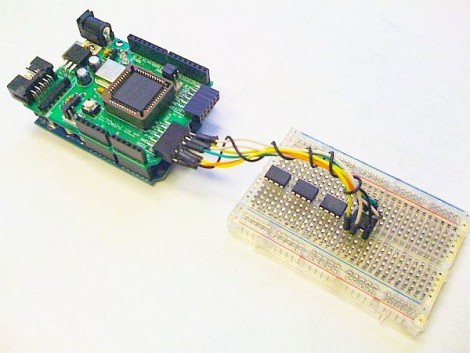
The IOIO, a breakout board for Android phones that predates the Android Developer Kit hardware, is a now a little bit easier to upgrade. That’s because [Ytai’s] IOIO manager app just his the Android market. The PIC24F that sits proudly on top of the board has always been running a bootloader, but for security reasons it is programmed to only talk to apps that have been officially signed. Now that there’s an app that meets this qualification, you can upgrade the firmware from your phone without the need for an external programmer.

What about the bootloader itself? Surely that will need upgrades over time, right? Well, yes. [Ytai’s] announcement today also came with an option for upgrading the bootloader but with one caveat. You’ll need two IOIO boards to complete the upgrade. One connects to the phone and becomes a programmer, while the other lays back and waits for a refreshing code flash.

Omniwheel Robot

Like all of us, [Jonathan Guberman] has a list of projects and builds that ‘will get done when I have time.’ His Kiwi drive robot is no exception. It’s intended to be one piece of a much larger project, but he decided to document it anyway (we think in the hope of getting is rear in gear).

The robot uses a holonomic drive to get around. A holonomic drive uses three fixed wheels placed 120 degrees apart. The wheels can be independently controlled and with some vector addition the robot can move in any direction and rotate 360º inside its own wheelbase. Of course the wheels will have to be able to roll in two dimensions, so an omniwheel is used. Everything is controlled with a Wiimote nunchuck, and the movement is very smooth.

[Jonathan] has had a few projects featured on Hack A Day before, like his Mechanical Pac-Man and his adorable Portal turret plushie. [Jonathan] really demonstrates his artistry and skill in his project, so we’re really wondering what his ‘larger project’ actually is. Take a guess in the comments section, that might get [Jonathan]’s rear in gear.

Check out the video of the omnidirectional robot after the break.

Continue reading “Omniwheel Robot”

Replacing Non-standard USB Charging Ports

htc_charging_port_replacement

While many mobile phone manufacturers are moving towards the micro-USB interface as a standard, others such as Apple and HTC are still bucking the trend. Part of [arto’s] job includes repairing mobile phones, and last month he found himself faced with a pair of broken HTC handsets that needed their charging ports replaced.

Replacements for HTC’s proprietary connectors are apparently quite hard to find, and [arto] says he had to source them from an HTC repair center. With the proper parts in hand, he could finally get down to work.

The HTC Hermes handset he repaired was a breeze, as it had plenty of space available around the charging port. He said that this allowed him to replace the jack pretty easily, but the HTC Touch Dual was a mess in comparison. He started by removing the old adapter, which was done by cutting it out bit by bit. He says that he did it this way rather than desoldering, due to its proximity to other heat-sensitive components. After some careful soldering under a microscope, everything was back in working order.

While his repairs are not necessarily the things that hacks are made of, the information is still quite helpful. Broken charging ports are extremely common among smart phones, and with plenty of these older models still floating around, his pointers just might help someone save a few bucks on a replacement phone.

Color Changing EL Wire

All EL wire drivers use a resonator circuit to supply power to the EL wire. It’s an efficient system, but [Paul] noticed that there was some color change when powering different lengths of wire off of the same driver. He realized that this is because of the changing frequency of the resonator circuit, so the only reasonable thing for [Paul] to do was to build a color fading EL wire driver.

The circuit used to drive the wire is very simple. [Paul] used a Teensy board to switch two transistors and produce AC current. This is sent through a step-up transformer which powers the EL wire. It was necessary to use aqua or ‘Tron blue’ EL wire for this build because of the clear wire jacket. Many colors of EL wire have a fluorescent jacket – much like a fluorescent light bulb – that changes the color produced inside the wire to something different. [Paul] says the color change is subtle, but unique.

Of course the build is nothing without a video of the color changing EL wire. Check it out after the break.

Continue reading “Color Changing EL Wire”

DIY Wiper Speed Control And Collision Avoidance

ir_sensor_rain_detection

On many new cars, automatic wiper speed control can be had as an upgrade, though most cars do not offer front-end collision prevention at all. [Rishi Hora] and [Diwakar Labh], students at the Guru Tegh Bahadur Institute of Technology in New Delhi, developed their own version of these features, (PDF warning, skip to page 20) which they entered into last year’s Texas Instruments Analog Design Contest. Under the guidance of professors [Gurmeet Singh] and [Pawan Kumar], the pair built the systems using easily obtainable parts, including of course, an MSP430 microcontroller from TI.

The collision prevention system uses a laser emitter and an optical detector to estimate the distance between your car and the vehicle in front of you, sounding an alarm if you are getting too close. In a somewhat similar fashion, the wiper speed control system uses an IR emitter and detector pair to estimate the amount of water built up on the windshield, triggering the wipers when necessary.

While not groundbreaking, the systems would be quite handy during monsoon season in India, and seem easy enough to install in an older vehicle. The only thing we’re not so sure about is pointing lasers at cars in traffic, but there are quite a few available alternatives that can be used to measure distance.

Continue reading to see a video walkthrough and demonstration of both systems.

Continue reading “DIY Wiper Speed Control And Collision Avoidance”

Building A Solar Power Heliostat

[Frits] has been working on an solar panel heliostat (in Dutch, check out the translated page here).

The heliostat uses a small PICAXE to control the motor, along with an DS1307 real-time clock to make sure the motors start at dawn. Instead of using optical encoders or magnetic sensors, the angle of the heliostat is measure with a pot attached to the drive shaft. [Frits] did a lot of data collection to figure out that this method is accurate to about 1 degree – just fine for something that doesn’t need to be exact.

According to [Frits] this heliostat will put out 12 to 50 percent more electricity than a fixed panel. Although the build does seem a little bulky, putting it on a  house with a roof pitch of 23.5° would greatly reduce the horizontal profile.

A video of a solar panel rotating at 15 degrees/hour isn’t that interesting, so [Frits] posted a clip of 6 mirrors slewing around fairly fast to demonstrate his system. Check it out after the break.

Continue reading “Building A Solar Power Heliostat”

Automotive Battery Voltage Monitor

car_battery_voltage_monitor

[Rajendra’s] car had just about all the bells, whistles, and gauges he could dream of, but he thought it was missing one important item. In an age where cars are heavily reliant on intricate electrical systems, he felt that he should have some way of monitoring the car’s battery and charging system.

To keep tabs on his car’s electrical system, he built a simple device that allows him to monitor the battery’s instantaneous voltage when the car is powered off, as well as the charging voltage across the battery when the car is running. A PIC16F1827 runs the show, using a simple voltage divider network to step the input voltage down to an acceptable level for use with the PIC’s A/D conversion channel. The resultant measurements are output to a four digit 7 segment display, mounted on the front of the device.

He says that the voltage monitor works quite well, and we’re sure he feels a lot better about the health of his car’s charging system. For anyone interested in keeping closer tabs on their car, he has a circuit diagram as well as code available on his site.