Large Remote-controlled Game Of Life Display

game_of_life

Sometimes it’s just plain fun to over-engineer. [Stephanie] gets a warm fuzzy feeling when she successfully adds way more electronics components to a project than she really needs – just because she can. We can’t really argue with her if that is the intended goal, nor can we find fault with the sweet Game of Life display she put together.

She started off with six Game of Life kits from Adafruit, but she quickly caught the LED bug and her collection grew until she had 20 kits (that’s 320 LEDs for those of you keeping count). After piecing them all together, they were mounted in a wooden frame and placed behind a dark piece of acrylic. It looked great and worked just fine, but it wasn’t overdone enough for her tastes.

In the end, she added a small Arduino and Xbee module to the Game of Life display, which enables it to be controlled by her network-enabled thermostat we featured a few weeks back. The thermostat was fitted with an Xbee unit as well, which allows it to turn the Game of Life on and off at whatever times [Stephanie] specifies.

We’ll take two please.

[via Adafruit Blog]
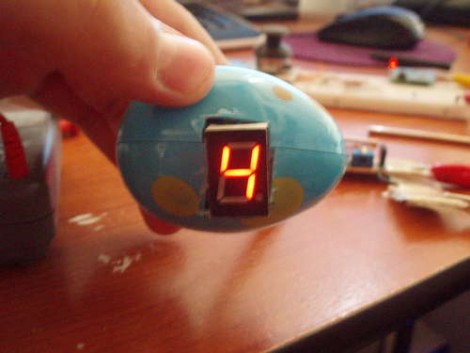
Egg Clock (it’s Egg-ceptional)

Easter is over and with some plastic eggs still on hand, [Franspaco] was looking for something to do with them. He decided to use an egg as an enclosure for a digital clock.

You can see that the finished project uses just one 7 segment LED display to show the time. A scrolling number method is used to delineate each digit of the 24-hour time readout. The display will go blank, followed by two numbers for the hours, a dash as a separator, and finally two more digits for the minutes. A PICAXE microcontroller drives the clock, but for accuracy a DS1307 does the timekeeping.

[Franspaco] etched his own circuit board that is sized to fit perfectly, housing the two chips, an LED, and a programming header. The on-board LED blinks at 1 Hz, giving some inner glow to the plastic shell. He accomplished most of his goals, but was unable to fit the batteries inside of one egg, prompting the need for a tethered power-egg. If he moves to surface mount components for the next generation of this device we think he’ll have no problem fitting a small battery (like an A23) inside.

Old Computer Parts Demonstrate How Particle Accelerators Work

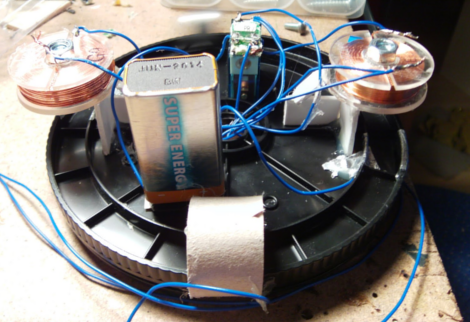
[Ameres Valentin] writes in to let us know about his DIY particle accelerator model. The model, made mostly out of old computer stuff, mimics a linear high-energy particle accelerator which use drift tubes to toss particles around. Drift tubes work by first attracting a particle (in this case, ball bearing) until it crosses a charged plate (in this case, coil), then flipping the charge polarity and repelling the particle.  In this case the accelerators function more like a multiple coil gun, as they can’t exactly push the bearing away. Regardless of the specifics the model is an excellent visual aid.

As the bearing rolls along the rails of the CD spindle it shorts bits of foil tape placed just ahead of the magnets. This (appears) to flip a relay that switches on the magnet. Once the magnet coil is energized it pulls the bearing towards its center, accelerating it. The foil stops just before the point where the magnet would pull back the bearing. We are not sure if [Ameres] is using any trickery to get the magnets to individually power, as schematics are not available. The circuit should be simple enough to figure out with a couple relays. In the video [Ameres] adds a lamp to the coils to display when they are powered. Nice work! This could make a fun distraction desk accessory, better than those clicky Newton’s cradles.

Check out [Ameres]’ site for a video of the model in action.

Adding Remote Touch Control To The Kaoss Pad

touchosc_kaoss

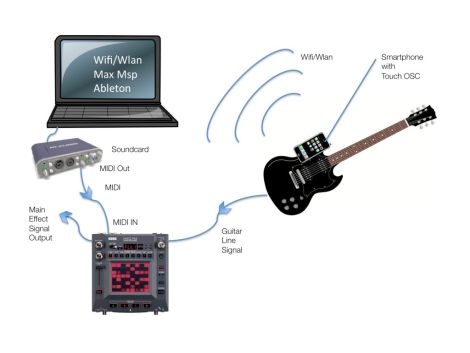
[Munki] enjoys using his Kaoss Pad MIDI controller to add a new dimension to his music while playing guitar. The only thing that bothers him about the Kaoss Pad interface is that it can be difficult to trigger or alter effects in the middle of a bitchin’ guitar solo. He started looking around to see if there was a way to control the Kaoss Pad wirelessly via a touchscreen and found that with a little tweaking, his iPhone was a perfect candidate for the job.

He grabbed a copy of TouchOSC from the AppStore and configured it to communicate with his computer. After building an interface for his iPhone, he taped it to his guitar and gave it a try. Everything seemed to work pretty well, but he didn’t stop there – he also wanted to control Ableton Live and Max MSP from his iPhone. It took a bit of research and some tinkering with the Live API, but he eventually got everything working together nicely as you can see in the video below.

If you are interested in trying this out yourself, he has several useful links throughout his article, and he has made his TouchOSC/Max MSP patch available for download as well.

Continue reading “Adding Remote Touch Control To The Kaoss Pad”

Quick Hack Disables IPod Dock Auto-standby

ipod_dock_hacking

[Aaron] wrote in to share with us a quick hack that has made his life a little easier. He bought a Rocketfish RF-HV3 portable iPod dock to listen to his music, but he wanted to utilize it as an alarm clock as well. He also found that the speakers worked quite well when he hooked up his Yaesu handheld transmitter to the dock.

The only problem he had with it was that the dock would automatically power down when there was no input for 5 minutes. That’s fine when the dock is running on batteries, but if [Aaron] was going to use it as an alarm clock or to listen to his HAM radio, that simply wouldn’t do.

He pulled the dock apart and started poking around with his DSO Nano scope. He found that if pin 16 stays low for 5 minutes, it turns off the dock even if there is a signal coming through. His fix for the problem was actually quite simple – all he did was solder the VDD pin to the pin in question, and the 5-minute timeout was disabled.

We’re glad that [Aaron] was able to solve his problem in such an easy manner – it just goes to show what you can do with a scope and a few minutes’ time.

Thrift Store Hard Drive Enclosure

[Ken] visited our site looking for case modding stuff a little while back, but more importantly he came back to show off his latest project. Using a jewelry box found at our favorite place, the thrift store, he converted it into a 2.5 inch USB drive enclosure.

Almost instantly he found that this particular jewelry box is a perfect fit for a 2.5 inch SATA laptop drive. Taking that as a sign he whipped up some acrylic mounts and cut some holes for power and USB . The electronics are provided by another enclosure with a dead drive, again acrylic is used to insulate the drive from the decorative metal box and some rubber washers were used to help cancel out vibrations and noise.

The end result is a classy looking 150gig usb drive that looks nice on the desk, and a little reminder that if your not hitting up your local thrift / second hand stores, you could be missing out on some real gems.

Scout, The Autonomous Transatlantic Boat

autonomous_boat

Sailing a small boat across the Atlantic ocean is quite the daunting task. As many have discovered, it is a journey often fraught with perils, typically ending in failure. A team of four college students decided the best way to get a small boat across the ocean would be to remove the human element from the process, so they set off to build an autonomous craft to take on the task.

Like most projects, this one started as a handful of wild ideas exchanged between friends [Dylan Rodriguez and Max Kramers]. As they thought about it more, they decided that turning [Max’s] sailboat into an autonomous ocean-going craft would be pretty awesome, so they got to work. Recruiting help from their friends [Brendan Prior and Ricky Lyman], the project started to quickly take shape, and Scout was born.

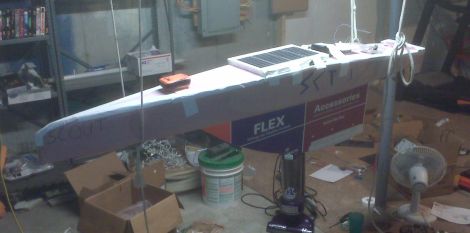
Scout is 8 feet long and consists of foam core covered in carbon fiber. It is filled with various electronic components such as a SPOT tracker, a battery bank that will power the boat for up to 25 hours, and the various servos and motors which will be used to pilot the craft.

It’s a rather ambitious project, though the boat is nearly complete – just in time for their launch, slated for May 29th. We’ll certainly be keeping an eye on this project as the launch date approaches – good luck guys!

Head on over to their Kickstarter page to see a promo video introducing Scout.

Continue reading “Scout, The Autonomous Transatlantic Boat”