Reworking Ball Grid Array Circuit Board Components At Home

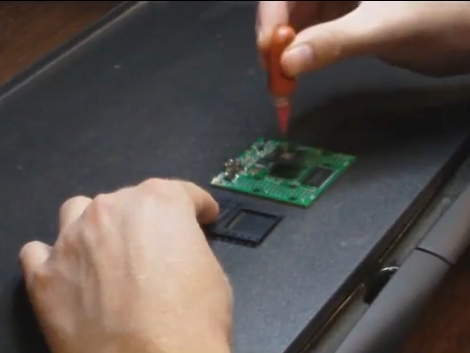
[Jack Gassett] is developing a new breakout board for an FPGA. The chip comes in a ball grid array (BGA) package which is notoriously difficult to solder reliably. Since he’s still in development, the test boards are being assembled in his basement. Of the first lot of four boards, only one is functional. So he’s setting out to rework the bad boards and we came along for the ride.

To reflow the surface mount components he picked up a cheap pancake griddle. The first thing [Jack] does is to heat up the board for about two minutes, then pluck off the FPGA and the FTDI chips using a vacuum tweezers. Next, the board gets a good cleaning with the help of a flux pen, some solder wick, and a regular soldering iron. Once clean, he hits the pads with solder paste from a syringe and begins the soldering process. BGA packages and the solder paste itself usually have manufacturer recommended time and temperature guidelines. [Jack] is following these profiles using the griddle’s temperature controller knob and the timer on an Android phone. In the video after the break you can see that he adjusts the timing based on gut reaction to what is going on with the solder. After cleaning up some solder bridges on the FTDI chip he tested it again and it works!

Continue reading “Reworking Ball Grid Array Circuit Board Components At Home” →
Converting A Roomba Into A Mars Rover

When we first heard of [Dino]’s all-terrain Roomba, we hoped the ‘stair-climbing Roomba’ problem had finally been solved, but the final build turned out much cooler.

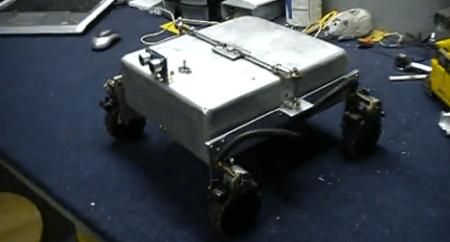
A year ago, [Dino] built a small robot based on a rocker-bogie suspension. This suspension system has been used on every Mars rover, including the huge Mars Science Labratory scheduled to land on Mars next year. [Dino] beefed up the suspension from the previous version and changed the wheels and center of gravity. Now, the little Roomba rover seems quite capable of climbing over objects as tall as itself.

The control of the rover is similar to other Roomba hacks we’ve seen – just tapping a few transistors. [Dino] is using a Seeduino and an ultrasonic sensor to avoid collisions. [Dino] says that he’s thinking about pivoting each wheel independently to get around the skid-steering, but maybe an omnidirectional wheel would be better suited.

Check out the video after the break for a demo of the Roomba rover traversing the treacherous boulder strewn terrain in [Dino]’s garage.

Continue reading “Converting A Roomba Into A Mars Rover” →

Spokes? We Don’t Need No Stinking Spokes!

The Air Kraken is a bicycle for demon spawn. Well, that’s what it reminds us of anyway. [Gabriel Cain] took his inspiration from burning man and also had several reasons for building it, but the one that we just love to hear is ‘because I can’.

The over-grown tricycle built for two is more than just some bicycle frames welded together. [Gabriel] built the wheel set himself using some very interesting methods. We believe the hubs themselves are actually automobile rims drilled to accept eye bolts. Instead of rigid spokes, a network of steel cable keeps the rims, made from plastic culvert pipe, centered. For grip, mountain bike tires were cut into pieces and screwed onto the pipe parts. The whole shebang is steered using a ship’s wheel (not pictured above) to turn the small wheel located behind the two riders.

After the break we’ve embedded a video of the vehicle in motion. It is the second of three videos that have been posted so far, with the other two walking through how [Gabriel] solved the design challenges facing him during the build.

[Gabriel] sent us a link after seeing the quadbike post on Monday. Don’t keep your projects to yourself, make sure to send us a tip and we’ll make sure to keep posting about them.

Continue reading “Spokes? We Don’t Need No Stinking Spokes!” →

Photo Hardware That Automatically Produces Rotating GIFs

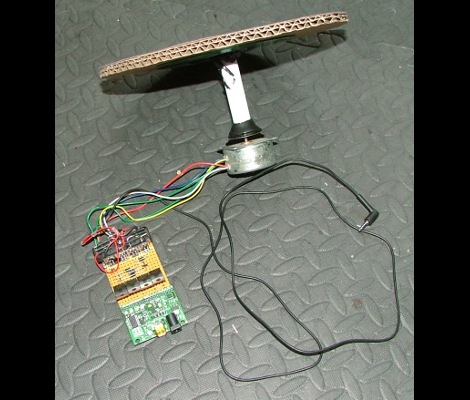
[Fergus Kendall’s] company is making development and breakout boards targeting electronic hobbyists. As with any endeavor that involves selling something, they need marketing. It sounds like [Fergus] was put in charge of getting some nice animated 360 degree images of each component. Instead of going through the drudgery of snapping frames by hand in a stop-motion-style, he whipped up a rotating platform that does the work for him.

The brain of the operation is a Boobie Board, a microcontroller breakout board that is one of their products. It controls a stepper motor attached to the cardboard platform via a quartet of power transistors. [Fergus] mentions in passing that their digital camera didn’t have a connection for a shutter trigger attachment. But they modded it to make things work. There’s no detail on that part of the hack but we’d wager that they soldered a transistor to the contacts for the shutter button.

The stepper motor has 48 steps, so the hardware is programmed to take 48 pictures which become the frames of an animated GIF – embedded after the break – to show off the product.

Continue reading “Photo Hardware That Automatically Produces Rotating GIFs” →

Twitter Notifier Lets Us Know How Awesome We Are

twitter_notifier

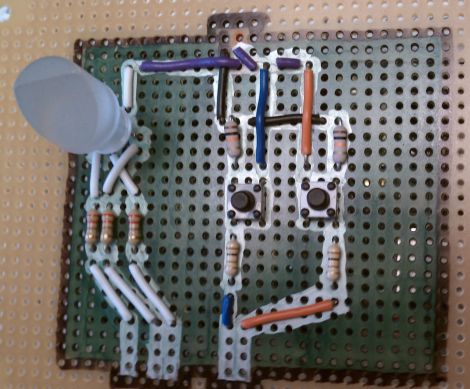
Let’s admit it, you’re just a little bit vain. Heck, we’re all just a little bit vain when you really think about it. Instructables user [pdxnat] was self-absorbed enough that he constructed an LED “mood light” that alerts him each time someone mentions his user name on Twitter.

The build is pretty simple, with most of the work being done on his PC. His Arduino is wired to a simple RGB LED that calmly cycles through various colors until someone mentions his name on Twitter. At that point, the client software running on his PC passes a message to the Arduino over a serial interface, causing it to wildly pulse the LED. Once it catches his eye, he stops the alert cycle with the press of the reset button, returning the LED to its previous state. As a bonus, he decided to write the Twitter-polling application in both Processing and Python, enabling fans of either language to easily replicate his work.

It’s a pretty cool idea, and it would be great to see someone expand it to include other online services to provide a greater overall feel for how awesome they really are.

Keep reading to see a quick video of the notifier in action.

Continue reading “Twitter Notifier Lets Us Know How Awesome We Are” →

Making Airsoft Guns Far More Potent

airsoft_laser_rifle

[Drake] wrote in to share his recent project, which involves repurposing an Airsoft rifle that was sitting around, collecting dust. Airsoft guns as a whole are not all that impressive, but convert your Airsoft gun into a laser rifle, and we’re all ears.

His laser blaster is honestly pretty straightforward as far as laser projects go, but we just couldn’t resist. He pulled apart the Airsoft gun, removing all of the “airy” bits, leaving just the trigger behind. He added a 9v battery and a linear power supply to the gun, wiring them up to a 700mW laser diode from what we hope was a broken Blu-ray burner.

In the obligatory “look at what I can destroy with my laser gun” video embedded below, [Drake] shows off his gun’s potency at various ranges, popping balloons from 35 feet away. He even shows off the laser’s usefulness as a light pen for glow in the dark surfaces.

While his modifications are nothing we haven’t seen before, his gun is far more accessible than others we have featured.

Have any cool high-powered laser projects of your own? Share them with us in the comments.

Continue reading “Making Airsoft Guns Far More Potent” →

The Engineering Guy Explains Fiber Optics

engineering_guy_fiber_optics

[Bill the “Engineer Guy” Hammack] is back with another lesson in the science behind the technology we know and love, but might not fully understand. This time around he discusses fiber optic cabling and how it is used to relay data across distances both small and large.

He starts off by showing how laser light can be easily transmitted from one end of an audio-grade fiber optic cable to the other. To show us how this is accomplished, he sets up a simple table top demonstration involving a bucket, some propylene glycol, and a green laser pointer. The bucket has been modified to include a clear window at one side and a spout at the other. The laser is carefully lined up, and when the spout is unplugged, a steady stream of propylene glycol is released into a second bucket. As [Bill] explains, the laser stays within the stream of fluid due to total internal reflection, and can be seen shining in the second bucket.

[Bill] also discusses how fiber optics were employed in the first transatlantic telecommunications cable, as well as how pulse code modulation was used to send analog voice data over the undersea digital link.

As always, [Bill’s] video is as entertaining as it is enlightening, so be sure to check it out below.

Continue reading “The Engineering Guy Explains Fiber Optics” →