Halloween Props: Dancing Spider

[Isaac] grabbed the motor from an old printer and used it to make a spider run up and down the wall for Halloween. A PIC 12F683 uses a MOSFET to drive the motor. The program loop has a little bit of dramatic flare to it, raising the arachnid with a bit of a jerky motion to give it some life, then wait for a time before quietly lowering the spider (hopefully onto an unsuspecting party-goer).  The driver board is set up for two motors, making it easy to reuse in future projects. This is quite effective, and the only addition we might suggest is to add a couple of red LEDs as some glowing eyes.

Take a look at the finished product after the break.
Continue reading “Halloween Props: Dancing Spider” →

Hackaday Links: October 17, 2010

Cards you should crank

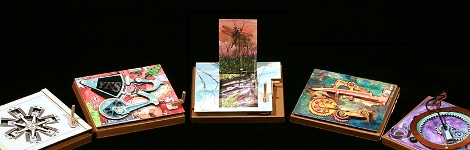
These greeting cards must be the product of a mechanical engineer run amok. They come with a crank and are designed to entertain with their simple, yet elegant movements. [Thanks Phil]

Magnetic card stripe reader

[JP] built an Arduino based magnetic card reader. It uses off-the-shelf parts but if you don’t mind buying the components this will get you up and running in no time. If you want more info there’s also this Teensy based version.

Homemade Airsoft sentry gun

This sentry gun has an amazingly fast firing rate that can continue for quite a while, thanks to the big flashlight housing that is holds a lot of ammo. [Thanks David]

Scanner easter egg

The engineers over at HP had a little fun building an easter egg into this scanner. If you know what you’re doing you can get it to play the Ode to Joy. It needs to join the old-hardware band from our Links post earlier in the month. [Thanks Googfan]

Master Clock System Uses All Logic, No Microcontrollers

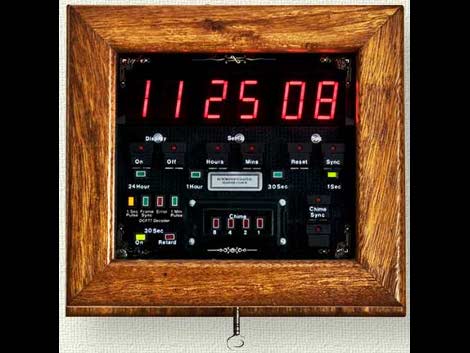
What you see above is a master clock. It is the center of a system that can run an unlimited number of slave clocks, keeping them on-time thanks to its ability to synchronize with an atomic clock. [Brett Oliver] put together the project back in 2005 using digital logic chips, and no programmable microcontrollers. This includes everything from the binary decoders that drive the 7-segment displays, to the radio transceiver board that gathers the atomic clock data, to the various dividers that output 1 second, 2 second, 30 second, 1 minute, 1 hour, and 24 hour signal pulses. It’s  a well document and fascinating read if you’re interested in digital logic clocks.

Gesture Controlled Robotic Hand

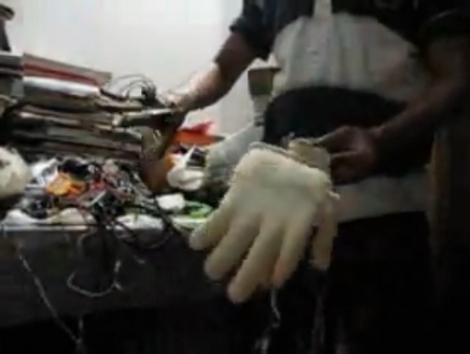
Inspired by the control system for the AMP suits in the movie Avatar, [Feelpavan] built this gesture controlled robotic hand. So far there is functionality for the wrists to rotate and bend, as well as for the fingers to flex (but not individually). This is accomplished by three servo motors on the hand assembly. The instructions for the hand are gathered from your own hand, through the use of an accelerometer and an Arduino that he built himself. Check it out after the break.

Continue reading “Gesture Controlled Robotic Hand” →

Live Action Fighting Games

Here’s a strange one. This fighting game uses a video game interface to instruct modern-age gladiators on how to bring the pain. The costumed fighters cannot see anything other than a set of lights in their helmets instructing them to move or punch. A camera films them and overlays the footage on a digital background along with simulated blood and a health bar for each. NES controllers are used to instruct them, and switches inside the costumes register the pummeling they receive and deduct health accordingly. This wouldn’t be any good without a demonstration, which we’ve embedded after the break.

Continue reading “Live Action Fighting Games” →

Homemade Music Player

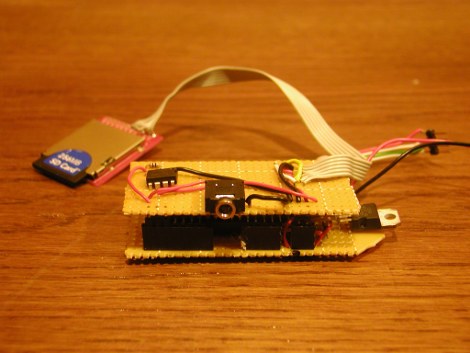
Sadly, this pocket mp3 wav player doesn’t come close to the capabilities of even an iPod generation 1 yet, but you have to give [Owen] props for making it in less than 24 hours. The system consists of a Propeller MCU (cleverly wired to be swappable with “shields” similar to Arduino systems), SD card for song storage, and an LM386 for audio. While the setup is a little dull, and only plays through songs non stop with no controls whatsoever, it certainly is a good start in the right direction for a cheap and simple portable music player. Of course some planned changes are in the works, include an accelerometer (gesture based controls?), etched PCB, docking station, and a case. We’re surprised there is no form of screen planned, considering Owen appears to have a rather good handle on touch interfaces; perhaps he’s waiting for revision 3.

Shiny Motorcycle Computer

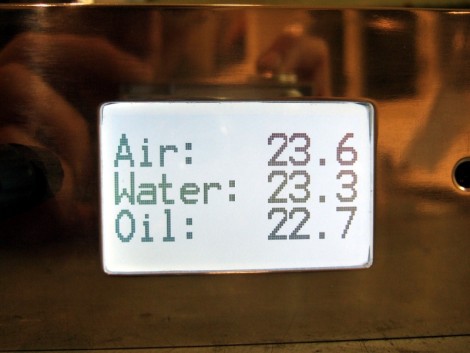
We’re rather surprised at how popular it has become to build your own motorcycle computer. [Mario Mauerer] tipped us off about his shiny motorcycle computer (translated) for his Yamaha XTZ 750. It uses an ATmega644 microcontroller to pull a variety of data together and display it on this white LED backlit display. He connected a flow meter to the fuel line to monitor gas consumption. Oil temperature is captured by inserting a brass tube (containing the sensor) through a hole in the oil cap and soldering it in place. Water temperature is gathered by measuring the external temperature of one of the cooling lines. [Mario] uses a rotary encode with a click function as the control interface device, and a battery backed real time clock keeps time.

A quick look at the PCBs tells the tale of good circuit design. But we do wonder about catching the reflection of the sun in that shiny bezel.