Introductions: 3 New Writers

We would like to introduce our new writers [Rachel Fee], [Greg Jacobs], and [Jacob Nahin]. They will be focusing on software reviews and tutorials in response to the daily requests for posts that don’t require that you be an electrical engineer to understand.

The Hack a Day community is growing very fast and we are happy to be a valued source of information to our readers.

Wear A Helmet, Rollerblades With Attitude

Wireless controller, more powerful custom-made motors, stronger frame, and with a name like DeathBlades, we can’t think of a single reason why you would prefer heel treads, well everyone was young at one time.

[Charleg] has been testing out a slightly new frame, despite having only half the motors necessary, and is getting great results hitting around 23Wh/mi. If you’re looking to build your own, his blog has a post for nearly every aspect of the design.

[Thanks Jerome Demers]

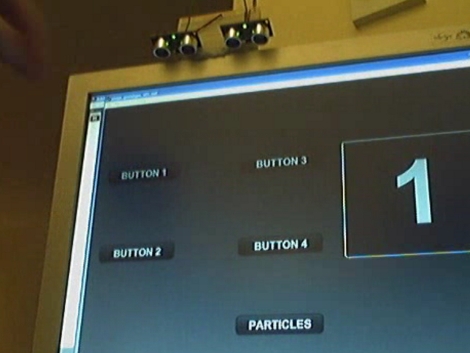
Touch Screen Using Range Sensors

This touch screen relies on measurements from two range finders to track your finger as you press buttons. [James Alliban] put this together as his first Arduino project. We’re familiar with [James’] background because of his informative augmented reality business card. As the Arduino picks up data from the range finder it sends it to a Flash script that is running on the PC.

As we watched the video after the break a lot of questions came to mind. What kind of angle do these Ping sensors have? Will there be interference problems if they were placed perpendicular with each other? Would you get more accurate data if they were not both on the top of the screen? For now this is just a preliminary experiment, but we like the concept and may give it a try ourselves.

Continue reading “Touch Screen Using Range Sensors”

Heel Treads Make Shoes Go

Motorized treads as a replacement for the heel of your shoe? Okay, remember how The Jetsons had moving sidewalks everywhere so you wouldn’t have to walk at all? Well, there’s a much more efficient way to do it and Treadway Mobility seems to have figured it out. In the video after the break you can see several of their prototype units zipping the wearer around quite happily. We think the best part is that with the tread locked in place you can stand and walk like normal, assuming you don’t feel like you have a block of concrete attached to each foot. Maybe the real question is which is more geeky, this or the power lace shoes?

Continue reading “Heel Treads Make Shoes Go”

Whole House Current Monitoring

[youtube=http://www.youtube.com/watch?v=HlRBrTTLQFU]

[Debraj Deb] put together a current monitoring device that interfaces with the circuit box at his house. The system is controlled by a PIC 18F4520 and uses an LM358 Op-Amp to rectify the AC signal, as well as an MCP6S21 for range adjustments for detecting both high or low current loads. The data displayed on a character LCD includes average, RMS, and peak current. For now the data is saved to an EEPROM and can be dumped using a serial connection but [Debraj] plans to add a GSM modem so he can send energy use data to his cell phone.

[Thanks Ganesh]

Humble Homes, Simple Shacks

[Derek] puts the “hack” into the word shack.  We really enjoyed his “little yellow house” videos and shared them with you. After that, we discovered that he has published a book. No, he didn’t have it published, he published it. This guy is DIY through and through. “Humble Homes, Simple Shacks, Cozy Cottages, Ramshackle Retreats, Funky Forts (And Whatever The Heck Else We Could Squeeze In Here)” was hand produced by [Derek] himself.  It includes plans for a number of different shacks, ranging in size from too tiny for an adult to large enough to house a family. Not all of them are completely practical, but there are several that would make perfect workshops.

We got a copy of the book and have been getting lost in the seemingly endless illustrations. We highly recommend that you do so as well, if you have any interest in building from scrap, or unique structures. Even if you aren’t that interested in construction, the eclectic style and humorous rants about waste might just be enough to keep this book around.

Nexus One Gets Linux

[youtube http://www.youtube.com/watch?v=3wQ9XogfjRU&feature=player_embedded%5D

Considering how hackable the Nexus One is already, we can only imagine a whole new host of interesting things thanks to Ubuntu running on the device. [Max Lee] set his heart out on getting not just Ubuntu on the Nexus One, but also Debian, and he wrote a perfect install guide to help out those wanting to give it a shot.

He cheated a little bit by having Ubuntu run in the background while the X11 interface is simply VNCed, but he still did an awesome job with plenty of pictures and details to help you achieve Ubuntu on your Nexus One.