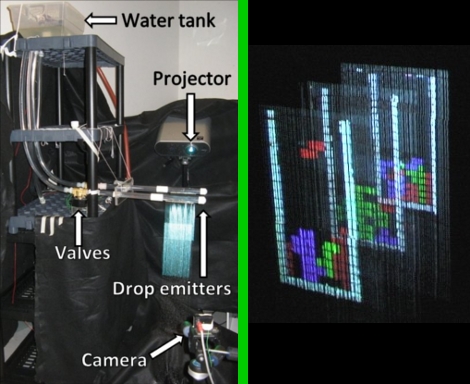
Multi-layer Display Uses Water Instead Of Screen

This multi-layer display uses droplets of water as a projection medium. This way, several different projected areas can be seen for a not-quite-3D layering effect. The trick is in syncing up all aspects of the apparatus. There are three manifolds, each with 50 stainless steel needles for water drop production. A solenoid valve actuates the drops, a camera images them mid-air, and a computer syncs the images of the dots with a projector. In the video after the break you can see the SIGGRAPH 2010 presentation that includes a description of the process as well as action shots including a 3-layer version of Tetris.

Continue reading “Multi-layer Display Uses Water Instead Of Screen”
Wireless Face Tracking Camera

[youtube=http://www.youtube.com/watch?v=8luy8jP1UNs]

A student team at University of Massachusetts  have built this wireless face tracking camera system. Using a small 2-axis motorized camera meant to be mounted on model airplanes, an arduino, and some custom software, they can track faces and keep them in frame in real-time. This is pretty cool, but maybe not quite as groundbreaking as they make it sound. We think it is pretty awesome though. You can download the software and schematics on their site.

[via MakeZine]

Texting With Some Walkie-talkies

[Travers Buda] is giving new life to his abandoned childhood toys. He cracked open a set of Family Radio Services radios he had received for a birthday which work up to 2 kilometers apart. With just a bit of extra circuitry he was able to get them to act as wireless modems. The system functions but it looks like it would benefit from some more refinement, including error correction. In the end [Travers] manages to send and receive ASCII based messages at a whopping baud rate of 10.

Decatron Stand-in

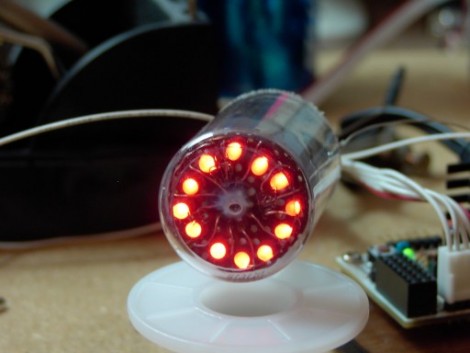
Think the swirling glow of a Decatron is cool but don’t want to deal with the voltage issues? [Osgeld] sidestepped the problem by developing a fake Decatron. Admiral Nelson (Captain Morgan’s cheaper cousin) provided the enclosure in the form of an airplane sized liquor bottle. The LEDs are common-something (not sure if it’s anode or cathode) so they end up being individually addressable through the mess of wires coming out the end. This will greatly simplify that kitchen timer we’ve been meaning to build. See the blinking lights go around and around after the break.

Continue reading “Decatron Stand-in”

Mini Racing Cabinet

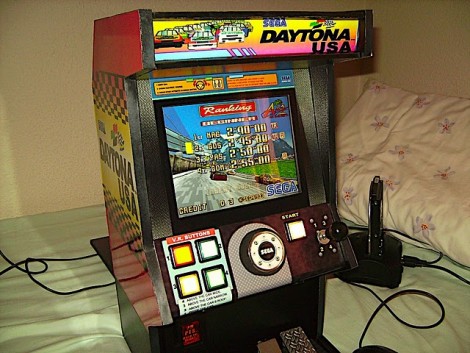
Here’s another small arcade cabinet. This time around it’s the racing simulator Daytona USA. [Pocket_lucho’s] cabinet work has been featured before and he did some fine work with the control interface on this build. The wheel is from the controller of an RC car and the gear lever from a heavily used toy. He fashioned two pedals using gate hinges and a couple of leaf switches. The guts pack quite a punch with a mini ITX motherboard running the show. This will look great next to Ms. Pac-Man. Check out the video after the break.

Continue reading “Mini Racing Cabinet”

Bassoforte And Other New Instruments

[youtube=http://www.youtube.com/watch?v=lhp6P9Ygsoc]

[Diego Stocco] makes music with instruments he assembled. For instance, his Bassoforte uses piano keys, the neck and strings from an electric bass, and what look like some cymbals. Throw in a hammer from that piano and a double bass bow (plus heavy use of audio software) and he’s in business. Big business actually, his work has been in video games such as The Conduit and in feature films like Sherlock Holmes where he worked with Hans Zimmer. Bassoforte isn’t his only invention, he’s got several more including the Experibass string family on one instrument, the Light Controlled Oscillator, and sand music using the fine aggregate along with some piezoelectric film transducers.

[Thanks LuciusMare]

Connecting A Nokia 3310 LCD Using An AVR

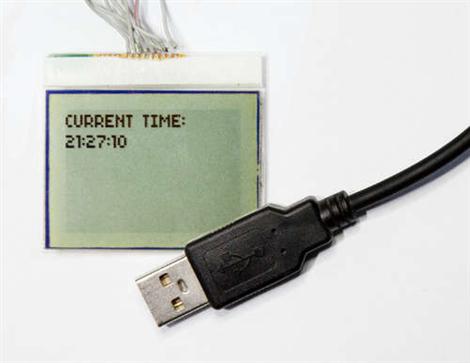
In this instructible, [wkter] takes us through the process of running a Nokia 3310 LCD display using an ATmega8.  This instructible isn’t a beginners project as he assumes you already have a strong understanding of how to work with these components and their programming languages. He is very thorough with information though, providing datasheets, pinout diagrams, and source code. Once you get this down, you could go a little further and make  Conway’s game of life.