Pressurized PVC Water Gun

Hackaday’s [Caleb Kraft] has branded today “kiddie d-day” after seeing this PVC water gun follow close on the heals of the LEGO sniper rifle. This is a great summer project if you don’t mind letting the kids use the quick connect on your air compressor. It’s really just a ‘T’ made of PVC with two valves for air and water management and a soda bottle on the third leg as a reservoir. In the short clip after the break you can see that you don’t get a lot of shooting time out of each charge compared to the DIY Super Soaker, but this build is also a lot less complicated.

Continue reading “Pressurized PVC Water Gun”

Seven-six-two Millimeter. Full Plastic Jacket.

Minifigs beware, something’s afoot. This LEGO sniper rifle is in talented hands to clean up those problem areas. [Jack Streat] put together this fascinating build as well as the delightful demo after the break. The bolt pulls a 1×4 block out of the eight-round magazine and loads it into the chamber. A pull of the trigger flings it with surprising accuracy. Want to be the coolest parent ever? Forgo the store-bought toys this year and put one of these together for your kid. Just don’t turn them into Private Pyle (NSFW).

Continue reading “Seven-six-two Millimeter. Full Plastic Jacket.”

Dingoo A320 RAM Upgrade

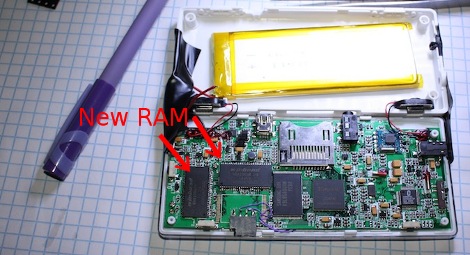
[Stephanie] beefed up the hardware on her Dingoo A320. She enjoyed the features that the A320 handheld gaming system offered, but wanted the 64mb of RAM available in its bigger brother, the A330. A comparison of the two led her to believe a swap might be possible and after sourcing a pair of replacement chips for $12.50 she took the plunge. Once the solder had cooled it was just a matter of flashing some different firmware to take advantage of the upgrade.

[Thanks Juan via Dingoonity]

Making Liquid Nitrogen At Home

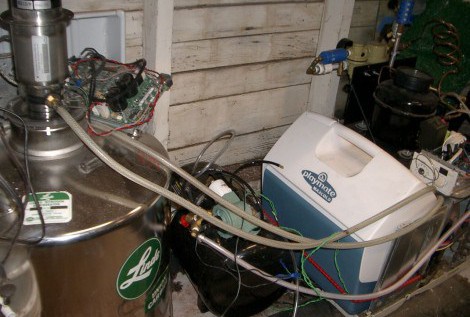
If you’ve got some time to scour eBay and $500 sitting around you can build your own liquid nitrogen plant. [Ben Krasnow] figured it all out for you and estimates he can produce a liter of the stuff for around $1.15. The process depends on a membrane to separate nitrogen from the other materials in the air around us and a cryocooler to get the gas cold enough to condense into a liquid. Other than atmospheric air, you need to pump in electricity. About 9.6 kWh per liter… yikes! Is your human hair solar panel up to that?

Anyway, once you’re up and running you can make yourself some ice cream or possibly save the world from oily destruction.

[Thanks Chris]

DMX Keyboard Display

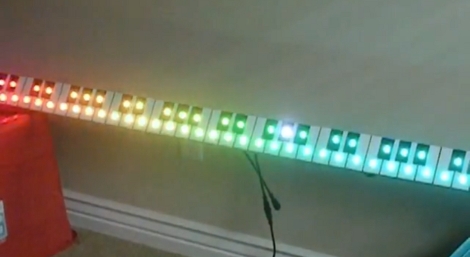
This keyboard display has an RGB LED for each key that is addressable through the common stage lighting protocol, DMX. The project video, seen after the break, does a good job of walking us through the concept. By using a MIDI to DMX converter box [John] can show MIDI signals coming from a keyboard on the appropriate key of the display. By further monkeying with the firmware in the converter box he shows a plasma effect on the whole keyboard, making the corresponding light for each pressed key pop out in bright white. Jump to about 3:45 to hear and see “Sweet Child o’ Mine”.

This isn’t the first time [John’s] been caught with a slew of blinking lights. He helped create the giant LED Christmas tree that brightened up our holiday.

Continue reading “DMX Keyboard Display”

Rotary Display Uses VCR Head And LEDs

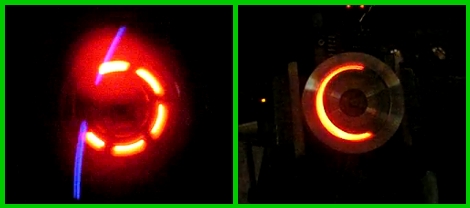
[Daniel Daigle] is developing a rotary display that uses persistence of vision to graph data. The hardware he used includes a spinning head from a VCR, some LEDs, and a timing circuit to display 360 degrees of data. His timing input uses a waveform so this will work with any application where you can generate a PWM signal.

Check out his videos after the break that demonstrate a graph with a single line and another with six display lines.

Continue reading “Rotary Display Uses VCR Head And LEDs”