Clove 2 Glove For One Handed Input


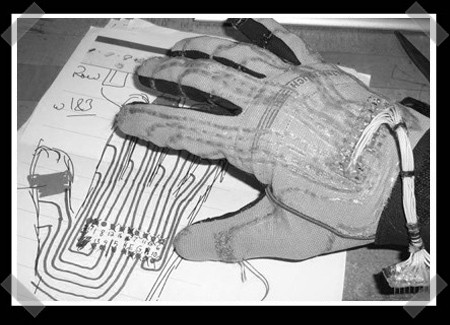
[Christopher Mitchell] (previously on Hack a Day) has come up with a rather interesting input device. The Clove 2 glove is a Bluetooth data input interface. The goal is to be able to “type” without the use of a traditional keyboard. Key strokes are achieved through finger movements. Your computer simply sees this as a Bluetooth HID device and some software translates it for you.

While it may seem confusing, he’s designed it to be very similar to typing on a keyboard. Each finger movement or combination is a key stroke. Just like typing on a regular keyboard, there are modifying strokes such as ALT or shift that effect others. Most common used keys require the least combinations of finger movements.

Continue reading “Clove 2 Glove For One Handed Input”

Hackit: Ripping DVDs


A recent report from Futuresource Consulting states that just under 1/3 of Americans and just over 1/3 of UK residents have engaged in some form of DVD ripping in the last 6 months. Though [Jacqui Cheng] of Ars Technica was unphased, we were very surprised to learn that one of the most common methods is possibly the most low-tech, yet certainly cross-platform: hooking a DVD player to a DVD recorder via coaxial cable or composite. Our toolbelt is somewhat different, as we imagine yours is.

Continue reading “Hackit: Ripping DVDs”

BiPed Robot Version 3

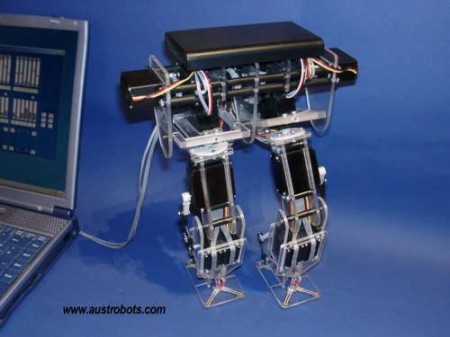
Instructables user [alex.v] posted version 3 of his BiPed Robot. This robot is designed to mimic the control and movements of a human’s lower body. It has 12 degrees of freedom and a nice custom framework CNC’d from acryl sheets. The electronics consist of servos controlled by a custom board built around an ATmega8 and 3 ATtiny26s all programmed in assembly. He also has custom desktop software written in VB which allows direct control of the robot and graphs sensor data. His site contains pictures, videos, and design materials.

Subwoofer Makes Cornstarch Dance


People tend not to think about the non-Newtonian properties of foodstuffs, but we’re glad at least one person did. When it comes to cornstarch, it’s indeterminate viscosity when mixed with water made it the perfect solution for a pretty neat trick: making a liquid move in reaction to a subwoofer. The unique motion can be attributed to the physical properties of the solution: when enough force is applied quickly, it acts as a solid. Otherwise, it flows like a liquid. The erratic bouncing of the sound waves combined with a little tactile manipulation create varying degrees and speeds of applied pressure, which in turn create a mass of flowing shapes that almost appear to be alive.

We’ve covered weird fluids before, but this is perhaps most similar to SnOil, a game that uses ferrofluids to achieve a similar result. SnOil, however, does not depend of vibrations to create shapes in the fluid, it uses small electromagnets and magnetically charges liquid instead. We love the ordered appearance of the SnOil unit, but the chaotic motion of the cornstarch and it’s non-Newtonian properties make it appear almost otherworldly. We wonder how ferrofluids would react in a situation similar to the cornstarch above, since it would respond to both the vibration and the voice coil’s magnetic field.

[via Neatorama]

Microfluidic Art


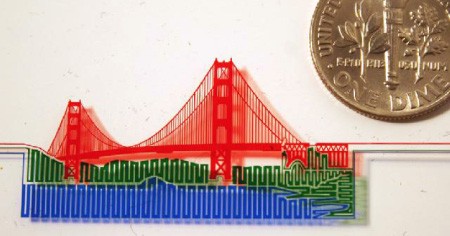
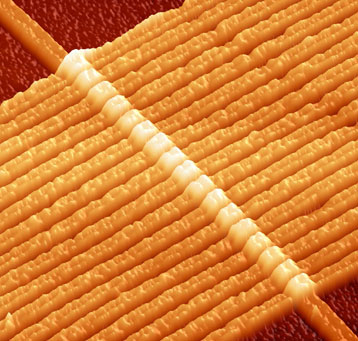
Microfluidics expert [J. Tanner Neville] decided to turn his work into art. Along with his student, [Austin Day], they turned lab chips into miniscule works of art by developing a technique of patterning proteins onto substrates. Each colored line you see is actually a groove full of liquid about 20 microns in width. Another student of [Neville’s], [Albert Mach], is currently working on a method of preserving the liquid for longer amounts of time. As you can probably guess, the dye tends to dry up within a few days. He is also taking submissions for artwork, so we encourage you to submit! We’re certainly looking forward to what else [Neville] and his students come up with next.

[via io9]

Memristor-based Memory Prototype By 2009

An article in EETimes suggests that we may see a memristor-based memory prototype in development as soon as 2009. The memristor is claimed by many to be the theorized fourth passive circuit element, linking the fundamental circuit variables of charge and flux. This news may not sound that exciting to most computer geeks, but this new component could usher in a new era of computer memory by forming the basis of RRAM (resistive random-access memory).

Scientists at HP labs have finally confirmed that the memristor behaves as their theories predicted. The reason that the component will work so well for memory is that the process is nonvolatile and the bits themselves will only change after the CPU tells them to. The bits in current DRAM systems slowly fade out and require a refreshment every 50 nanoseconds.

[via /.]

7 Really Creepy Robots


Creepiness is a hard feeling to objectively evaluate, but we dare you to not get creeped out by these realistic robots listed by Cracked.com. It’s the uncanny valley of robots that are almost, but not completely lifelike, and which repulse most humans. It begs the question: how could you resolve the uncanny valley problem? Would you build a robot to look exactly like you, as [Hiroshi Ishiguro] did, or would you build one to look like a famous figure, like the Albert Hubo?

[via BotJunkie]