3DP Enigma Keyboard Improves On The Original

[Asciimation], who previously created an Enigma Machine wristwatch, decided to go all-in and make a 3D-printed Enigma machine. Not a perfect replica, but rather an improved version that works the same but doesn’t concern itself with historical accuracy. For instance, the current step involves building the keyboard. Rather than trying to re-create the spring-and-pin method of the original, he simply swapped in readily available, double-throw micro switches.

This project has a tremendous amount of fascinating detail. [Asciimation] did his research and it shows; he downloaded blueprints of the original and used hacked digital calipers to precisely measure each rotor’s teeth, so that it could be re-created for printing. He even re-created the Enigma font to ensure that his printed rotor wheels would look right–though in doing so he discovered that the original machine used one typeface for the keyboard, one for the wheels, and one for the indicator lamps.

We previously published [Asciimation]’s Enigma machine wristwatch project, where he simulated the functionality of an Enigma with an Arduino.

Continue reading “3DP Enigma Keyboard Improves On The Original”

ZBeam

Hackaday Prize Best Product Finalist: Shape Shifting Structures For Space

While [Elon Musk] and [Jeff Bezos] are working on getting us to Mars and the Moon, [Ronald Jaramillo] is working on building structures once we get there. To that end, he’s been developing the ZBeam, two rolls of links that zip together like a zipper to form a rigid beam.

ZBeam making, regolith munching machine

Initially stored in a compact cube targeted to eventually fit in a CubeSat’s dimension’s, 100 mm x 100 mm x 100 mm, the beam emerges from within the cube and will be able to connect with other cubes to form rigid structures. His hope is that they can one day be made automatically from lunar or Martian regolith (loose surface dirt) munching machines. His current one has 160 mm sides and uses a servo hacked to turn continuously.

In his hackaday.io project logs he shows the trial and error he’s gone through to get to his current stage: experimenting with the links to form a more rigid beam, fine tuning the unreeling of the rolls of links to prevent jamming, adding a safety-ratchet-gear to the gearing to overcome speed issues, and more. He currently 3D prints as many connected sets of links as he can on his Prusa i3, and then manually connects sets together to make a longer chain, but he has his eye on the Printrbot Printrbelt for printing arbitrarily long chains in one piece.

You can see one pretty impressive iteration of the ZBeam in action in the video below and more is on his project page. In fact, the judges for the 2017 Hackaday Prize liked [Ronald]’s projects so much that they designated it as a Best Product finalist.

Continue reading “Hackaday Prize Best Product Finalist: Shape Shifting Structures For Space”

3D Printing Flexible Surfaces Out Of Non-Flexible Material

Here’s some interesting work shared by [Ben Kromhout] and [Lukas Lambrichts] on making flexible 3D prints, but not by using flexible filament. After seeing a project where a sheet of plywood was rendered pliable by cutting a pattern out of it – essentially turning the material into a giant kerf bend – they got interested in whether one could 3D print such a thing directly.

Inspiration for the project was this laser-cut plywood.

The original project used plywood and a laser cutter and went through many iterations before settling on a rectangular spiral pattern. The results were striking, but the details regarding why the chosen pattern was best were unclear. [Ben] and [Lukas] were interested not just in whether a 3D printer could be used to get a similar result, but also wanted to find out what factors separated success from failure when doing so.

After converting the original project’s rectangular spiral pattern into a 3D model, a quick proof-of-concept showed that three things influenced the flexibility of the end result: the scale of the pattern, the size of the open spaces, and the thickness of the print itself. Early results indicated that the size of the open spaces between the solid elements of the pattern was one of the most important factors; the larger the spacing the better the flexibility. A smaller and denser pattern also helps flexibility, but when 3D printing there is a limit to how small features can be made. If the scale of the pattern is reduced too much, open spaces tend to bridge which is counter-productive.

Kerf bending with laser-cut materials gets some clever results, and it’s interesting to see evidence that the method could cross over to 3D printing, at least in concept.

Electric LEGO Longboard Now Complete With Epic Road Test

We recently posted about [James Bruton]’s most excellent oversized LEGO electric longboard. Well, now he has completed the project by tidying a few things and building oversized versions of classic light-up bricks to serve as headlamps and the tail light. Most importantly, he’s hitting the road with it!

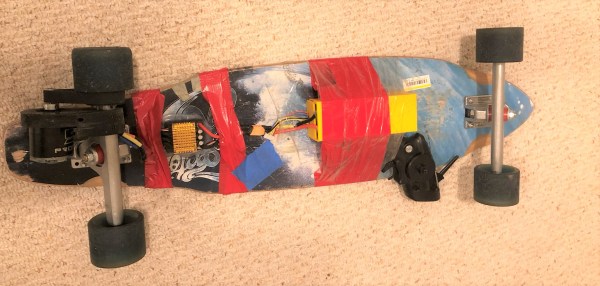
He built a LEGO-looking enclosure for the battery as well, based on a 2×6 brick. The battery pack sits behind the motor with the tail light on top and holds the radio control receiver as well the twin LiPos. The head and tail lights pack 24-LED discs and are controlled by [James]’ FS-GT2B 3-channel RC transmitter. Its third channel is just a button, and he can trip that button to activate the lights with the help of a Turnigy receiver-controlled switch.

For an added touch he printed some LEGO flowers and a minifig, suitably oversized, and took the skateboard on the road. The thing has some zip! [James] kept his balance while holding the controller in one hand and a selfie stick with the other. The headlamp housings fell off, and a while later the minifig fell off. Fortunately [James] was able to snap them back into place, in proper LEGO fashion.

[James] runs XRobots and also served as a judge for the 2016 Hackaday Prize. We wrote up his Star Wars builds a while back, as well as his tutorial on mixed reality filming without a green screen.

Continue reading “Electric LEGO Longboard Now Complete With Epic Road Test”

Simple 3D-Printed Circuitry

One of the problems encountered thus far with 3D-printing circuits with conductive filament is that it doesn’t really bond to anything, let alone solder, so how does one use it?

[mikey77] wrote an Instructable showing how to print circuit boards and create simple circuits, using shape of the plastic as a way to control the circuit. We like how he used using the flexible nature of the filament to make buttons, with two layers of conductive material coming together with the press of a finger.

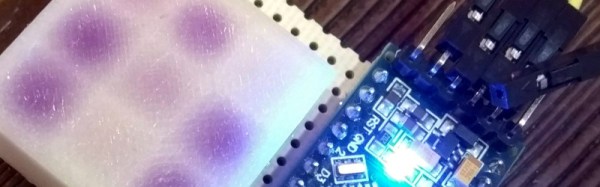
He also created a linear potentiometer with a 3D-printed wiper that increases the ohms of the connection the farther it’s pushed. The filament doesn’t have the same conductivity as copper so [mikey] was able make resistors by stringing pieces of conductive plastic between two leads. There are also some hexagonal touch pads that turned out very nice.

We’ve published a lot of posts about DIY circuitry, including a previous effort of [mikey]’s, 3D-printed solderless circuits, plus another post about printing point-to-point circuits on a 3D printer.

Continue reading “Simple 3D-Printed Circuitry”

Motorized Turntable Created From TV Stand

[Robin Reiter] had a powered TV stand that only rotates around 20°, because who really needs their TV to rotate fully? He wanted to turn it into a motorized turntable for shooting videos, but first he had to hack it.

After opening it up [Robin] discovered that there was a surprising amount of electronics in the base. In addition to a DC motor, there was a potentiometer attached to a gear to give feedback, but it was set up for partial rotation so it had to be yanked out.

There was also a plastic gear with teeth around just part of the interior. [Robin] took a picture of the gear and dropped it into Fusion360, using the photo as a reference image while he re-created the gear. The new piece had teeth all around the periphery. After printing it out he glued it into the old gearbox, and now he had turned his TV stand into a motorized turntable.

If you’re looking for more along these lines, check out our posts on making parametric models in Fusion360 and turning a turntable into a waveform generator. Continue reading “Motorized Turntable Created From TV Stand”

Worried About Running Out Of Filament Mid-Print? Join It!

If you’ve ever cringed over throwing away any printer filament you know wouldn’t cover your next small part — let alone an overnight print — you may appreciate [starlino]’s method for joining two spools of filament together.

While there are other methods to track how much filament you’re using, this method removes some of the guesswork. First, snip the ends of the filament on a diagonal — as close to the same angle as possible. Cover both ends with shrink wrap tubing — 2mm tubing for 1.75mm filament for example — ensuring that the two ends overlap inside the wrap. Tape the filament to a heat resistant mat with Kapton tape, leaving exposed the joint between the two filaments. A temperature sensor may help you to find your filament’s melting point, or you can experiment as necessary to get a feel for it.

Melt the filament inside the tubing with a hot air soldering station or heat gun and cool it down promptly with a few blasts from an air duster. All that’s left is to cut the filament free of the tape and shrink wrap, scraping away any excess so as to prevent printer jams. Done! Now, back to printing! Check out the tutorial video after the break.nning

Continue reading “Worried About Running Out Of Filament Mid-Print? Join It!”