Why Sodium-Ion Batteries Are Terrible For Solar Storage

These days just about any battery storage solution connected to PV solar or similar uses LiFePO4 (LFP) batteries. The reason for this is obvious: they have a very practical charge and discharge curve that chargers and inverters love, along with a great round trip efficiency. Meanwhile some are claiming that sodium-ion (Na+) batteries would be even better, but this is not borne out by the evidence, with [Will Prowse] testing and tearing down an Na+ battery to prove the point.

The OCV curve for LFP vs Na+ batteries.

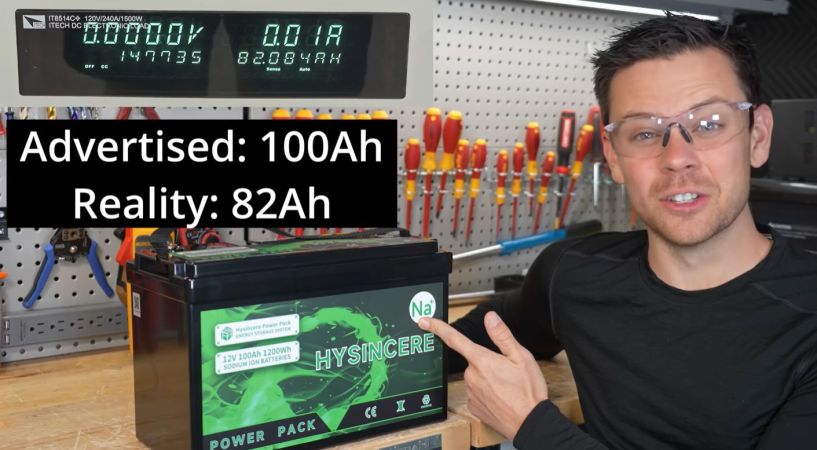
The Hysincere brand battery that [Will] has on the test bench claims a nominal voltage of 12 V and a 100 Ah capacity, which all appears to be in place based on the cells found inside. The lower nominal voltage compared to LFP’s 12.8 V is only part of the picture, as can be seen in the OCV curve. Virtually all of LFP’s useful capacity is found in a very narrow voltage band, with only significant excursions when reaching around >98% or <10% of state of charge.

What this means is that with existing chargers and inverters, there is a whole chunk of the Na+ discharge curve that’s impossible to use, and chargers will refuse to charge Na+ batteries that are technically still healthy due to the low cell voltage. In numbers, this means that [Will] got a capacity of 82 Ah out of this particular 100 Ah battery, despite the battery costing twice that of a comparable LFP one.

Yet even after correcting for that, the internal resistance of these Na+ batteries appears to be significantly higher, giving a round trip efficiency of 60 – 92%, which is a far cry from the 95% to 99% of LFP. Until things change here, [Will] doesn’t see much of a future for Na+ beyond perhaps grid-level storage and as a starter battery for very cold climates.

Continue reading “Why Sodium-Ion Batteries Are Terrible For Solar Storage”
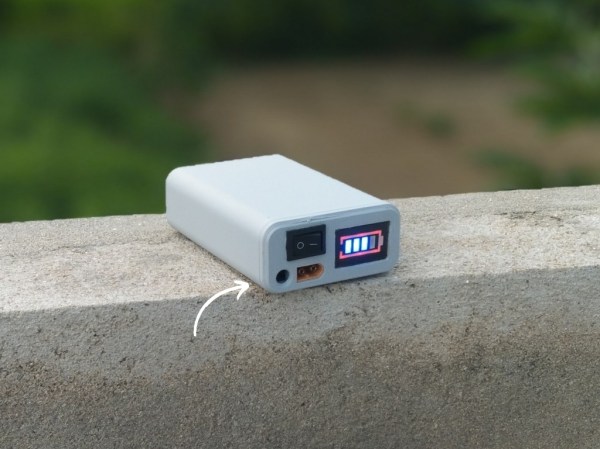
Tiny UPS Keeps WiFi Online

For any mission-critical computer system, it’s a good idea to think about how the system will handle power outages. At the very least it’s a good idea to give the computer enough time to gracefully shut down if the power outage will last for an indefinite time. But for extremely critical infrastructure, like our home Wi-Fi, we might consider a more long-term battery backup that can let us get through the longest of power outages.

Part of why this project from [Next Builder] works so well is that most off-the-shelf routers don’t actually use that much energy. Keeping that and a modem online when the power is out only requires a few lithium batteries. To that end, three lithium ion cells are arranged in series to provide the router with between 9 and 12 volts, complete with a battery management system (BMS) to ensure they aren’t over- or under-charged and that they are balanced. The router plugs directly into a barrel jack, eliminating any switching losses from having to use an inverter during battery operation.

While [Next Builder] is a student who lives in an area with frequent interruptions to the electricity supply, this does a good job of keeping him online. If you’re planning for worse or longer outages, a design like this is easily adapted for more batteries provided the correct BMS is used to keep the cells safely charged and regulated. You can also adapt much larger UPS systems to power more of your home’s electrical system, provided you can find enough batteries.

Lumafield Shows Why Your Cheap 18650 Cells Are Terrible

Lithium-ion cells deliver very high energy densities compared to many other battery technologies, but they bring with them a danger of fire or explosion if they are misused. We’re mostly aware of the battery conditioning requirements to ensure cells stay in a safe condition, but how much do we know about the construction of the cells as a factor? [Lumafield] is an industrial imaging company, and to demonstrate their expertise, they’ve subjected a large number of 18650 cells from different brands to a CT scan.

The construction of an 18650 sees the various layers of the cell rolled up in a spiral inside the metal tube that makes up the cell body. The construction of this “jellyroll” is key to the quality of the cell. [Lumafield’s] conclusions go into detail over the various inconsistencies in this spiral, which can result in cell failure. It’s important that the edges of the spiral be straight and that there is no electrode overhang. Perhaps unsurprisingly, they find that cheap no-name cells are poorly constructed and more likely to fail, but it’s also interesting to note that these low-quality cells also have fewer layers in their spiral.

We hope that none of you see more of the inside of a cell in real life than you have to, as they’re best left alone, but this report certainly sheds some light as to what’s going on inside a cell. Of course, even the best cells can still be dangerous without protection.

Calculator Battery Mod Lets You Go The Distance

Disposable batteries seem so 1990s. Sure, it’s nice to be able to spend a couple of bucks at the drugstore and get a flashlight or TV remote back in the game, but when the device is a daily driver, rechargeable batteries sure seem to make more financial sense. Unfortunately, what makes sense to the end user doesn’t always make sense to manufacturers, so rolling your own rechargeable calculator battery pack might be your best option.

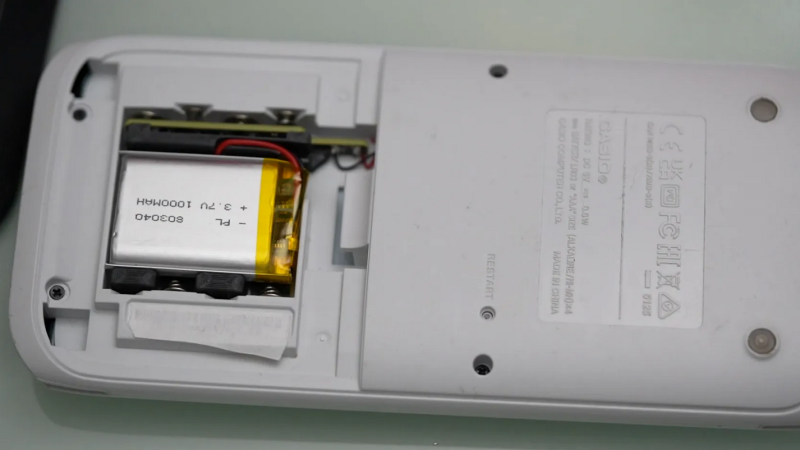
This slick hack comes to us from [Magmabow], who uses a Casio FXCG50 calculator, a known battery hog. With regular use, it goes through a set of four alkaline AA batteries every couple of months, which adds up quickly. In search of a visually clean build, [Magmabow] based the build around the biggest LiPo pillow-pack he could find that would fit inside the empty battery compartment, and planned to tap into the calculator’s existing USB port for charging. A custom PCB provides charging control and boosts the nominal 3.7-volt output of the battery to the 5-ish volts the calculator wants to see. The PCB design is quite clever; it spans across the battery compartment, with its output feeding directly into the spring contacts normally used for the AAs. A 3D-printed insert keeps the LiPo and the PCB in place inside the battery compartment.

Almost no modifications to the calculator are needed, other than a couple of bodge wires to connect the battery pack to the calculator’s USB port. The downside is that the calculator’s battery status indicator won’t work anymore since the controller will just shut the 5-volt output down when the LiPo is discharged. It seems like there might be a simple fix for that, but implementing it on such a small PCB could be quite a challenge, in which case a calculator with a little more room to work with might be nice. Continue reading “Calculator Battery Mod Lets You Go The Distance”

Reverse-Engineering The Milwaukee M18 Diagnostics Protocol

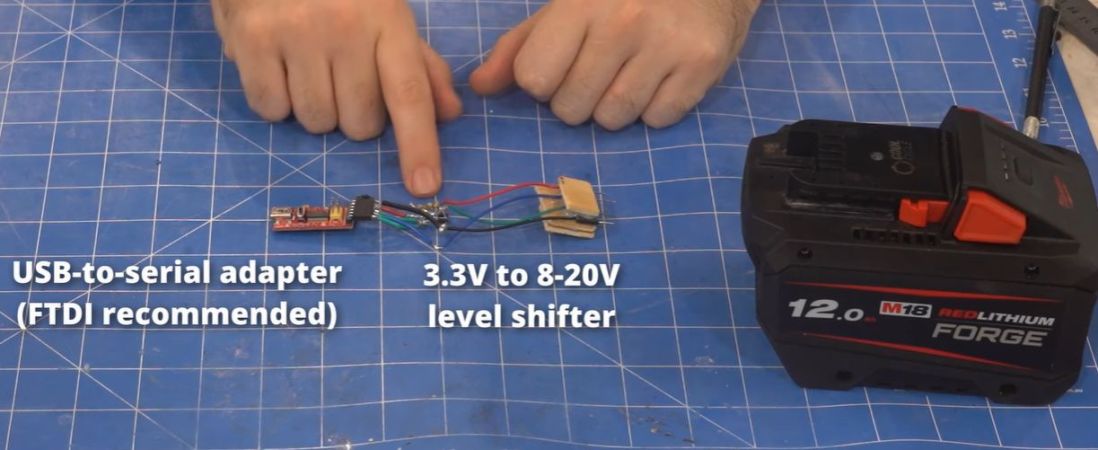
As is regrettably typical in the cordless tool world, Milwaukee’s M18 batteries are highly proprietary. Consequently, this makes them a welcome target for reverse-engineering of their interfaces and protocols. Most recently the full diagnostic command set for M18 battery packs were reverse-engineered by [ToolScientist] and others, allowing anyone to check useful things like individual cell voltages and a range of statistics without having to crack open the battery case.

These results follow on our previous coverage back in 2023, when the basic interface and poorly checksummed protocol was being explored. At the time basic battery management system (BMS) information could be obtained this way, but now the range of known commands has been massively expanded. This mostly involved just brute-forcing responses from a gaggle of battery pack BMSes.

Interpreting the responses was the next challenge, with responses like cell voltage being deciphered so far, but serial number and the like being harder to determine. As explained in the video below, there are many gotchas that make analyzing these packs significantly harder, such as some reads only working properly if the battery is on a charger, or after an initial read.

Continue reading “Reverse-Engineering The Milwaukee M18 Diagnostics Protocol”

Battery Repair By Reverse Engineering

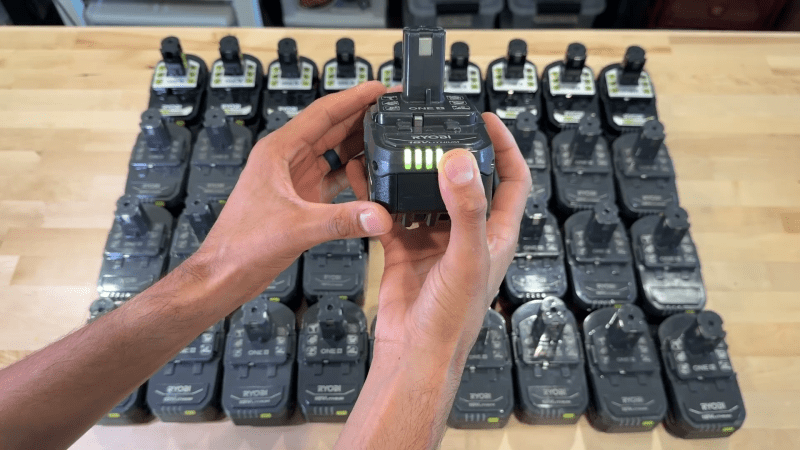
Ryobi is not exactly the Cadillac of cordless tools, but one still has certain expectations when buying a product. For most of us “don’t randomly stop working” is on the list. Ryobi 18-volt battery packs don’t always meet that expectation, but fortunately for the rest of us [Badar Jahangir Kayani] took matters into his own hands and reverse-engineered the pack to find all the common faults– and how to fix them.

[Badar]’s work was specifically on the Ryobi PBP005 18-volt battery packs. He’s reproduced the schematic for them and given a fairly comprehensive troubleshooting guide on his blog. The most common issue (65%) with the large number of batteries he tested had nothing to do with the cells or the circuit, but was the result of some sort of firmware lock.

It isn’t totally clear what caused the firmware to lock the batteries in these cases. We agree with [Badar] that it is probably some kind of glitch in a safety routine. Regardless, if you have one of these batteries that won’t charge and exhibits the characteristic flash pattern (flashing once, then again four times when pushing the battery test button), [Badar] has the fix for you. He actually has the written up the fix for a few flash patterns, but the firmware lockout is the one that needed the most work.

[Badar] took the time to find the J-tag pins hidden on the board, and flash the firmware from the NXP micro-controller that runs the show. Having done that, some snooping and comparison between bricked and working batteries found a single byte difference at a specific hex address. Writing the byte to zero, and refreshing the firmware results in batteries as good as new. At least as good as they were before the firmware lock-down kicked in, anyway.

He also discusses how to deal with unbalanced packs, dead diodes, and more. Thanks to the magic of buying a lot of dead packs on e-Bay, [Badar] was able to tally up the various failure modes; the firmware lockout discussed above was by far the majority of them, at 65%. [Badar]’s work is both comprehensive and impressive, and his blog is worth checking out even if you don’t use the green brand’s batteries. We’ve also embedded his video below if you’d rather watch than read and/or want to help out [Badar] get pennies from YouTube monetization. We really do have to give kudos for providing such a good write up along with the video.

This isn’t the first attempt we’ve seen at tearing into Ryobi batteries. When they’re working, the cheap packs are an excellent source of power for everything from CPap machines to electric bicycles.

Thanks to [Badar] for the tip.

Continue reading “Battery Repair By Reverse Engineering”

Open Source Lithium-Titanate Battery Management System

Lithium-titanate (LTO) is an interesting battery chemistry that is akin to Li-ion but uses Li2TiO3 nanocrystals instead of carbon for the anode. This makes LTO cells capable of much faster charging and with better stability characteristics, albeit at the cost of lower energy density. Much like LiFePO4 cells, this makes them interesting for a range of applications where the highest possible energy density isn’t the biggest concern, while providing even more stability and long-term safety.

That said, LTO is uncommon enough that finding a battery management system (BMS) can be a bit of a pain. This is where [Vlastimil Slintak]’s open source LTO BMS project may come in handy, which targets single cell (1S) configurations with the typical LTO cell voltage of around 1.7 – 2.8V, with 3 cells in parallel (1S3P). This particular BMS was designed for low-power applications like Meshtastic nodes, as explained on the accompanying blog post which also covers the entire development and final design in detail.

The BMS design features all the stuff that you’d hope is on there, like under-voltage, over-voltage and over-current protection, with an ATtiny824 MCU providing the brains. Up to 1 A of discharge and charge current is supported, for about 2.4 Watt at average cell voltage. With the triple 1,300 mAh LTO cells in the demonstrated pack you’d have over 9 Wh of capacity, with the connected hardware able to query the BMS over I2C for a range of statistics.

Thanks to [Marcel] for the tip.