Mechanisms: Bearings

They lie at the heart of every fidget spinner and in every motor that runs our lives, from the steppers in a 3D printer to the hundreds in every car engine. They can be as simple as a lubricated bushing or as complicated as the roller bearing in a car axle. Bearings are at work every day for us, directing forces and reducing friction, and understanding them is important to getting stuff done with rotating mechanisms.

Continue reading “Mechanisms: Bearings”

OpenSCAD: Tieing It Together With Hull()

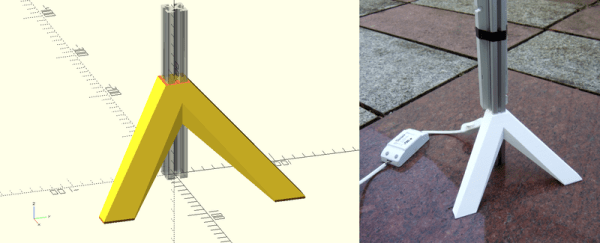
What’s your favorite OpenSCAD command? Perhaps it’s intersection() or difference()? Or are you a polygon() and extrude() modeler? For me, the most useful, and maybe most often overlooked, function is hull(). Hull() does just what it says on the can — creates a convex hull around the objects that are passed to it as children — but that turns out to be invaluable.

Hull() solves a number of newbie problems: making things round and connecting things together. And with a little ingenuity, hull() can provide a nearly complete modelling strategy all on its own. If you use OpenSCAD and your creations end up with hard edges, or you spend too much time figuring out angles, or if you just want to experience another way to get the job done, read on!

Continue reading “OpenSCAD: Tieing It Together With Hull()”

Mary Somerville: The First Scientist

Science, as a concept, is relatively new. Benjamin Franklin wasn’t a scientist probing the mysteries of amber and wool and electricity and ‘air baths’; he was a natural philosopher. Antonie van Leeuwenhoek was simply a man with a proclivity towards creating new and novel instruments. Robert Hooke was a naturalist and polymath, and Newton was simply a ‘man of science’. None of these men were ever called ‘scientists’ in their time; the term hadn’t even been coined yet.

The word ‘scientist’ wouldn’t come into vogue until the 1830s. The word itself was created by William Whewell, reviewing The Connexion of the Physical Sciences by Mary Somerville. The term used at the time, ‘a man of science’, didn’t apply to Mrs. Somerville, and, truth be told, the men of science of the day each filled a particular niche; Faraday was interested in electricity, Darwin was a naturalist. Mary Somerville was a woman and an interdisciplinarian, and the word ‘scientist’ was created for her.

Continue reading “Mary Somerville: The First Scientist”

Hands On With The Smallest Game Boy Ever Made

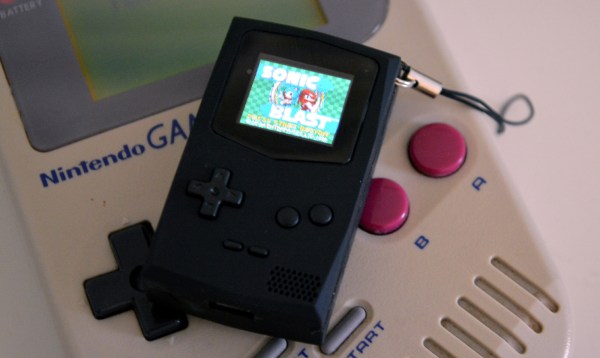
The PocketSprite is the tiniest fully-functional Game Boy Color and Sega Master System emulator. Not only is it small enough to fit in your pocket, it’s small enough to lose in your pocket. It’s now available as a Crowd Supply campaign, and it’s everything you could ever want in a portable, WiFi-enabled, fully hackable video game console. It also plays Witcher 3. And probably Crysis, because of the meme.

This has been a year and a half in the making. The first hardware version of the PocketSprite was revealed at the 2016 Hackaday Superconference by hardware engineer extraordinaire [Sprite_TM]. As [Sprite] has a long list of incredibly impressive hardware hacks like installing Linux on a hard drive and building a Matrix of Tamagotchis, he always has to keep pushing deep into the hardware frontier.

In 2016, [Sprite] showed off the tiniest Game Boy ever, powered by the then brand-spankin’ new ESP32. This was released as Open Source, with the hope that a factory in China would take the files and start pumping out mini Game Boys for everyone to enjoy. Now, a year and a half later, it’s finally happened. In a collaboration with manufacturing wizard [Steve K], [Sprite] is the mastermind behind TeamPocket. The pocket-sized Game Boy-shaped emulator is now real. This is our hands-on review.

Continue reading “Hands On With The Smallest Game Boy Ever Made”

Hackaday Links Column Banner

Hackaday Links: February 11, 2018

Are you a student? Are you part of a hackerspace? We have a contest going on right now where you can win a fancy new Prusa i3 MK3. The Repairs You Can Print contest is a challenge to do something useful with that machine that spits out tugboats. We’re looking for functional repairs of items around your house, office, or garage. Did you repair something with a 3D printer? Then you too can get in on the action! Enter now! Check out the entries!

You may know Flite Test as the group who do everything surrounding remote control flight (mostly fixed wings, a nice counter to the quadification of the hobby over the last few years). Flite Test designs and sells airplanes made out of Dollar Tree foam board, they have yearly, bi-coastal meetups, and they’re all-around awesome dudes. Now, they want to build the Disneyland of RC flight. [Josh Bixler], the face of Flite Test and a guy who has a plane named after him, wants to buy a golf course and turn it into the world’s best RC flying park, with a ~2000 foot grass strip for general aviation. We’re looking at their crowdfunding campaign, and it looks promising it might be funded by the time this goes live.

A while ago, [Peter Jansen], the guy who built a tricorder and a laser-cut CT scanner, made a magnetic camera. This Hall Effect camera is a camera for magnetism instead of light. Now, this camera has been fully built and vastly improved. He’s capturing ‘frames’ of magnetism in a spinning fan at 2000 Hz (or FPS, terminology kind of breaks down here), and it’s beautiful.

Oh thank God we can finally buy GPUs again. Try buying them with Bitcoin.

In the last few years, CITES, the Convention on International Trade in Endangered Species of Wild Fauna and Flora, has expanded. Originally, this was one of the treaties that banned the import or export of rhino horn, but recently this expanded to the export of rosewood thanks to increased demand in China for rosewood furniture. The laws of unintended consequences kicked into effect, and importing anything made out of rosewood is now a mess of permits and inspections at the border, including musical instruments. Travelling orchestras, for example, are at risk of having their string section confiscated because of rosewood tuning pegs. Cooler minds may now be prevailing, and there’s some hope the regulations may be changed during the next meeting of the CITES convention next year.

As noted a few months ago, there was a possibility of Broadcom buying Qualcomm for one… hundred… Billion dollarsThis offer was rejected, with Qualcomm saying the offer wasn’t high enough. Broadcom fired back with an offer of $82 per share, or $121B. This offer was rejected this week.

Need some EMC testing? [Zach]’s got your back. He’s reserved some time in a 10m EMC chamber for testing NeuroBytes this week. If you have an Open Source project that needs a pre-test scan for unintentional radiator, you can get in on the action. This is just a pre-test, you’re not getting certification, and you’re not going to test anything with radios, and you need to ship [Zach] your stuff. But still, free test time. Woo.

Ball and socket helping hands

Printed It: Do More With Lockable Ball And Socket Helping Hands

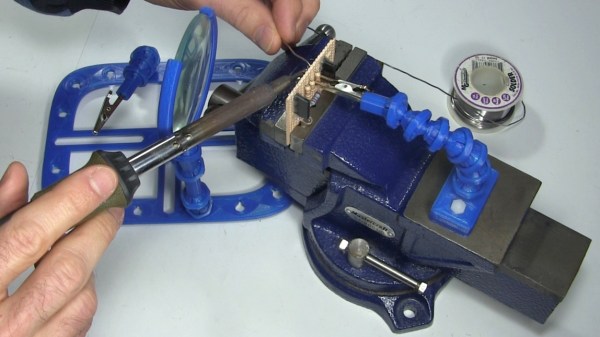
In one hand you hold the soldering iron, in the other the solder, and in two more hands the parts you’re trying to solder together. Clearly this is a case where helping hands could be useful.

Magnifying glass with helping hands

Luckily helping hands are easy to make, coolant hoses will do the job at under $10. Attach alligator clips to one end, mount them on some sort of base, and you’re done. Alternatively, you can steal the legs from an “octopus” tripod normally used for cell phones. So why would you 3D print them?

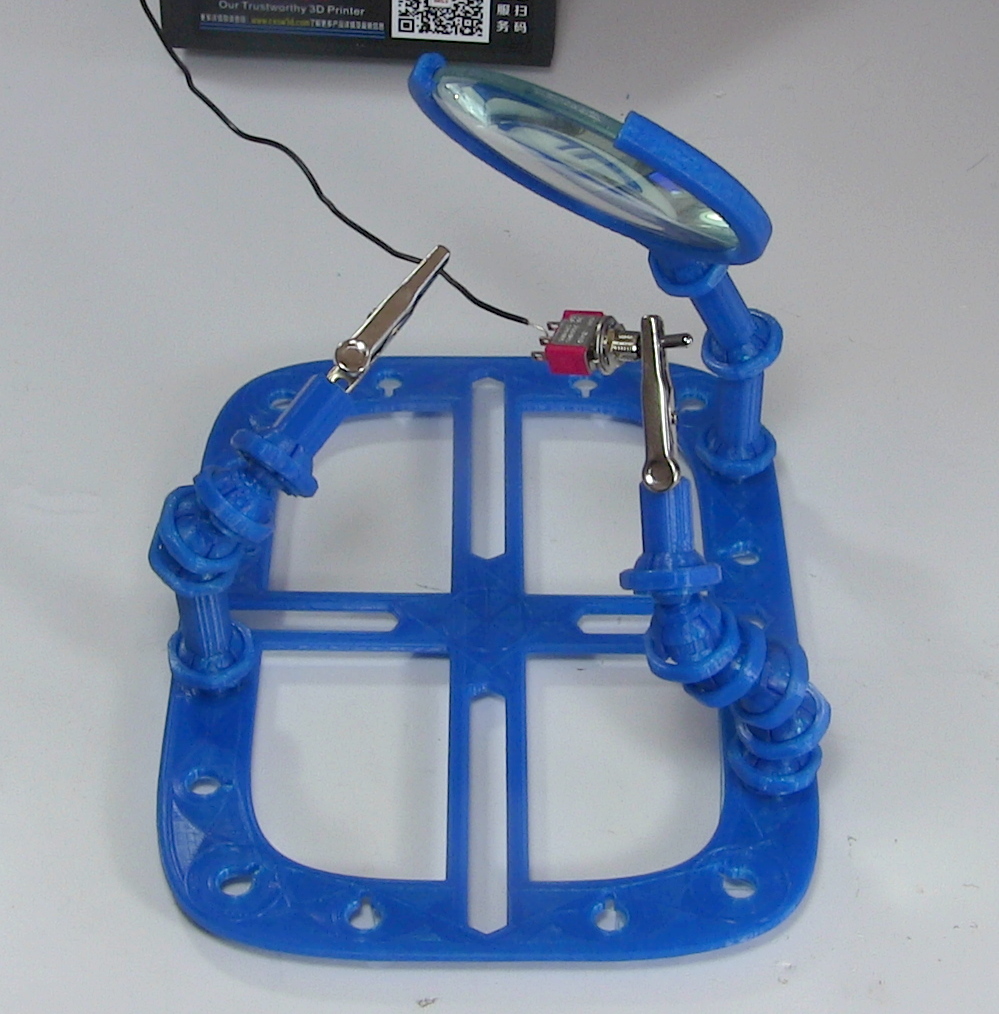
One reason is to take advantage of standardized, open source creativity. Anyone can share a model of their design for all to use as is, or to modify for their needs. A case in point is the ball and socket model which I downloaded for a helping hand. I then drew up and printed a magnifying glass holder with a matching socket, made a variation of the ball and socket joint, and came up with a magnetic holder with matching ball. Let’s takea  look at what worked well and what didn’t.

Continue reading “Printed It: Do More With Lockable Ball And Socket Helping Hands”

Friday Hack Chat: How Do You Collaborate With Hardware?

The world of Open Source software is built on collaboration. In one corner of the world, someone can fix a bug in a piece of software, and push it up to the gits. In another part of the world, someone else can put that fix into the next release, and soon everyone has newer, better software. The Internet, or the ability to rapidly transmit text and binary files, has made this all possible.

Hardware is another story. There’s a financial barrier to entry. Not only do you need a meter and a good iron, you’re probably going to need oscilloscopes, logic analyzers, and a bunch of other expensive tools. You’ll need to buy your BOM. If you’re using a PIC, it might be a good idea to buy the good compiler. Hardware is hard and expensive, and all those software devs who complain don’t know what they’re talking about. Collaborating on hardware is much more difficult than pushing some code up to the cloud.

For this week’s Hack Chat, we’re going to be talking about collaborating on hardware projects. This is a deep dive on how to make collaboration with physical objects work, and this week we’re going to be learning from some of the best.

Our guests for this week’s Hack Chat are Pete Dokter and Toni Klopfenstein of SparkFun Electronics. Pete is formerly the Director of Engineering at SparkFun and now the Brand Ambassador for SparkFun Electronics. He hosts the According to Pete video series expounding on various engineering principles and seriously needs a silverburst Les Paul and a Sunn Model T. Toni is currently the product development manager at SparkFun. She’s served on the Open Source Hardware Association Board and participates in the Open Hardware Summit yearly. In her free time, she spends fifty weeks out of the year finding dust in her art and electronics projects.

During this chat, we’re going to be discussing what makes a collaborative hardware project, how to make distributed development work for your team, and the limits of what you can do with several hardware engineers separated by thousands of miles. This is a hard problem, much harder than a distributed team of software engineers, and a fantastic discussion for all.

join-hack-chat

Our Hack Chats are live community events on the Hackaday.io Hack Chat group messaging. This Hack Chat is going down Friday, February 9th at noon, Pacific time. Time Zones got you down? Here’s a handy countdown timer!

Click that speech bubble to the left, and you’ll be taken directly to the Hack Chat group on Hackaday.io.

You don’t have to wait until Friday; join whenever you want and you can see what the community is talking about.