The Dangers Of Engineering While Unlicensed

Citizen engineers, beware the Beaver State. If you want to discuss engineering in a public setting, you’d better have a license. If you don’t, you could end up like Oregon resident Mats Järlström — paying a $500 fine and being threatened with even larger civil penalties and jail time.

The story of how Järlström became ensnared in this unfortunate series of events begins innocently enough, and it’s a story that any Hackaday reader can probably relate to. After his wife received a traffic ticket in the mail from a red-light camera in the town of Beaverton, Järlström began pondering the math of traffic signal timing. After a little digging, he found the formula used for calculating the time traffic signals stay in the yellow stage. Moreover, he found a flaw in the formula, which dates back to 1959, that could lead to incorrect violations issued by automated traffic cameras.

Continue reading “The Dangers Of Engineering While Unlicensed”

Hackaday Links Column Banner

Hackaday Links: May 7, 2017

The International Journal of PoC||GTFO is the hacker quarterly we all deserve. It’s Pastor Manul Laphroaig’s publication featuring crazy exploits and builds and neat woodcut illustrations. It’s going to be a freakin’ dead tree book published by No Starch Press. The word on the street is this is a literal bible. No, really. No Starch found a place that publishes (manufactures?) bibles, and they sent over the PDFs. There will probably be a Hackaday review of this book, but since all the content is freely available online, this review will literally only be judging a book by its cover.

Hoverboards are more innovative than a selfie stick. The snuggie is an innovative product. The iPhone came before greek yogurt. These are the findings of an online consumer research poll being held by CB Insights. As of this writing (and it might be updated by the time this is published), the bracket for the ‘Most Innovative Consumer Product Since The iPhone’ is down to two competitors — the Tesla Model S and the Raspberry Pi. That’s more opinion than anything, but check out the bracket. The Amazon Echo is more innovative than the ‘desktop 3D printer’, which as we all know was invented by MakerBot. The Dollar Shave Club — otherwise known as giving away the razor and selling subscriptions for the blades — is innovative. Taco Bell didn’t make it past the first round. What the hell is going on here?

This robot plays tiddlywinks. What’s tiddlywinks? It’s that game where you put your hand down on a table and stab a knife between your fingers. It’s a test of fine motor skills and courage, or in this case, programming. This robot also plays tiddlywinks.

This is a Kickstarter for an FPGA’d ZX Spectrum. With the blessing of Sky UK — the owner of the Amstrad brand — this team is cloning the ZX Spectrum, adding HDMI and SD card storage, creating a new enclosure, and calling this project the Spectrum Next. It’s fully compatible with the original and future proofs the Speccy for another few decades.

The Internet of Things comes to alcohol. This vodka comes with a wrap-around LED display that apparently has Bluetooth and is programmable with an iPhone or Android device. Why does this exist? Because it’ll sell. [Bryan Williams] bought one of these bottles and sent this in on the tip line. He’s currently waiting for the batteries to die so he can bust out the Dremel. If anyone else out there wants to check this out, it’s $11 at Sam’s Club.

Need a Z80 C compiler? Here you go.

Clickspring, the guy who has put far, far too much effort into building a clock is now working on the Antikythera Mechanism. His latest video demonstrates how the main plates of the Antikythera mechanism come together. There’s some interesting stuff here, but we’re really waiting for the main gears.

YouTube is well known for the technical astuteness of its community and the fair and level-headed comment section. This, for a short time, was one of the top trending videos on YouTube. It’s ‘free energy’ from two power strips. All you need to do is coil the leads of the power strips around each other. Free intermittent energy for life!


Learn By Fixing: Another Verilog CPU

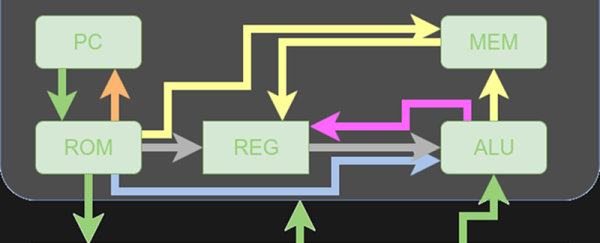
Because I often work with students, I’m always on the look-out for a simple CPU, preferably in Verilog, in the Goldilocks zone. That is, not too easy and not too hard. I had high hopes for this 16-bit RISC processor presented by [fpga4student], but without some extra work, it probably isn’t usable for its intended purpose.

The CPU itself is pretty simple and fits on a fairly long web page. However, the details about it are a bit sparse. This isn’t always a bad thing. You can offer students too much help. Then again, you can also offer too little. However, what was worse is one of the modules needed to get it to work was missing! You might argue it was an exercise left to the reader, but it probably should have been pointed out that way.

At first, I was ready to delete the bookmark and move on. Then I decided that the process of fixing this design and doing a little analysis on it might actually be more instructive than just studying a fully working design. So I decided to share my fix with you and look inside the architecture a bit more. On top of that, I’ll show you how to get the thing to run in an online simulator so you can experiment with no software installation. Of course, if you are comfortable with a Verilog toolchain (like the ones from Xilinx or Altera, or even free ones like Icarus or CVer) you should have no problem making that work, either. This time I’ll focus on how the CPU works and next time I’ll show you how to simulate it with some free tools. Continue reading “Learn By Fixing: Another Verilog CPU”

Using Modern C++ Techniques With Arduino

C++ has been quickly modernizing itself over the last few years. Starting with the introduction of C++11, the language has made a huge step forward and things have changed under the hood. To the average Arduino user, some of this is irrelevant, maybe most of it, but the language still gives us some nice features that we can take advantage of as we program our microcontrollers.

Modern C++ allows us to write cleaner, more concise code, and make the code we write more reusable. The following are some techniques using new features of C++ that don’t add memory overhead, reduce speed, or increase size because they’re all handled by the compiler. Using these features of the language you no longer have to worry about specifying a 16-bit variable, calling the wrong function with NULL, or peppering your constructors with initializations. The old ways are still available and you can still use them, but at the very least, after reading this you’ll be more aware of the newer features as we start to see them roll out in Arduino code.
Continue reading “Using Modern C++ Techniques With Arduino”

We’ve Got It Down PAT: Appliance Electrical Safety Testing

Everywhere we look in our everyday lives, from our bench to our bedroom, there are the ubiquitous electrical cords of mains-powered appliances. We don’t give our electrical devices a second thought, but in addition to their primary purpose they all perform the function of keeping us safe from the dangerous mains voltages delivered from our wall sockets.

Of course, we’ve all had appliances that have become damaged. How often have you seen a plug held together with electrical tape, or a cord with some of its outer sheath missing? It’s something that we shouldn’t do, but it’s likely many readers are guiltily shuffling a particular piece of equipment out of the way at the moment.

In most countries there are electrical regulations which impose some level of electrical safety on commercial premises. Under those regulations, all appliances must be regularly tested, and any appliances that fail the tests must be either repaired or taken out of service

In the United Kingdom,where this piece is being written, the law in question is the Electricity At Work Regulations 1989, which specifies the maintenance of electrical safety and that there should be evidence of regular maintenance of electrical appliances. It doesn’t specify how this should be done, but the way this is usually achieved is by a set of electrical tests whose official name: “In-service Inspection & Testing of Electrical Equipment”, isn’t very catchy. Thus “Portable Appliance Testing”, or PAT, is how the process is usually referred to. Join me after the break for an overview of the PAT system.

Continue reading “We’ve Got It Down PAT: Appliance Electrical Safety Testing”

Friday Hack Chat: Chip Gracey From Parallax

Learn the ins and outs of multi-core microcontrollers as Chip Gracey leads this week’s Hack Chat on Friday 5/5 at noon PDT. Chip founded Parallax and has now been working for more than a decade on the Propeller 2 design, a microcontroller which has 8 and 16 core options.

When it comes to embedded development, most people think of a single process running. Doing more than one task at a time is an illusion provided by interrupts that stop one part of your program to spend a few cycles on another part before returning. The Propeller 2 has true parallel processing; each core can run its own part of the program. From the embedded engineer’s perspective that makes multiple real-time operations possible. Where things get really interesting is how those cores work together.

Here’s your chance to hear about multi-core embedded first hand, from both the silicon design side and the firmware developer side. Join us for a Parallax Hack Chat this Friday at noon PDT.

Here’s How To Take Part:

join-hack-chatOur Hack Chats are live community events on the Hackaday.io Hack Chat group messaging.

Log into Hackaday.io, visit that page, and look for the ‘Join this Project’ Button. Once you’re part of the project, the button will change to ‘Team Messaging’, which takes you directly to the Hack Chat.

You don’t have to wait until Friday; join whenever you want and you can see what the community is talking about.

Fail Of The Week: New Hackerspace Burglarized Days Before Opening

Starting up a new hackerspace from the ground up is a daunting task. Before you even think about the fun stuff like tools and a space, you’ve got a ton of social engineering to do. Finding like-minded people with the drive and passion for seeing the project through is a major stumbling block where many projects falter. If you get past that, then figuring out a corporate structure and getting funds together to start building something can be difficult, as can local permits and the endless red tape that always seems to accompany anything seen as new or innovative.

But finally the magic day comes for your group to open the doors on the new hackerspace, perhaps with an open house or some event to bring the community in and maybe rustle up some paying members. It should be a happy occasion, but for a new hackerspace near Houston, the grand opening celebration was thwarted when thieves broke into the space and cleaned out all their tools days before it opened.

Continue reading “Fail Of The Week: New Hackerspace Burglarized Days Before Opening”