Assembly Required: Subroutine Calls And The 1K Challenge

The first computer I personally owned had 256 bytes of memory. Bytes. The processor in my mouse and keyboard both have more memory than that. Lots more. Granted, 256 bytes was a bit extreme, but even the embedded systems I was building as part of my job back then generally had a small fraction of the 64K bytes of memory they could address.

Some people are probably glad they don’t have to worry about things like that anymore. Me, I kind of miss it. It was often like a puzzle trying to squeeze ten more bytes out of an EPROM to get a bug fix or a new feature put in. I though with the 1K challenge underway, I might share some of the tricks we used in those days to work around the small memory problems.

Continue reading “Assembly Required: Subroutine Calls And The 1K Challenge”

The Internet Of Tampons

At the 2016 Hackaday Superconference, Amanda Brief and Jacob McEntire gave a talk on what they’ve been working on for the past few years. It’s My.Flow, the world’s first tampon monitor capable of tracking saturation, and eliminating anxiety, leakage, and infection. It’s better than a traditional tampon, and it’s one of the rare Internet of Things things that actually makes sense.

There’s a long history of technological innovation to deal with menstruation. What began with simply sending women out of the village for a week turned into a ‘sanitary belt’ after a few thousand years. This astonishing technological advance of treating women as people led to the pad, the cup, and eventually, the disposable tampon. Now My.Flow is applying modern electrochemical technology to move the state of the art forward.

Continue reading “The Internet Of Tampons”

Hack Safely: Fire Safety In The Home Shop

Within the past two months we’ve covered two separate incidents of 3D printing-related fires. One was caused by an ill-advised attempt to smooth a print with acetone heated over an open flame, while the other was investigated by fire officials and found to have been caused by overuse of hairspray to stick prints to the printer bed. The former was potentially lethal but ended with no more than a good scare and a winning clip for “Hacking’s Funniest Home Videos”; the latter tragically claimed the life of a 17-year old lad with a lot of promise.

In light of these incidents, we here at Hackaday thought it would be a good idea to review some of the basics of fire safety as they relate to the home shop. Nowhere was this need made clearer than in the comments section on the post covering the fatal fire. There was fierce debate about the cause of the fire and the potential negative effect it might have on the 3D-printing community, with comments ranging from measured and thoughtful to appallingly callous. But it was a comment by a user named [Scuffles] that sealed the deal:

“My moment of reflection is that it’s well past time I invest in a fire extinguisher for my workstation. Cause right now my fire plan pretty much consists of shouting obscenities at the blaze and hoping it goes out on its own.”

Let’s try to come up with a better plan for [Scuffles] and for everyone else. We’ll cover the basics: avoidance, detection, control, and escape.

Continue reading “Hack Safely: Fire Safety In The Home Shop”

Fail Of The Week: The Accidental FM Radio

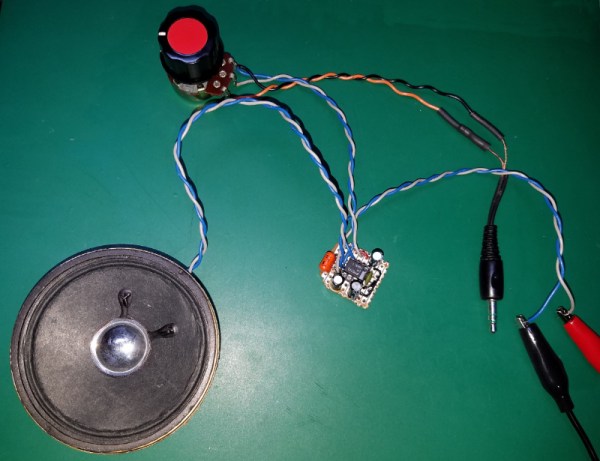
[B Arnold] is hearing voices and needs help from the Hackaday community. But before any of you armchair psychiatrists run off to WebMD, rest assured that [B Arnold] suffers not from schizophrenia but rather has an RF coupling problem.

The project (which isn’t posted yet) is an attempt to turn a C.H.I.P into an Amazon Echo, for which [B Arnold] needed an audio amplifier. Turning to the junk bin, he unearthed an LM386, that venerable power amp chip that first appeared in the mid-70s. Dead simple and able to run off a 9-volt battery, the LM386 that has found its way into thousands of commercial products and countless hacks.

Shortly after applying power to the amp, [B Arnold] started hearing things – faint, far-off voices, scratchy but discernible. A bit of repositioning of wires and hands improved the signal enough for a station ID – an FM talk radio station on 97.1 MHz. [B Arnold] doesn’t mention the call sign, but it might have been KFTK out of St. Louis, Missouri; in any case, it would be helpful to know the range from the transmitter to the inadvertent receiver. Two low-fidelity audio clips are included below for your listening pleasure – you’ll want your headphones on, and Sample 2 is better than Sample 1 – as are photos of the offending circuit.

What do you think is going on here? We’ve heard of RF coupling of AM radio stations before, but how would FM signals be making it into this circuit and out of the speaker? Is there anything [B Arnold] did wrong to get this result? Sound off in the comments and let us know your horror stories of RF coupling.

Continue reading “Fail Of The Week: The Accidental FM Radio”

Hackaday Links Column Banner

Hackaday Links: December 4, 2016

The Chaos Communication Congress is growing! Actually, it’s not, but there may be an ‘overflow venue’ for everyone who didn’t get a ticket. There’s a slack up for people who didn’t get a ticket to 33C3 but would still like to rent a venue, set up some tables, stream some videos, and generally have a good time.

Need to test a lot of batteries? Have one of those magnetic parts tray/dish things sitting around? This is freakin’ brilliant. Put your batteries vertically in a metal dish, clip one lead of a meter to the dish and probe each battery with the other lead of your meter.

Pravda reports the USS Zumwalt and HMS Duncan – the most technologically advanced ships in the US and Royal Navies – have turned into, ‘useless tin cans due to China’, with ‘Microchips made in China putting the vessels out of action’. Again, Pravda reports this, so don’t worry. In other news, someone found a few USB drives in a parking lot in Norfolk, Virginia.

Here’s how discourse goes on the Internet. Someone does something. Everyone says it’s stupid. We wait a few days or weeks. Someone posts something on Medium telling everyone it’s actually okay. Public opinion is muddled until the actual issue being discussed is rendered technologically irrelevant. For the newest MacBook Pro, we’re currently at stage 3 and ‘it’s kind of great for hackers’. Now if only we knew how to make USB-C ports work with microcontrollers…

If you have a Prusa i3, here’s a free gift: a Spitfire. The files to print a remote control, 973mm Spitfire Mk XVI are now free for Prusa i3 and i3 Mk 2 owners. Why? Because it’s cool, duh, and [Stephan Dokupil] and [Patrik Svida], the guys behind the Spitfire and other 3D printed RC planes, are also in Czech. Now all we need are Czech roundel stickers.


Ask Hackaday: What’s Your Favorite Internet Relic?

[Sadiq Mohamed] posted this great list of light bulb jokes in our post about drones changing light bulbs. This favored relic used to exist on a Compuserve SIG, but fortunately a dedicated user had saved the list.

There have been virtual worlds long before our computers could render anything but potatoes with anime faces. Bulletin boards, mailing lists, and forums dominated and then fell, for the most part, to social media. In a way even the personal home page has gone to the wayside. (remember geocities?)

The internet has gone through many phases of development. We’ve experimented with lots of concepts and when they fail or go out of style, there are ghost towns of information left untouched.

However, we remember. I still think fondly of my old shell server. Some of it is even history worthy enough to be in the books. What’s your favorite piece of internet gone by or just plain internet obscura? An old joke? A book five layers deep in a file structure somewhere. Or maybe just the 1959 definition of the word, “hack,” in the Tech Model Railroad Club’s first edition dictionary.

Biologically Inspired Sensors Turned Into Silicon

For the last three and a half Billion years, evolution has built sensors. The nerves on your fingertips are just as good as any electronic touch sensor, a retina is able to detect a single photon, and the human ear is more finely tuned than the best microphones.

At the 2016 Hackaday SuperConference, Dr. Christal Gordon, educator and engineer, talked about the hardware behind our wetware. While AI researchers are still wondering if they have to define consciousness, there’s still a lot that medicine, psychology, and neuroscience can teach us about building better hardware with simple tools, just like nature has been doing for Billions of years.

Continue reading “Biologically Inspired Sensors Turned Into Silicon”