We’re Hiring

Hackaday has been expanding into all kinds of new areas. We find ourselves stretched a bit thin and it’s time to ask for help. Want to lend a hand while making some extra dough to plow back into your projects? These are work-from-home (or wherever you like) positions and we’re looking for awesome, motivated people to help guide Hackaday forward!

Contributors are hired as private contractors and paid for each post. You should have the technical expertise to understand the projects you write about, and a passion for the wide range of topics we feature. If you’re interested, please email our jobs line, and include:

  • Details about your background (education, employment, etc.) that make you a valuable addition to the team
  • Links to your blog/project posts/etc. which have been published on the Internet
  • One example post written in the voice of Hackaday. Include a banner image, at least 150 words, the link to the project, and any in-links to related and relevant Hackaday features

What are you waiting for? Ladies and Gentlemen, start your applications!

Founding A Company In Shenzhen For Eight Days

Nadya Peek is one of the hackers that should require no introduction for the regular Hackaday reader. She is a postdoc at the Center for Bits and Atoms at the MIT Media Lab. She’s responsible for Popfab, a CNC machine that fits in a suitcase and one of the first implementations of a Core XY stage we’ve seen. Nadya has joined the ranks of Rudolf Diesel, Nikola Tesla, Mikhail Kalashnikov, and George W.G. Ferris by having a very tiny piece of the Novena laptop bear her name. She’s built cardboard CNC machines, and taken the idea of simple, easy to build printers, routers, and drawbots worldwide.  She just defended her thesis, the gist of which is, ‘How to rapidly prototype rapid prototyping machines.’ She’s also one of this year’s Hackaday Prize judges, for which we have the utmost appreciation.

This year, the organizers of the Fab 12 conference on digital fabrication in Shenzhen turned to Nadya and her team to bring their amazing experience to conference attendees. A workshop was in order, but Nadya didn’t have time to organize the logistics. The conference organizers made a deal: the Center for Bits and Atoms would teach a workshop, but getting all the materials and electronics was the responsibility of the organizers.

Upon arriving at the Shenzhen Sheridan, Nadya found the organizers didn’t hold up their end of the bargain. The cardboard, motors, electronics, and glue were nowhere to be found. A “rider” doesn’t quite translate from English, it seems. This is Shenzhen, though, where you can buy all the cardboard, motors, electronics, and iPhone clones you could imagine. What was the solution to this problem? Founding a company in Shenzhen for eight days.

Half a tourist’s guide to Shenzhen and half a deconstruction of what goes into cardboard CNC, Nadya’s talk for the 2016 Hackaday SuperConference covers what happens when you have a week to build a company that will build machines that build machines.

Continue reading “Founding A Company In Shenzhen For Eight Days”

My DIY BB-8 interior

My DIY BB-8: Problems, Solutions, Lessons Learned

Imagine trying to make a ball-shaped robot that rolls in any direction but with a head that stays on. When I saw the BB-8 droid doing just that in the first Star Wars: The Force Awakens trailer, it was an interesting engineering challenge that I couldn’t resist. All the details for how I made it would fill a book, so here are the highlights: the problems I ran into, how I solved them and what I learned.

Continue reading “My DIY BB-8: Problems, Solutions, Lessons Learned”

Fail Of The Week: Pinewood Derby Cheat Fails Two Ways

Would you use your tech prowess to cheat at the Pinewood Derby? When your kid brings home that minimalist kit and expects you to help engineer a car that can beat all the others in the gravity-powered race, the temptation is there. But luckily, there are some events that don’t include the kiddies and the need for parents to assume the proper moral posture. When the whole point of the Pinewood Derby is to cheat, then you pull out all the stops, and you might try building an electrodynamic suspension hoverboard car.

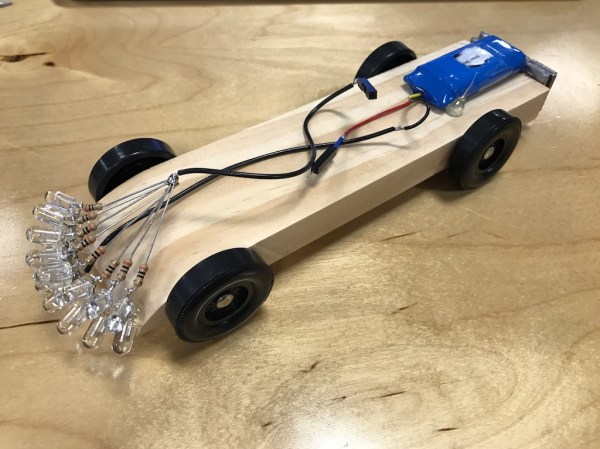
Fortunately for [ch00ftech], the team-building Derby sponsored by his employer is a little looser with the rules than the usual event. Loose enough perhaps to try a magnetically levitating car. The aluminum track provided a perfect surface to leverage Lenz’s Law. [ch00ftech] tried different arrangements of coils and drivers in an attempt to at least reduce the friction between car and track, if not outright levitate it. Sadly, time ran out and physics had others ideas, so [ch00ftech], intent on cheating by any means, tried spoofing the track timing system with a ridiculous front bumper of IR LEDs. But even that didn’t work in the end, and poor [ch00f]’s car wound up in sixth place.

So what could [ch00ftech] had done better? Was he on the right course with levitation? Or was spoofing the sensors likely to have worked with better optics? Or should he have resorted to jet propulsion or a propeller drive? How would you cheat at the Pinewood Derby?


2013-09-05-Hackaday-Fail-tips-tileFail of the Week is a Hackaday column which celebrates failure as a learning tool. Help keep the fun rolling by writing about your own failures and sending us a link to the story — or sending in links to fail write ups you find in your Internet travels.
Awarding The 2016 Hackaday Prize

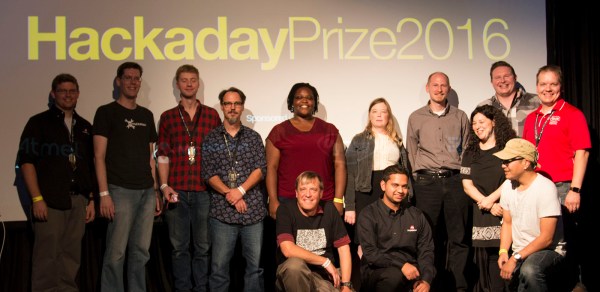
Saturday evening at the Hackaday SuperConference is reserved for the Hackaday Prize Party. Our engineering initiative each year, The Hackaday Prize, starts in the spring and ends in the fall. What happens in between is magic: thousands of engineers and engineering enthusiasts focus their skills on building something that matters. The top entries take home some pretty amazing prizes. At this year’s prize ceremony (seen below) we announced the five top entries which took home $200,000 in addition to the $100,000 already awarded to 100 final projects.

Check out the presentation which includes appearances by several of our amazing judges, then join us after the break for a bit more about this year’s Hackaday Prize.

Continue reading “Awarding The 2016 Hackaday Prize”

Controlling Your Instruments From A Computer: Doing Something Useful

Do you know how to harvest data from your bench tools, like plotting bandwidth from your oscilloscope with a computer? It’s actually pretty easy. Many bench tools make this easy using a standard protocol with USB to make the connection.

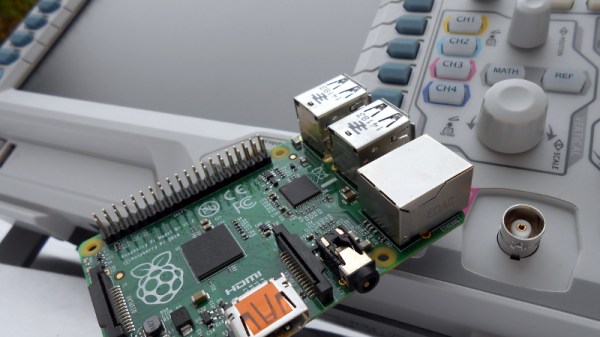
In the previous installment of this article we talked about the National Instruments VISA (Virtual Instrument Software Archetecture) standard for communicating with your instruments from a computer, and introduced its Python wrapper with a simple demonstration using a Raspberry Pi. We’ll now build on that modest start by describing a more useful application for a Raspberry Pi and a digital oscilloscope; we’ll plot the bandwidth of an RF filter. We’ll assume that you’ve read the previous installment and have both Python and the required libraries on your machine. In our case the computer is a Raspberry Pi and the instrument is a Rigol DS1054z, but similar techniques could be employed with other computers and instruments.

Continue reading “Controlling Your Instruments From A Computer: Doing Something Useful”

Glues You Can Use: Adhesives For The Home Shop

A while back I looked at lubricants for the home shop, with an eye to the physics and chemistry behind lubrication. Talking about how to keep parts moving got me thinking about the other side of the equation – what’s the science behind sticking stuff together? Home shops have a lot of applications for adhesives, so it probably pays to know how they work so you can choose the right glue for the job. We’ll also take a look at a couple of broad classes of adhesives that are handy to have around the home shop. Continue reading “Glues You Can Use: Adhesives For The Home Shop”