Don’t Understand The Periodic Table? It’s Just A Quantum Truth Table

In the wee hours of the late 17th century, Isaac Newton could be found locked up in his laboratory prodding the secrets of nature. Giant plumes of green smoke poured from cauldrons of all shapes and sizes, while others hissed  and spat new and mysterious chemical concoctions, like miniature volcanoes erupting with knowledge from the unknown. Under the eerie glow of twinkling candle light, Newton would go on to write over a million words on the subject of alchemy. He had to do so in secret because the practice was frowned upon at that time.  In fact, it is now known that alchemy was the ‘science’ in which he was chiefly interested in. His fascination with turning lead into gold via the elusive philosopher’s stone is now evident. He had even turned down a professorship at Cambridge and instead opted for England’s Director of Mint, where he oversaw his nation’s gold repository.

Not much was known about the fundamental structure of matter in Newton’s time. The first version of the periodic table would not come along for more than a hundred and forty years after his death. With the modern atomic structure not surfacing for another 30 years after that. Today, we know that we can’t turn lead into gold without setting the world on fire. Alchemy is recognized as a pseudoscience, and we opt for modern chemistry to describe the interactions between the elements. Everyone walking out of high school knows what atoms and the periodic table are. They know what the sub-atomic particles and their associated electric charges are. In this article, we’re going to push beyond the basics. We’re going to look at atomic structure from a quantum mechanical view, which will give you a new understanding of why the periodic table looks the way it does. In fact, you can construct the entire periodic table using nothing but the quantum numbers.

Continue reading “Don’t Understand The Periodic Table? It’s Just A Quantum Truth Table”

Hackaday’s DC Meetup And Workshops

Washington DC has a vibrant hardware hacking community and it was out in force on Saturday night. We had over one hundred people through the door at Nova Labs in Reston, Virginia (DC metro area). This sleek and spacious hackerspace opened their doors for a Hackaday Meetup as part of a weekend packed full of activities.

The building that Nova Labs moved into not too long ago is a really well-suited area for a Hackerspace. The front half of the building includes a huge open space which has plenty of room for people to set up the hardware they wanted to show off. The back has a full woodshop, machine shop, and more, with classrooms and conference rooms in between.

Above are a set of hats with addressible LED strings wrapped around them which [ArsenioDev] brought along with him. Several members of the Wyolum team are involved with Nova Labs and they were showing off some LED matrix-based projects like the marquee cube and a 3-player reaction time game. And clacking away all night long is a vintage teletype machine that [Bob Coggeshall] fixed and connected to a Raspberry Pi.

Continue reading “Hackaday’s DC Meetup And Workshops”

Hackaday Links Column Banner

Hackaday Links: September 13, 2015

One more go at new enclosures for the Amiga 1200. Yes, it’s a Kickstarter campaign, and we mentioned a similar the same campaign last month. The previous campaign received a little more than half of the desired funding in a 30-day campaign. The new campaign received half its funding in a week. The only difference? Now you can put a Raspberry Pi in a newly manufactured A1200 case. And they say Raspberry Pi consumerism isn’t a thing…

Cheap SLA printing service. [Ian] and Dangerous Prototypes have made a name for themselves with dirt cheap, acceptable quality PCBs. Now they’re going for custom prints on a resin machine. It’s $0.95 per gram (density is 1.3g/cc). That’s cheap.

[James Willis] built a floppy drive orchestra. There are 16 drives in this orchestra, all controlled by an FPGA. Here’s the writeup.

Here’s a video overview of a real, huge, rideable hexapod robot. ‘Wow’ is just about the only thing we got for this.

Western Digital introduced a hard drive made specifically for the Raspberry Pi. It’s a hard drive with a USB interface, and a USB cable that connects to the Pi, the drive, and a power adapter. In other news, externally powered USB hard drives exist. You can buy a 2TB drive for the price of the 1TB PiDrive. What was that thing about Raspi consumerism?

Next week is the Open Hardware Summit in Philadelphia. We’ll be there (or rather, I will). We’ll have a post on the OHS badge up on Monday. Would anyone like to go see the lady made out of soap? It’s right around the corner from the venue.

Hacklet 74 – Well Balanced Projects

Balance: we humans take it for granted. Without the sense of balance provided by our inner ears, we would have a hard time standing or walking around. What’s easy for us can be very hard for machines though. Projects that balance things have long been a challenge for engineers, makers and hackers. And rightly so, as building a machine to keep an object in balance often requires some novel electronic and mechanical solutions. This week’s Hacklet is all about projects that keep an object – or themselves – in balance.

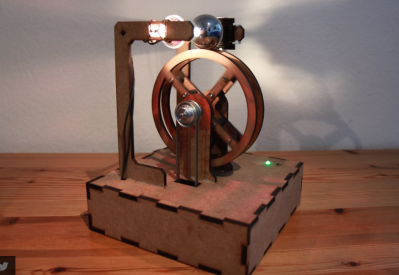
wheelWe start with [Manuel Kasten] and Balance Wheel. Inspired by a project at Chaos Communication Congress, [Manuel] created a hack that looks timeless. A stainless steel ball is balanced on top of a wooden wheel. The system detects the ball’s position using a solar cell. More light on the cell means the ball is slipping off the wheel. The system counteracts this by spinning the wheel to oppose the falling ball. In the old days this would have been an analog system. [Manuel] made things a bit more modern by using an ATmega644p processor. The video shows the wheel spinning a bit fast, as the system was tuned for a ping pong ball rather than a heavy steel roller.

sidewayNext up is [Jason Dorie] with Sideway. Sideway is a two-wheeled skateboard that self-balances. One of the best parts of this project is that most of the mechanical components are from electric scooters, which means they are easy to source. The frame is even easier: A solid piece of plywood supports the rider and all the electronics. Two scooter motors are driven by a Sabertooth 2x32A motor controller. A Parallax Propeller performs the balancing act, obtaining IMU data from an ITG3200 digital gyro and an ADXL345 accelerometer. Speed is controlled by leaning forward and back, like a Segway. Steering is controlled by a Wiimote nunchuck. Sideway is powered by 3 cell LiPo batteries. [Jason] says this ride gets a lot of attention every time he takes it out.


balance-robot[Dominic Robillard] developed his Stair-climbing self-balancing robot as part of his masters degree at the University of Ottawa. We don’t know what grade his advisors gave him, but we give this project an A+. The robot is a 4WD off-road monster. Two heavy-duty drive motors give it tank style steering. The most impressive part of the robot are the two arms which allow it to roll its entire chassis up and over obstacles which would stop much larger robots. [Dominic’s] robot isn’t just statically balanced though – it can rear up and ride on two wheels Segway style. If it does tip over, the arms will lift it right back up!


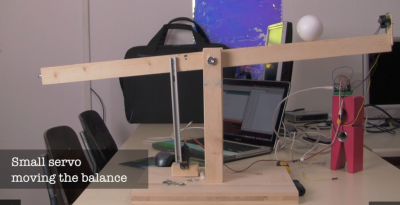
terrabalanceFinally, we have [Paul Bristow] with Terabalance. [Paul] got his hands on an early copy of the TeraRanger One, a Time of Flight (ToF) sensor developed at CERN. He decided to test it out by using it to balance a ping pong ball on a wooden bar. The sensor had to be slowed down quite a bit in this application, data is only read about 1000 times a second and averaged. An Arduino reads the distance data from the sensor and uses that data to drive a hobby servo. No PID loops here, in fact, Terabalance is a great example of how a proportional only system will hunt forever. That said, it is good enough to keep the ball on the balance bar.

There are a plenty of balancing projects on Hackaday.io. If you want to see more, check out the new well balanced project list! Did I miss your project? Don’t be shy, just drop me a message on Hackaday.io. That’s it for this week’s Hacklet, As always, see you next week. Same hack time, same hack channel, bringing you the best of Hackaday.io!

Logic Noise: Playing In Tune With An Exponential VCO

Last session, we use the cheap and cheerful 4046 Phase-locked Loop chip as a simple voltage-controlled oscillator (VCO). It was dead simple, in fact, because the chip has a VCO already built in. There’s one big drawback of the 4046’s VCO; the pitch changes linearly with the control voltage. Ideally, as we’ll discuss in the next sections, we’d like the frequency to be an exponential function of the control voltage (CV), and that’s going to mean a little bit of analog circuitry.

René Schmitz has a fantastic exponential VCO design that’s almost a perfect fit for the Logic Noise series — it’s built with a minimum of parts, it’s a little bit rough around the edges, and at its core is a 4000-series CMOS chip that’s normally used for digital logic applications. The only drawback, from our perspective, is that it uses a dual (positive and negative) power supply. We’ll hack our way around that, and ignore some of René’s otherwise worthwhile refinements in the name of doing something truly quick and dirty. We’ll get 95% of the results with 70% of the work, although it’s easy enough to add on the rest if it strikes your fancy.

Continue reading “Logic Noise: Playing In Tune With An Exponential VCO”

Retrotechtacular: So You Want To Be A Weldor

Welding is one of those things that takes minutes to learn and years to master. It requires coordination, strength, and a good pair of eyes. This vocational guidance video from the early 1940s touches on these points and more for those considering careers in welding. The narrator jumps right in, discussing welding types, equipment operation, and employment opportunities in both the welding field itself and other fields that use welding techniques.

Oxy-acetylene welding is one of the oldest methods of fusing metal. A flame fueled by a specific mixture of pure oxygen and acetylene gas heats the metal welding rod and the work piece to plasticity, which allows them to join together. An oxy-acetylene setup can also be used to cut metal, though a special cutting torch with a kind of oxygen turbo boost lever is required. The work piece is heated to red-hot at the point along the edge where the cut will start. The oxygen-rich flame will cut right through the piece.

Continue reading “Retrotechtacular: So You Want To Be A Weldor”

Kids And Hacking: Blind Robotics

If you are a Hackaday reader, it is a good bet that when you were a kid there was some adult who infected you with the madness you have for science, engineering, tinkering, or whatever it is that brings you here. Maybe it was a parent or a teacher. For many of us, it was a local ham radio operator. But it was probably someone who had the passion for this kind of thing and you caught it.

Paying that debt forward can be very rewarding. Schools and youth organizations are always looking for people to share their passions with kids and at the right age and the right school, you could be that one push that moves a kid off a bad path.

Continue reading “Kids And Hacking: Blind Robotics”