Hackaday Prize Worldwide: Zürich On Thursday

Join us for a Meetup Thursday the 24th of September in Zürich, Switzerland. We’re co-hosting a meetup with FabLab Zürich and we are excited to see you!

Doors open at 18:00 on Thursday, 24 September. We’ll have some food and drink, project show and tell, and time to hang out and get to know each other. This is a free event but please RSVP to let us know you’re coming.

Bring the project you are working on to show off, everyone loves to see projects regardless of what stage they’re in. Many times, showing your project and talking about it pushes your project forward; “oh hey, I have an extra RN42 BT module you can have” or “I already wrote a driver for that chip and it’s on github”. Showing your project to others can also inspire someone else to make their own project based on your awesome idea. I’ve been motivated many times to start a project because of what I saw someone else make.

Germany Too!

This Zurich meetup isn’t the only chance to connect with Hackaday in Europe. Next week, we’ll be in Berlin! We’re co-hosting a Berlin Meetup with Vintage Computer Festival organizers in the evening after Berlin Maker Faire and the Vintage Computing Festival. VCF have planned food and drink, a live band or two… chip tunes! It will be on October 3rd, and [Elliot], [Sophi] and [Bilke] will all be there.
Retrotechtacular: Weston Electrical Instruments

A ‘meter is one of the most important tools on any electronics bench. After you’ve exhausted your five senses trying to figure out what’s happening in a circuit, firing up the old ‘meter is usually the next step. Meters are largely digital nowadays, but their analog ancestors are still widely available. We have a chemist and inventor named [Edward Weston] to thank for the portability and ubiquity of DC measuring equipment.

After immigrating to the United States from England with the degree in medicine his parents wanted him to earn, [Edward Weston] asserted that he was more interested in chemistry. His career began in electroplating, where he soon realized that he needed a reliable, constant current source to do quality plating. This intense interest in power generation led him to develop a saturated cadmium cell, which is known as the Weston cell. Its chemistry produces a voltage stable enough to be used for meter calibration. The Weston cell is also good for making EMF determinations.

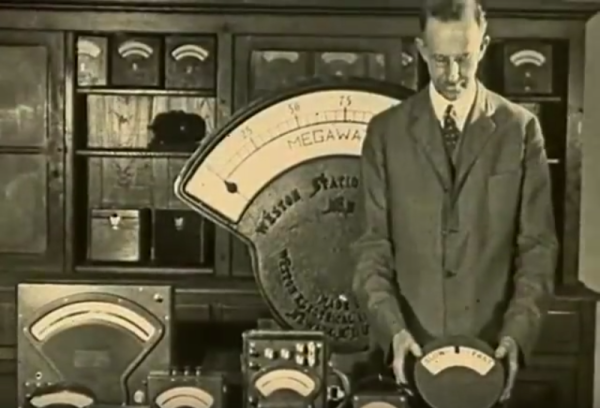
Within a few years, he co-founded the Weston Electrical Instrument Corporation. The company produced several types of meters along with transformers and transducers known for their portability and accuracy. In 1920, [Weston & Co.] created this 1920 educational film in cooperation with the United States Navy as part of a series on the principles of electricity.

The viewer is invited to consider the importance of measurement to civilization, most notably those fundamental measurements of length, mass, and time. [Weston] positions his electrical measuring instruments at this level, touting them as the international favorite. We get the full tour of a Weston meter, from the magnet treated for permanence to the specially designed pole pieces that correctly distribute lines of magnetic force. What education film about electromagnetism would be complete without an iron filings demonstration? This one definitely delivers.

Continue reading “Retrotechtacular: Weston Electrical Instruments”

Why Are You Still Making PCBs?

Few things have had the impact on electronics that printed circuit boards (PCBs) have had. Cheap consumer electronics would not be as cheap if someone still had to wire everything (although by now we’d be seeing wiring robots, I’m sure). Between removing the human from the wiring process and providing many excellent electrical properties (at least, on a well-designed board), it isn’t surprising that even the cheapest examples of electronics now use PCBs.

For many years, the hallmark of being a big-time electronic hacker was the ability to make your own PCBs. There have been many ways that people have tried to bring PCB manufacturing into the hacker’s garage: stick on decals, light-sensitive blank PCBs, and even using laser printer toner (that last one spurred me to write a book on PCB layout many years back). You also see a lot of people using 3D printers or CNC mills to create PCBs. Hardly a week goes by that someone doesn’t ask me how to make a PCB in a home or small business lab.

Continue reading “Why Are You Still Making PCBs?”

Hackaday Links: September 20, 2015

Here’s an offer from Intel and the guy behind all of reality TV [Mark Burnett]: win a million dollars for making something. Pitch an idea for wearable electronics to the producers by October 2, and you might be on a reality TV show about building electronics which they’re calling America’s Greatest Makers. With this, Intel is promoting the Curie module a tiny, tiny SoC with Bluetooth, IMU, and DSP functions. We’re of the opinion that a Hackaday reader should win this contest, or at the very least be featured prominently in the show. No, it’s not Junkyard Wars, but it’s still a million dollar prize.

[Jeremy] builds bombs clocks, and he has a Kickstarter for an interesting Nixie clock. Most Nixie tubes have digits, but [Jeremy] is using the IN-9 ‘bar’ tubes for the hour and minute hand.

The Luka EV is a semifinalist for the Hackaday Prize, and a completely open, road legal electric vehicle powered by hub motors. It also looks really, really cool.  Now, they’re selling them. It’s €20,000 for a complete car. Did I mention how cool it looks?

Boca Bearings is having a ‘Show Us Your Workshop’ contest, with the best (or should it be worst?) workshop winning tool cabinets, tool kits, a work mat, and calipers.

The EMU Drumulator is a classic drum machine that featured dirty 12-bit drum sounds in ROM. Now, it’s a single chip thanks to [Jan]. He’s done a lot of great work putting synths in single chips, and it’s great to see him move on to classic drum machines.

Offered without comment, here’s a ride through a PCB.

Hacklet 75 – Guitar Projects

Some things just go hand in hand. Hacking and guitars are one perfect example. A huge number of hackers, makers, and engineers have at least dabbled in playing the guitar. Even those who don’t play have heard the swan song of the wayward guitarist “Bro, you fix amps?”. Seriously, once your guitar toting friends find out you tinker in electronics, you’ll never be left wanting for pizza or beer. This week’s Hacklet is about some of the best guitar projects on Hackaday.io!

Continue reading “Hacklet 75 – Guitar Projects”

Embed With Elliot: Interrupts, The Good…

What’s the biggest difference between writing code for your big computer and a microcontroller? OK, the memory and limited resources, sure. But we were thinking more about the need to directly interface with hardware. And for that purpose, one of the most useful, and naturally also dangerous, tools in your embedded toolchest is the interrupt.

Interrupts do exactly what it sounds like they do — they interrupt the normal flow of your program’s operation when something happens — and run another chunk of code (an interrupt service routine, or ISR) instead. When the ISR is done, the microcontroller picks up exactly where it left off in your main flow.

Say you’ve tied your microcontroller to an accelerometer, and that accelerometer has a “data ready” pin that is set high when it has a new sample ready to read. You can wire that pin to an input on the microcontroller that’s interrupt-capable, write an ISR to handle the accelerometer data, and configure the microcontroller’s interrupt system to run that code when the accelerometer has new data ready. And from then on everything accelerometer-related happens automagically! (In theory.)

This is the first part of a three-part series: Interrupts, the Good, the Bad, and the Ugly. In this column, we’ll focus on how interrupts work and how to get the most out of them: The Good. The second column will deal with the hazards of heavyweight interrupt routines, priority mismatches, and main loop starvation: the Bad side of interrupts. Finally, we’ll cover some of the downright tricky bugs that can crop up when using interrupts, mainly due to a failure of atomicity, that can result in logical failures and corrupted data; that’s certainly Ugly.

Continue reading “Embed With Elliot: Interrupts, The Good…”

Why You Should Build A Clock For Social Good This Week

We’ve seen a wide range of emotional responses regarding [Ahmed Mohamed]’s arrest this week for bringing a clock he built to school. No matter where you fall on the political scale, we can all agree that mistaking a hobby engineering project for a bomb is a problem for education. People just don’t understand that mere mortals can, and do, build electronics. We can change that, but we need your help.

Our friends at NYC Resistor came up with a great idea. Why don’t we all build a clock? I want you to take it one step further: find a non-hacker to partner with on the project. Grab a friend, relative, or acquaintance and ask them to join you in building a clock from stuff you have on hand in order to promote STEM education.

Clocks have long been one of my favorite projects, and like the one shown above, most of my builds didn’t look anything like traditional clocks. Once you start getting into how clocks are built, you’ll be amazed at how accurate dirt-cheap clocks are and how difficult it can be to replicate that accuracy. Pass this knowledge on to your teammates. Teach them how to solder, or how to draw a schematic, or just how to open the case on some electronics without fear.

Post your project on hackaday.io and we’ll add it to the Clocks for Social Good list (message me with the link). If you decide to document it elsewhere just leave a link in the comments below. We’ll post a roundup of all these builds next week. I plan to repurpose the soldering workshop board I populated last week as the display for my clock. I’ll be helping a friend of mine learn to solder as part of the build!

Happy hacking, and thanks for helping to dispel fear and teach others about awesome engineering.

Need some inspiration to get going? You can always chat with others about it in the Hacker Channel. If you have an Arduino and some LED strips you can do something like this. Here’s a binary clock built with just a few LEDs. Or if you have a laser cutter at your disposal you can make a unique display with just a pair of motors.