Fail Of The Week: Inaugural Edition

We’re sure you’ve all been waiting on the edge of your seats to see whose project makes it as the first Hackaday Fail of the Week. Wait no longer, it’s [Mobile Will] with his woeful tale about monitoring AC current usage.

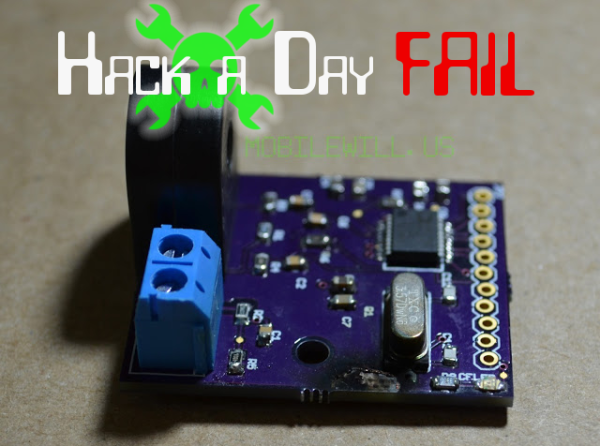
He had been working on a microcontroller actuated mains outlet project and wanted an accurate way to measure the AC current being used by the device connected to it. The ADE7753 energy metering IC was perfect for this so he designed the board above and ordered it up from OSH Park. After populating the components he hooked it up to his Arduino for a test run, and poof! Magic blue smoke arose from the board. As you’ve probably guessed — this also fried the Arduino, actually melting the plastic housing of the jumper wire that carried the rampant current. Thanks to the designers of the USB portion of his motherboard he didn’t lose the computer to as the current protection kicked in, requiring a reboot to reset it.

We can’t wait to hear the conversation in the comments. But as this is our first FotW post we’d like to remind you: [Mobile Will] already knows he screwed up, so no ripping on his skills or other non-productive dibble. Let’s keep this conversation productive, like what caused this? He still isn’t completely sure and that would be useful information for designing future iterations. Update: here’s the schematic and board artwork.

We’ve got a bit more to share in this post so keep reading after the break.

Continue reading “Fail Of The Week: Inaugural Edition”

3D Printering: Remote Control Of 3D Printers

extrude

With new owners comes new editorial direction. You’re looking at the first evidence of that right now. We’re going to be doing some weekly columns dedicated to certain subjects, and with our fascination of all things three dimensional, it only made sense our first weekly column was dedicated to 3D printers. And using 3D printers, stuff made with 3D printers. Also, things that can be used with 3D printers. Great wordsmiths we are, we’re calling this column ‘3D Printering.’ If you have a better name (or a title pic) send it in and we’ll probably use it.

With that out of the way…

This week we’re taking a look at remote printing. With anything from an Android tablet to a Raspberry Pi, it’s possible to have a networked 3D printer, the perfect thing for hackerspaces or anyone who wants to print objects from multiple computers. One of the most-used tools for this is OctoPrint, a printer host designed to be run on small embedded devices such as a Raspi.

We’ve seen OctoPrint before. but since then it’s matured a whole lot. with a ton of reports of successes running on everything from a Raspberry Pi, BeagleBone Black, and even an OUYA. All the major electronics boards – RAMPS, RAMBo, Sanguinololu – and firmwares should work with OctoPrint, making an Internet-connected 3D printer simply a matter of connecting a Raspberry Pi.

Of course OctoPrint isn’t the only networking solution for a 3D printer. PrintToPeer is deep into development and should be released sometime this fall. It’s a much more sophisticated way of networking a printer that includes an iPad app and ‘enterprise class’ functionality.

The PrintToPeer team is offering private beta invitations, but with a catch: you need to print out a piece of a sculpture and send it to them. These pieces will be unveiled in September as the largest 3D printed sculpture, and the word’s first collaborative 3D sculpture.

Retrotechtacular: Singing Bird Automata

retrotechtacular-birdsong-automata

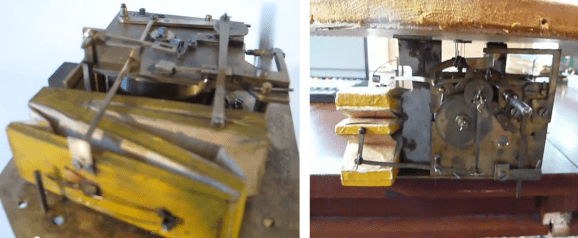
Our cats were both sleeping near the computer and these videos were driving them nuts. To our ears these birdsongs sound pretty good. They didn’t trick the cats into stalking mode, but they did spark an audible complaint. So the predators aren’t drooling but the mechanical engineers reading this should be. These automata combine the precision of a mechanical clock with a bellows and specialized whistle to recreate birdsong.

You’ve got to hear it for yourself to appreciate the variety produced by the mechanisms. The first video shows off the device seen on the left. This particular model is from the 1890’s and the demo gives a good look at the arms that open and block a passageway to alter the sound. After seeing that link — which was sent in by [Stefan] — we started searching around for more info on the devices. The one pictured to the right turned up. It’s from YouTube user [Singing Bird Boxes] who has many videos showcasing these types of devices. We picked this one because he tried to explain how each part of the mechanism works. These are still being made today, but there’s something magical about seeing one built during the steam age.

We’d like to make Retrotechtacular a weekly feature every Tuesday. Help us out by sending in links to projects that highlight old technology, instructional videos of yore, tours of museums or similar relics.

Continue reading “Retrotechtacular: Singing Bird Automata”

Have You Failed Hard Enough To Be On Hackaday?

hackaday-fail-announcement

There’s so much more to be discovered when your projects just don’t want to work. Grinding out the bugs, getting past roadblocks, and discovering gotchas is where real hacking know-how comes from. But most people aren’t motivated to document their failures. We want to change that.

We want to roll out a new weekly feature that showcases failure… well documented failure. But we need YOU to give up the goods. Write about your failed experience on your blog, post it to our project forums with [FAIL] in the title, or you can just write everything in an email and send it to us. Which ever way you choose, you’ll need to tip us off that you’d like to make it to the front page (come on, it’s not bragging since it didn’t even work!). If you already know of well documented project fails send in those links too even if they’re not your projects.

Make sure you include at least one descriptive image — snapshots, diagrams, schematics, screencaps, anything that tells the story is fair game. To show you what we’re after here’s a few of our favorite failed projects:

We’d like to point out that all of these projects are interesting ideas that show off missteps along the way. We will not be trashing on your skills as a hacker, but instead celebrating the lessons learned and hearlding the sharing of ideas from otherwise doomed projects.

Hackaday Links: Sunday, August 4th, 2013

hackaday-links-chain

[Craig Turner] shows that simplicity can be surprisingly interesting. He connected up different colors of blinking LEDs in a grid. There’s no controller, but the startup voltage differences between colors make for some neat patterns with zero effort.

Remember the 3D printed gun? How about a 3D printed rifle! [Thanks Anonymous via Reason]

While we’re on the topic of 3D printing, here’s a design to straighten out your filament.

It takes four really big propellers to get an ostrich off the ground. This quadcopter’s a bit too feathery for us, but we still couldn’t stop laughing.

This Kinect sign language translator looks pretty amazing. It puts the Kinect on a motorized gimbal so that it can better follow the signer. We just had a bit of trouble with translation since the sound and text are both in Hebrew. This probably should have been a standalone feature otherwise.

Work smarter, not harder with this internal combustion wheelbarrow. [via Adafruit]

Ask Hackaday: Can You Steal A Car With A Mini Tesla Coil?

Last week we caught wind of a piece from the Today Show that shows very technically minded thieves stealing cars with a small device. Cops don’t know how they’re doing it, and of course the Today show (and the Hackaday comments) were full of speculation. The top three theories for how these thieves are unlocking car doors are jamming a keyless entry’s ‘lock signal’, a radio transmitter to send an ‘unlock’ code, or a small EMP device touched to the passenger side door to make it unlock.

That last theory – using a small EMP device to unlock a car’s door – got the attention of someone who builds mini EMP devices and has used them to get credits on slot machines. He emailed us under a condition of anonymity, but he says it’s highly unlikely a mini EMP device would be able to activate the solenoid on a car door.

This anonymous electromagnetic wizard would like to open up a challenge to Hackaday readers, though: demonstrate a miniature EMP device able to unlock an unmodified car door, and you’ll earn the respect of high voltage tinkerers the world over. If you’re successful you could always sell your device to a few criminal interests, but let’s keep things above board here.

Ask Hackaday: What Are We Going To Do With The New Kinect?

kinect

Yesterday Microsoft announced their new cable box, the Xbox One. Included in the announcement is a vastly improved Kinect sensor. It won’t be available until next Christmas, but now the question is what are we going to do with it?

From what initial specs that can be found, the new version of the Kinect will output RGB 1080p video over a USB 3.0 connection to the new Xbox. The IR depth camera of the original Kinect has been replaced with a time of flight camera – a camera that is able to send out a pulse of light and time how long it takes for photons to be reflected back to the camera. While there have been some inroads into making low-cost ToF cameras – namely Intel and Creative’s Interactive Gesture Camera Development Kit and the $250 DepthSense 325 from SoftKinetic – the Kinect 2.0 will be the first time of flight camera you’ll be able to buy for a few hundred bucks at any Walmart.

We’ve seen a ton of awesome Kinect hacks over the years. Everything from a ‘holographic display’ that turns any TV into a 3D display, computer vision for robots, and a 3D scanner among others. A new Kinect sensor with better 3D resolution can only improve existing projects and the time of flight sensor – like the one found in Google’s driverless car – opens up the door for a whole bunch of new projects.

So, readers of Hackaday, assuming someone can write a driver in a few days like the Kinect 1.0, what are we going to do with it?

While we’re at it, keep in mind we made a call for Wii U controller hacks. If somebody can crack that nut, it’ll be an awesome remote for robots and FPV airplanes and drones.