Scratch Built Amiga 2000 Stacks Up The Mods

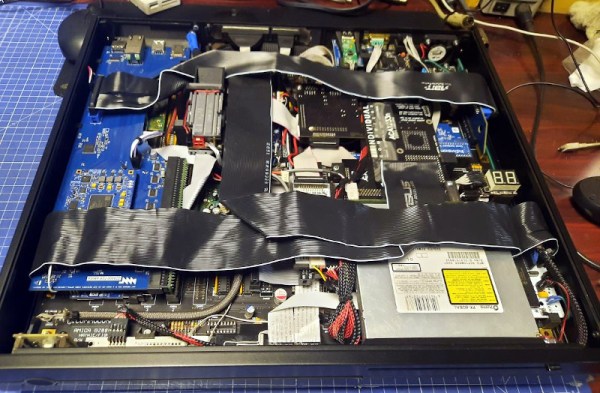
Around these parts, we most often associate [Drygol] with his incredible ability to bring damaged or even destroyed vintage computers back to life with a seemingly endless bag of repair and restoration techniques. But this time around, at the request of fellow retro aficionado [MrTrinsic], he was given a special assignment — to not only build a new Amiga 2000 from scratch, but to pack it with so many mods that just physically fitting them into the case would be a challenge in itself.

The final product, dubbed Tesseract, took two and a half years to complete and has been documented over the course of six blog posts. The first step was to get a brand new motherboard, in this case a modern recreation designed by Floppie209, and start populating it with components. With some modifications, the new board slipped neatly into a slick metal case. Unfortunately it quickly became clear some of the mods the duo wanted to install wouldn’t work with the reverse-engineered motherboard. This was around Spring of 2021, which is the last time we checked in on the project. Continue reading “Scratch Built Amiga 2000 Stacks Up The Mods”
Pi Picos Give Casio FX9000P Its Memory Back

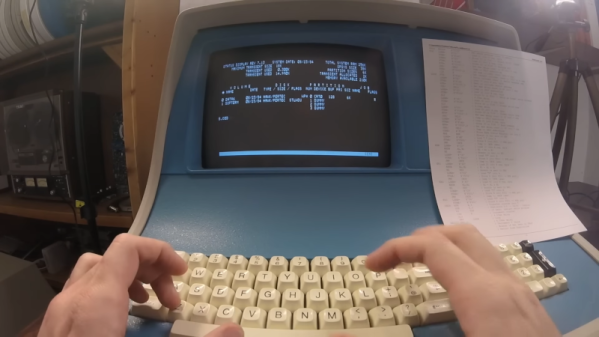
Is the Casio FX9000P a calculator or a computer? It’s hard to tell since Casio did make calculators that would run BASIC. [Menadue] didn’t know either, but since it had a CRT, a Z80, and memory modules, we think computer is a better moniker.

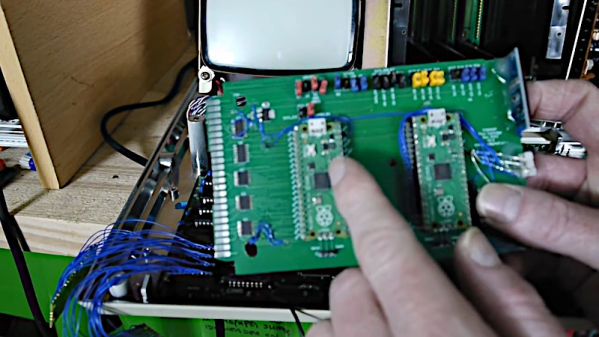
He found one of these, but as you might expect, it needed a bit of work. There were two bad video RAM chips on the device, and [Menadue] used two Raspberry Pi Picos running a program to make them think they are RAM chips. The number of wires connecting the microcontollers might raise some eyebrows, but it does appear to get the job done.

He also used more Picos to emulate memory on cartridges. Then he used a test clip and a — you guessed it — another Pico to monitor the Z80 bus signals. It is amazing that the Pico can replace what would have been state-of-the-art memory chips and a very expensive logic analyzer.

The second video mostly shows the computer in operation. The use of Picos to stand in for so much is clever. It reminded us of the minimal Z80 computer that used an Arduino for support chips. The computer itself, though, reminded us more of a cheap version of the HP9845.

Continue reading “Pi Picos Give Casio FX9000P Its Memory Back”

Assembly Language 80’s Minicomputer Style

In the days before computers usually used off-the-shelf CPU chips, people who needed a CPU often used something called “bitslice.” The idea was to have a building block chip that needed some surrounding logic and could cascade with other identical building block chips to form a CPU of any bit width that could do whatever you wanted to do. It was still harder than using a CPU chip, but not as hard as rolling your own CPU from scratch. [Usagi Electric] has a Centurion, which is a 1980s-vintage minicomputer based on a bitslice processor. He wanted to use it to write assembly language programs targeting the same system (or an identical one). You can see the video below.

Truthfully, unless you have a Centurion yourself, the details of this are probably not interesting. But if you have wondered what it was like to code on an old machine like this, you’ll enjoy the video. Even so, the process isn’t quite authentic since he uses a more modern editor written for the Centurion. Most editors from those days were more like CP/M ed or DOS edlin, which were painful, indeed.

The target program is a hard drive test, so part of it isn’t just knowing assembly but understanding how to interface with the machine. That was pretty common, too. You didn’t have a lot of help from canned routines in those days. For example, it was common to read an entire block from a hard drive, tape, or drum and have to figure out what part of it you were actually interested in instead of, say, opening a file and reading a stream of characters.

If nothing else, fast forward over to the 25-minute mark and see what a hard drive from that era looked like. Guess how much storage was on that monster? If you guessed more than 10 MB, you probably didn’t live through the 1980s. We won’t even guess what the price tag was, but you can bet it was spendy.

If you think entering programs like this is painful, try a front panel. That made paper tape seem like a great thing.

Continue reading “Assembly Language 80’s Minicomputer Style”

TRS-80 Model 100 Inspires Cool Cyberdeck Build, 40 Years Down The Line

The TRS-80 Model 100 was a strange beast. When it debuted in 1983, it resembled nothing that was available at the time, and filled a gap between desktop computers and the mostly-not-invented-yet laptop segment of the market. Collectors covet these machines, but they’re getting harder to find four decades later. So, if you want one, you just might have to roll your own.

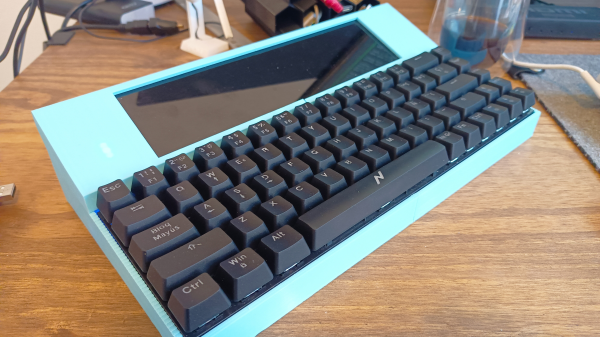
Honestly, it doesn’t appear [Roberto Alsina]’s purpose here we to recreate the Model 100 per se, but rather to take inspiration from its oddball form factor and experiment with the latest components. The design elements from the original that [Roberto]’s creation most strongly echo are the screen with the extreme landscape aspect ratio and the somewhat compressed keyboard. The latter is based on the cheapest mechanical 65% keyboard available, while the former is a 1920×480 LCD display intended for automotive applications. The display seems like it put up a fight, between its need for a custom HDMI cable to connect it to the Radxa Zero SBC under the hood as well as the custom kernel needed to support it.

Along with a USB hub for IO and some 18650s for power, everything went into a 3D printed case with considerably sleeker lines than the Model 100. It’s worth pointing out that [Roberto] didn’t have much experience with design or 3D printing when he kicked off this project. We love to see people stretching their skills like that, and we think the results are great in this case. We’ve seen a lot of Model 100 retrofits and brain transplants, but this may be the first time we’ve seen a build quite like this.

SCSI: The Disk Bus For Everything

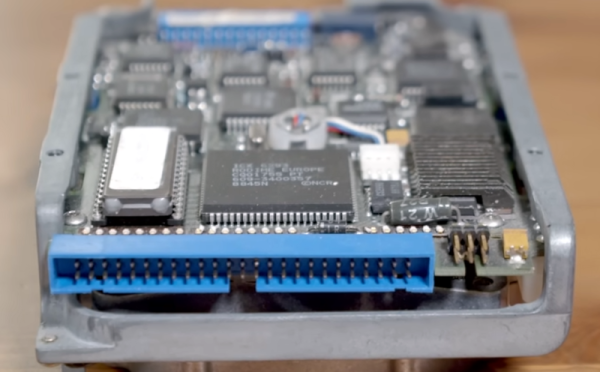
Early home PCs usually had a floppy disk and a simple hard drive controller. Later, IDE hard drives became the defacto standard. Of course, these days, you are more likely to find some version of SATA and — lately — NVME connectors. But a standard predating all of this was very common in high-end systems: SCSI. [RetroBytes] recently did a video on the bus which he calls the “USB of the 80s.”

Historically, Shugart — a maker of disks — was tired of producing custom drive electronics for each device they made. Instead, they made disks with a standard interface and then produced a single interface board for each computer they wanted to support. The interface was very generic, and they were able to get it standardized with ANSI — an early example of the benefit of opening up a standard.

Continue reading “SCSI: The Disk Bus For Everything”

Brand New Colecovision Console – On A Breadboard

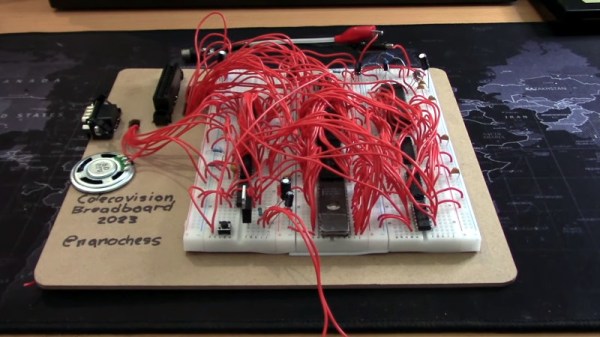
The Colecovision console from the early 1980s is probably not the most memorable platform of its era, but it retains a retrocomputing following to this day. The original hardware can be a bit pricey in 2023, so [nanochess] has built one of his own on a breadboard. It’s fully functional from original Colecovision cartridges, and we see it in the video below the break running Frogger.

Behind the mess of wires is a surprisingly simple circuit with only a few logic chips beyond the Z80 processor, the various memory and EPROM chips, and the video and sound chips. We’re told the complexity is considerably reduced by the use of a Texas Instruments  TMS9118 video controller instead of a 9918.

Had we been building it we would probably have taken the less brave step of using color coded wires for the various signals, because we remember the fun and games associated with wiring old-style 8-bit computers by hand only too well. But we have to admit that it reminds us of a lost youth working out Z80 address decoder schematics, so it’s very pleasing to see one built today.

If you’re hungry for more Coleco goodness, this isn’t the first home made Colecovision we’ve brought you.

Continue reading “Brand New Colecovision Console – On A Breadboard”

Trying (and Failing) To Restore A 1970s CDC 10MB Hard Drive

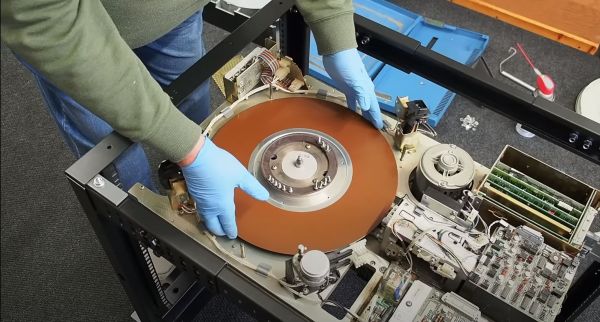
One fun aspect of 1970s-era hard disk drives is that they are big, clunky and are fairly easy to repair without the need for a clean room. A less fun aspect is that they are 1970s-era HDDs and thus old and often broken. While repairing a CDC 10 MB HDD for the upcoming VCF East event, the folks over at [Usagi Electric], this led to quite a few struggles, even after a replacement 14″ platter was found to replace the crashed platter with.

These CDC HDDs are referred to as Hawk drives, and they make the associated 8-bit Centurion  TTL logic-based computers so much faster and easier to work with (for a 1970s system, of course). Despite the large size of the components involved and the simple, all through-hole nature of the PCBs, issues that cropped up ranged from corroded DIP switches, to head alignment sensors, a defective analog board and ultimately a reported bad read-write head.

Frustratingly, even after getting the platters to spin up and everything moving as intended, it would seem that the remaining problem is that of possibly bad read-write heads, as in plural. Whether it’s due to age, previous head crashes onto platters, or something else, assembling a working Hawk drive turned out to be somewhat more complicated than hoped.

We definitely hope that the bunnies can get a working Hawk together, as working 1970s HDDs like these are become pretty rare.

Continue reading “Trying (and Failing) To Restore A 1970s CDC 10MB Hard Drive”