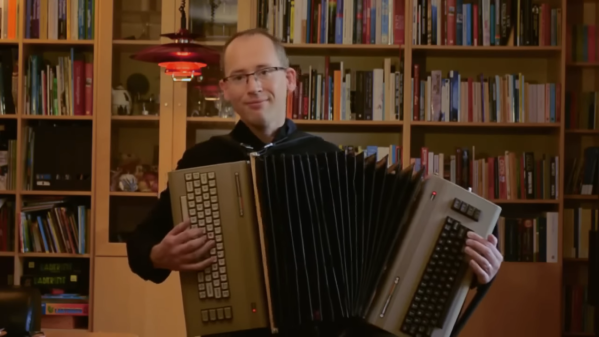
A man playing an accordion-like instrument made from two Commodore 64s

The Commodordion Turns Two C64s Into A Single Instrument

One of the main reasons the Commodore 64 became an icon of the 1980s was its MOS 6581 “SID” sound chip that gave it audio capabilities well beyond those of other microcomputers of the 8-bit era. The SID became something of a legend by itself among chiptune enthusiasts, and several electronic instruments have been designed that generate their sound through a SID chip. Not many of those look anything like traditional musical instruments however, so we’re delighted to see [Linus Ã…kesson]’s new project: two Commodore 64s joined back-to-back using a bellows to form a wonderful new instrument called the Commodordion. It can be played in a similar way one plays a traditional accordion: melodies are played with the right hand, chords with the left, and volume is adjusted by varying the pressure in the bellows.
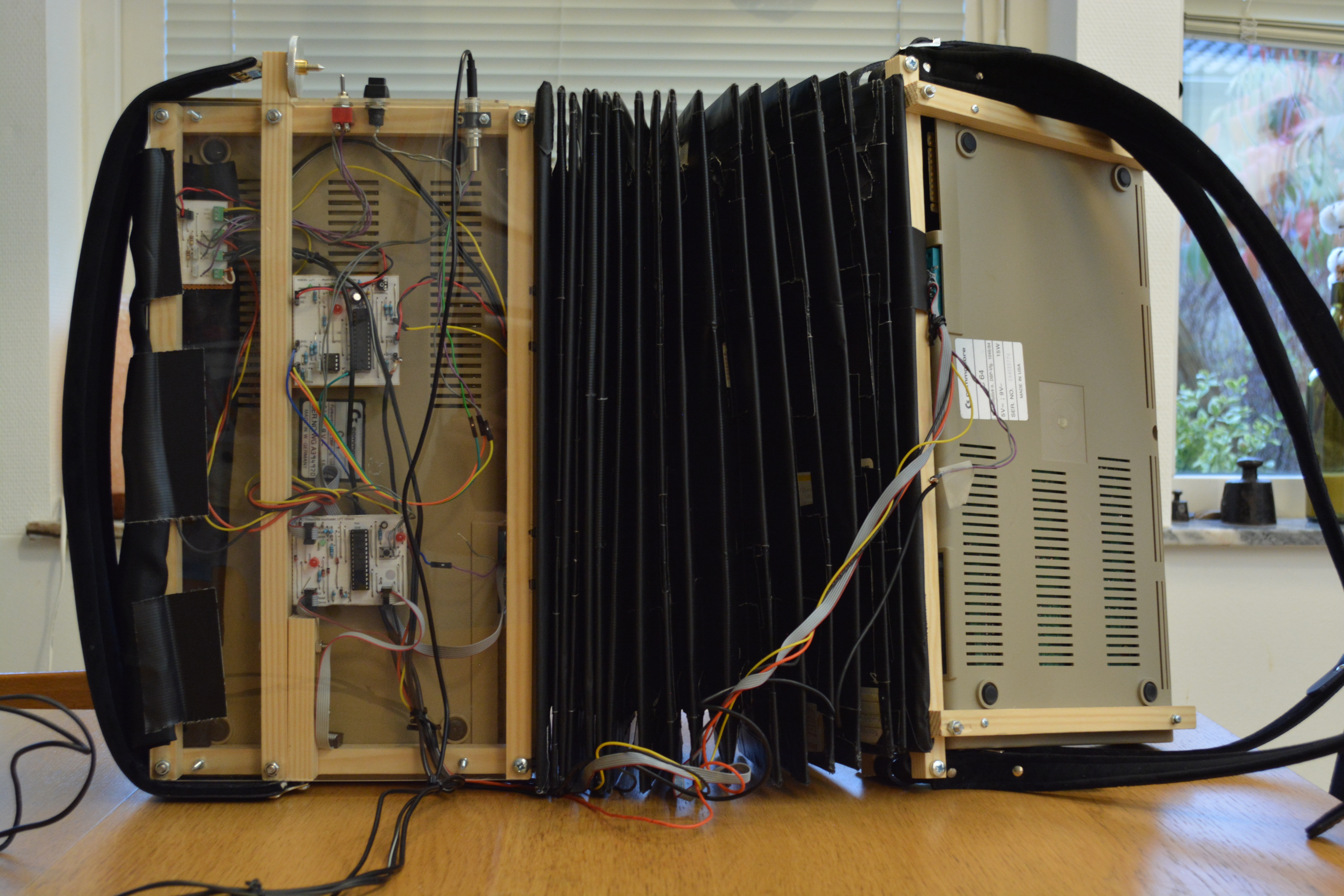
An accordion-like instrument made from two Commodore 64sThe two computers are basically unmodified, and boot Commodore BASIC like they normally would. A custom circuit board emulates a cassette player and provides the software to be loaded into memory. Both computers run the same program and can be switched between the right-hand and left-hand role by pressing a specific key combination. The software in question is called Qwertuoso, and basically maps notes and various features of the SID chip to keys on the Commodore’s keyboard.

Of course, it’s the bellows that makes this instrument a true member of the accordion family. Made from 5.25″ floppy disks and sticky tape, it forms a more-or-less air-tight system linking the two computers. The airflow in the bellows is measured through a microphone placed next to the air intake: the amount of noise generated is roughly proportional to the amount of air being expelled or inhaled. This information is then used to modulate the volume generated by the two SID chips.

By [Linus]’s own admission it’s not the most ergonomic of instruments, so we’re doubly impressed by the amount of skill he demonstrates while playing it in the video embedded below. It’s not the first time either that he has turned a Commodore 64 into a musical instrument: he previously built a church organ and a theremin. While the Commodordion may look complicated, it’s actually much simpler in construction than a mechanical accordion.

Continue reading “The Commodordion Turns Two C64s Into A Single Instrument”
This Snappy 8-Bit Microcomputer Brings The Speed To Retrocomputing

When the need for speed overcomes you, thoughts generally don’t turn to 8-bit computers. Sure, an 8-bit machine is fun for retro gameplay and reliving the glory days, and there certainly were some old machines that were notably faster than the others. But raw computing power isn’t really the point of retrocomputing.

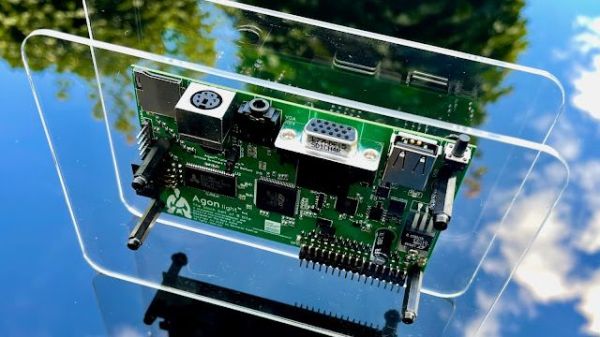
Or is it? [Bernardo Kastrup] over at The Byte Attic has introduced an interesting machine called the Agon Light, an 8-bit SBC that’s also a bit like a microcontroller. The machine has a single PCB that looks about half as big as an Arduino Uno, and sports some of the same connectors and terminals around its periphery. The heart of the Agon Light is an eZ80 8-bit, 18.432 MHz 3-stage pipelined CPU, which is binary compatible with the Z80. It also has an audio-video coprocessor, in the form of an ESP32-Pico-D4, which supports a 640×480 64-color display and two mono audio channels. There’s no word we could find of whether the ESP32’s RF systems are accessible; it would be nice, but perhaps unnecessary since there are both USB ports and a PS/2 keyboard jack. There’s also a pin header for 20 GPIOs as well as I2C, SPI, and UART for serial communication.

The lengthy video below goes into all the details on the Agon Light, including the results of benchmark testing, all of which soundly thrash the usual 8-bit suspects. The project is open source and all the design files are available, or you can get a PCB populated with all the SMD components and just put the through-hole parts on. [Bernardo] is also encouraging people to build and sell their own Agon Lights, which seems pretty cool too. It honestly looks like a lot of fun, and we’re looking forward to seeing what people do with this.

Continue reading “This Snappy 8-Bit Microcomputer Brings The Speed To Retrocomputing”

HP-41C, The Forth Edition

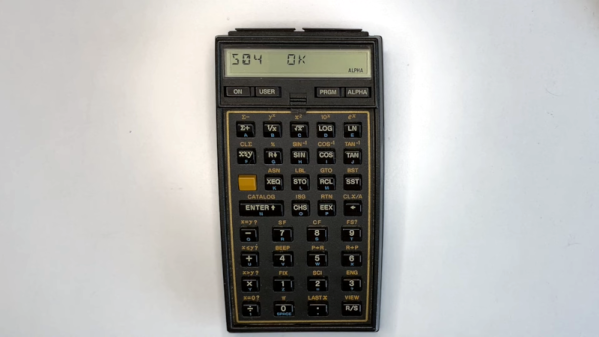
If you have an HP-41 — arguably the best calculator ever made, you might not have noticed that there’s a version of Forth for it. The code was written a while back in assembly and will work on anything that actually emulates the device properly, such as a SwissMicros DM41X. [Calculator Clique] shows you how it works in a recent video that you can watch below.

The original code dates back to 1984, but some recent detective work by [Angel Margin] has the code running again. If you know about synthetic programming on the 41C and the oddities of its internal architecture, you can’t help but be impressed.

Of course, Forth is meant to be easy to port over, but if you read about some of the architectural challenges, you start to realize this could be one of the more difficult implementations you’ve ever seen. Don’t forget you have what is, by today’s standards, an extremely limited amount of resources.

That being said, calling the HP41C a calculator is almost a crime. It is really a tiny computer hiding inside a calculator case. Then again, the best calculators always are.

We wonder if the code would run on an emulated 41C? Were you part of the TI calculator gang? No problem.

Continue reading “HP-41C, The Forth Edition”

A small green circuit board with a tiny OLED display

An Oscilloscope Trigger For Vintage Video Processors

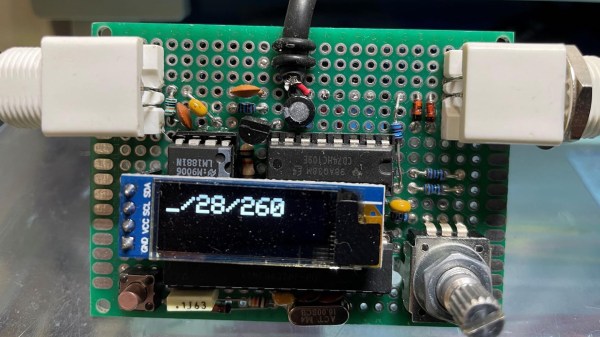
Working on retro computers is rarely straightforward, as [ukmaker] recently found out while designing a new display interface. Their oscilloscope was having trouble triggering on the video signal produced by older video circuitry, so they created the Video Trigger for Retrocomputers.

The Texas Instruments TMS9918 video display controller was used across a range of 1980s game consoles and home computers, from the well-known ColecoVision to Texas Instruments’ own TI-99/4. Substantial retro computing heritage notwithstanding, the video output from this chip was (for reasons unknown) not quite compatible with the Hantek DSO1502P oscilloscope. And without a better understanding of the video signal, it was difficult to use the chip with newer TFT displays, being designed for CRT televisions with more forgiving NTSC tolerances.

Maybe a different scope would have solved the problem, but [ukmaker] had a feeling that the ‘scope needed an external trigger signal. The Video Trigger project uses a LM1881 sync separator to tease out the horizontal and vertical sync signals from the vintage video chip, with the output piped into an ATmega 328P. Along with a smattering of discrete components, the ATmega aids the user in selecting which line to frame a trigger on, and the slope of the horizontal sync signal to align to. A tiny OLED display makes configuration easy.

If this has piqued your interest, [ukmaker] also has a great write-up over on GitHub with all the gory details. Maybe it will help you in your next vintage computing caper. Having the right tool can make all the difference, like this homebrew logic meter for hobby electronics troubleshooting. Or if you want to know more about the mystical properties of analog NTSC video, we’ve covered that, too.

Classic DOS Games On An Arduino?

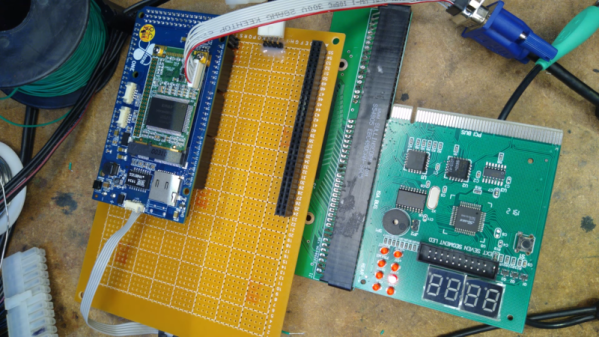
It has been a while since we’ve seen a 86Duino, but [TheRasteri] reminded us about it, with his video showing how to use one to run classic MS-DOS games. To be fair, the computer isn’t really an Arduino, it’s essentially a tiny 486 PC on an Arduino-style PCB.

If it were just running DOS games on a tiny PC, that wouldn’t be very newsworthy. However, the board by itself has no video card and, as [TheRasteri] points out, sound card compatibility is also a problem. A carrier board, however, has a tiny VGA card on it, and thanks to some work from another user, it is possible to add an ISA bus to the board if you want to plug in a legacy sound card.

The ISA hack was done neatly, but it is a bit of wiring. Instead of using a normal ISA backplane, it is possible to use a PC/104 backplane, if you have cards that will fit that bus — electrically, they are the same. The board was able to run DOOM and Quake at nearly 30 frames per second. Not bad. He did have problems getting a mouse to work, though.

Got a bit nostalgic watching him use QBasic to directly write to registers on an ISA card. If you want an old DOS machine and don’t want to tie up a lot of space, this could be the ticket. Especially if you need it to run some old piece of hardware that won’t work with modern computers. We have to wonder if anyone would make a USB to ISA adapter out of something like this. The drivers would seem to be the hard part.

We saw the 86Duino nearly 10 years ago when there were a few other x86 single-board computers around. Apparently, lots of people want to run vintage games.

Continue reading “Classic DOS Games On An Arduino?”

A small keyboard form factor retrocomputer with blue keys on a black background sits in front of a display and a LEGO model of the Space Shuttle. There are a number of jumper wires and a breadboard coming from an open panel on the right side of the machine.

Aqua PCB Is A Big Upgrade For The Mattel Aquarius

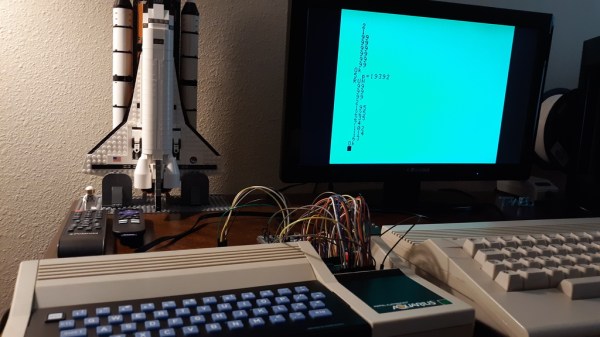
In case you weren’t around in the 80s, or you happened to blink, you may have missed the Mattel Aquarius computer. [Nick Bild] has a soft spot in his heart for the machine though and built the Aqua cartridge to make the Aquarius into a more usable machine.

Originally equipped with a mere 4 KB of RAM and a small, rubbery keyboard, it’s not too surprising that the Aquarius only lasted five months on the market. [Nick] decided on the cartridge slot to beef up the specs of this little machine given the small number of expansion ports on the device. Adding 32 KB of RAM certainly gives it a boost, and he also designed an SD card interface called Aqua Write that connects to the Aqua cartridge for easily transferring files from a more modern machine.

The Aqua Write uses an Arduino Mega 2560 to handle moving data between the SD card and the system’s memory. This is complicated somewhat because a “PLA sits between the Z80 and data bus that XORs data with a software lock code (initialized to a random value on startup).” [Nick] gets around this by running a small program to overwrite the lock code to zero after startup.

Getting data on and off retrocomputers can certainly be a challenge. If you’re trying to get files on or off another old machine, check out this Simple Universal Modem or consider Using a Raspberry Pi as a Virtual Floppy Drive.

A Cassette Interface For A 6502 Breadboard Computer, Kansas City-Style

It’s been a long time since computer hobbyists stored their programs and data on cassette tapes. But because floppy drives were expensive peripherals and hard drives were still a long way from being the commodity they are today, cassettes enjoyed a long run at the top of the bulk data storage heap.

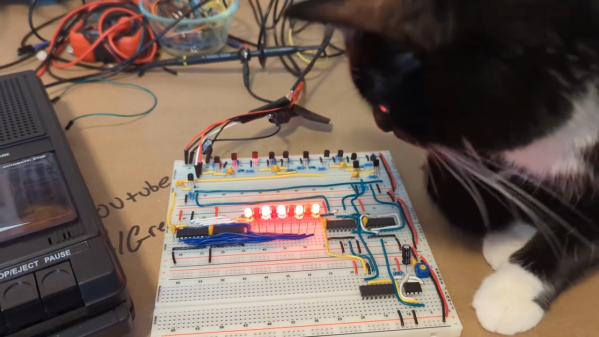
Celebrating that success by exploring the technology of cassette data storage is the idea behind [Greg Strike]’s Kansas City decoder project, which he hopes to use with his [Ben Eater]-style 6502 computer. The video below explains the Kansas City standard in some detail, and includes some interesting historical context we really hadn’t delved into before. There are also some good technical details on the modulation scheme KCS used, which [Greg] used to base his build. After a failed attempt to use an LM567 tone decoder chip, he stumbled upon [matseng]’s KCSViewer project, which decodes KCS-encoded audio signals using nothing but discrete components.

[Greg]’s prototype has a comparator to convert sine waves to square waves, followed by pair of monostable timers, each tuned to either the high or low frequency defined in the KCS specs. A test signal created using Audacity — is there anything it can’t do? — was successfully decoded, providing proof of concept for the project’s first phase. We’re looking forward to the rest of the series, which will turn this into an actual decoder, and presumably add an encoder as well.

Listeners of the Hackaday Podcast may recall we experimented with using KCS to hide some data within an episode a few months back.

Continue reading “A Cassette Interface For A 6502 Breadboard Computer, Kansas City-Style”