LED Art Reveals Itself In Very Slow Motion

Every bit of film or video you’ve ever seen is a mind trick, an optical illusion of continuous movement based on flashing 24 to 30 slightly different images into your eyes every second. The wetware between your ears can’t deal with all that information individually, so it convinces itself that you’re seeing smooth motion.

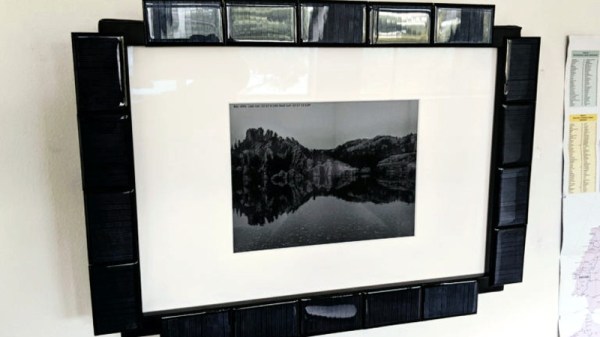
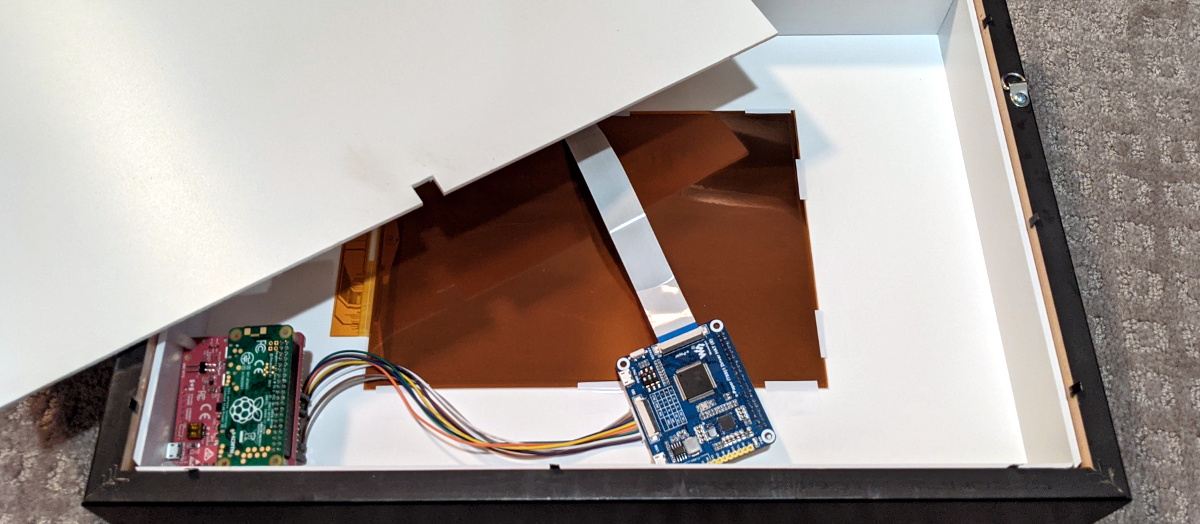
But what if you slow down time: dial things back to one frame every 100 seconds, or every 1,000? That’s the idea behind this slow-motion LED art display called, appropriately enough, “Continuum.” It’s the work of [Louis Beaudoin] and it was inspired by the original very-slow-motion movie player and the recent update we featured. But while those players featured e-paper displays for photorealistic images, “Continuum” takes a lower-resolution approach. The display is comprised of four nine HUB75 32×32 RGB LED displays, each with a 5-mm pitch. The resulting 96×96 pixel display fits nicely within an Ikea RIBBA picture frame.

The display is driven by a Teensy 4 and [Louis]’ custom-designed SmartLED Shield that plugs directly into the HUB75s. The rear of the frame is rimmed with APA102 LED strips for an Ambilight-style effect, and the front of the display has a frosted acrylic diffuser. It’s configured to show animated GIFs at anything from 1 frame per second its original framerate to 1,000 seconds per frame times slower, the latter resulting in an image that looks static unless you revisit it sometime later. [Louis] takes full advantage of the Teensy’s processing power to smoothly transition between each pair of frames, and the whole effect is quite wonderful. The video below captures it as best it can, but we imagine this is something best seen in person.

Continue reading “LED Art Reveals Itself In Very Slow Motion”

Mirrored Music Machine Reflects Circadian Rhythms

Interactive artist [Daric Gill] wrote in to share the incredible electronic sculpture he’s been working on for the past year. It’s called the Circadian Machine, and it’s a sensor-enabled mindfulness music-and-lights affair that plays a variety of original compositions based on the time of day and the circle of fifths. This machine performs some steady actions like playing chimes at the top of each hour, and a special sequence at solar noon.

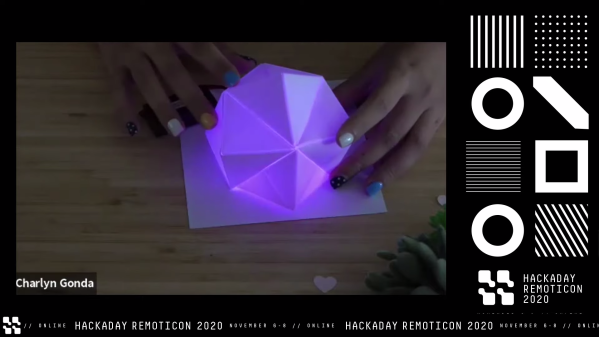
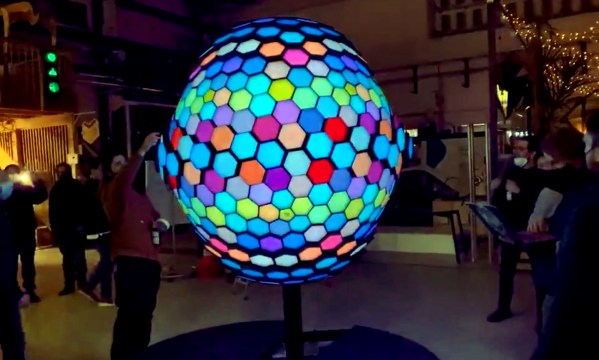
This cyberpunk-esque truncated hexagonal bi-pyramid first geolocates itself, and then learns the times for local sunrise and sunset. A music module made of a Feather M4 Express and a Music Maker FeatherWing fetches astronomical data and controls the lights, speakers, and a couple of motion sensors that, when tripped, will change the lights and sounds on the fly. A separate Feather Huzzah and DS3231 RTC handle the WiFi negotiation and keep track of the time.

On top of the hourly lights and sound, the Circadian Machine does something pretty interesting: it performs another set of actions based on sunrise and sunset, basically cramming an entire day’s worth of actions between the two events, which seems like a salute to what humans do each day. Check out the build notes and walk-through video after the break, then stick around for the full build video.

The internet is rife with information just begging to be turned into art. For instance, there are enough unsecured CCTV cameras around the world with primo vantage points that you can watch a different sunrise and sunset every hour of every day.

Continue reading “Mirrored Music Machine Reflects Circadian Rhythms”

Hand-Stitched Keycaps For Truly Luxurious Typing

We’ve seen some very unique custom keycaps recently, but nothing quite like the embroidered ones that [Billie Ruben] has been experimenting with. Using a clever 3D printed design, she’s crafted what could well be one of the most easily customizable keycaps ever made…assuming you’ve got a needle and thread handy.

The idea is to take a standard keycap blank and pop an array of 25 holes in the face. Your thread or yarn is run through these holes, allowing you to create whatever shape you wish within the 5 x 5 matrix. While it’s somewhat tight quarters on the underside of the cap, nothing prevents you from using multiple colors or even materials to do your stitching. As an added bonus, the soft threads should provide a very comfortable and particularly tactile surface to tap on.

Now the most obvious application is to simply stitch up versions of all the alphanumeric keys, but there’s clearly room for some interpretation here. [Billie] has already shown off some simple iconography like a red heart and we’re sure creative folks will have no trouble coming up with all sorts of interesting needlepoint creations to top their prized mechanical keyboards.

The intricate details necessary to make this idea work may be beyond the common desktop FDM 3D printer, so [Billie] ran these prototypes off on a resin printer (she attributes the visible layer lines to a hasty print). She’d love to hear feedback from other keyboard aficionados who’ve made the leap to liquid goo printing, so be sure to drop her a line if you print out a set of your own. It sounds like a new version is in the works which will provide a false bottom to cover the stitching from below, but functionally these should get you started.

Mixing Up Your Own Supersized Sidewalk Chalk

When folks started quarantining, chalk art spilled onto driveways and sidewalks to remind us that there’s still beauty and creative people doing what they always do. Now it’s time to strut your stuff and show your neighbors that things are greener on your slab of concrete. [friedpotatoes] has shared their giant sidewalk recipe with the world so you can paint the town red. With chalk.

Name brand sidewalk chalk is expensive considering how easy it is to make. What Big Chalk doesn’t want you to know is that the ingredients are just water, plaster of Paris, and tempera paint; meaning this project should be safe enough for the junior hackers to get some hands-on time. Some folks use food coloring instead of paint, but we know what happens to clothing when kids get their mitts on food coloring. [friedpotatoes] also includes extensive repurposing of recyclables, which is commendable.

The instructions suggest filling potato chip (crisp) tubes through a milk jug funnel to make giant pieces, but you can use any mold you like. If you have a CNC machine, it should be no trouble to make stamp-like pieces of chalk for tagging on the go, or shapes like arrows when you have to direct a miniature parade.

For permanent and precise sidewalk decorations, you can check out a graffiti paint machine and for totally temporary messages there is a water-dispensing writer.

Modular Vibrating ‘Bots Made From PCBs

Printed circuit boards, they’re a medium designed primarily to mount electrical components with the wires themselves places as copper traces on the boards. To accommodate wide range of needs that have arisen over decades, board houses have evolved all manner of advanced techniques in routing and plating. To our benefit, this also makes it possible to leverage PCBs in an entirely artistic way, taking advantage of the highly-optimized manufacturing process. [GeeekClub] did just that, creating awesome vibrating robots out of custom-made PCBs.

The ‘bots come as a single PCB, with the parts snapped out akin to removing parts from sprues in a plastic model kit. They can then be assembled, with a pair of pager vibration motors installed to provide motive power. But really it’s the aesthetic of the boards and not the functionality that make these so incredible.

The design nestles a coin cell in the base of each bot, providing power and using the weight to help keep them upright. There’s a smattering of LEDs on board, and the art style of the ‘bots draws from Hopi Indian, Asian, and South American influences.

Cyphercon 2017 featured these exciting cubic badges, created from PCBs and soldered by hand.
This Star Trek inspired piece shows just how far you can go with the right color soldermask and some creativity.

This “flat-pack” style of PCB design that comes to life with creative use of angles and layers is becoming its own sub-genre of the art. The Star Trek Enterprise inspired build in another great example. We’ve also seen a growing trend of using the PCB as enclosures, take the Cyphercon badge and Queercon badge projects from 2017 as examples. Get yourself up to speed on design techniques for using FR4 as an enclosure from [Voja Antonic’s] in-depth guide.

Print With Plasma!

Over the years there have been a variety of methods for a computer to commit its thoughts to paper. Be it a daisy wheel, a dot matrix, a laser, or an inkjet, we’ve all cursed at a recalcitrant printer. There’s another type of printer that maybe we don’t think of quite as often but is workhorse in a million cash registers and parking ticket machines: the thermal printer. These mechanisms can be readily found as surplus items and have made their way into more than one project here over the years. [HomoFaciens] has taken thermal printing a step further by building a plasma printer from scratch that makes use of the thermal paper.

A thermal printer does its job as its name suggests, by burning the image into the paper. It may not deliver the best quality print, but scores on not needing ink ribbons, cartridges, or toner. This DIY version uses an off-the-shelf battery-powered plasma lighter to do the job, mounted on a 3D printed XY printer mechanism driven by two stepper motors. Behind the scenes is an Arduino Uno, which receives its instructions via USB from a command-line program on a Linux box. It’s admitted that this is hardly the pinnacle of printing technology, but it does at least make for a fascinating project. You can see it in action in the video below the break.

This isn’t [HomoFaciens]’ first printer, we’re instantly reminded of this ink drop printer from a few years ago.

Continue reading “Print With Plasma!”

Generate Positivity With Machine Learning

Gesture recognition and machine learning are getting a lot of air time these days, as people understand them more and begin to develop methods to implement them on many different platforms. Of course this allows easier access to people who can make use of the new tools beyond strictly academic or business environments. For example, rollerblading down the streets of Atlanta with a gesture-recognizing, streaming TV that [nate.damen] wears over his head.

He’s known as [atltvhead] and the TV he wears has a functional LED screen on the front. The whole setup reminds us a little of Deep Thought. The screen can display various animations which are controlled through Twitch chat as he streams his journeys around town. He wanted to add a little more interaction to the animations though and simplify his user interface, so he set up a gesture-sensing sleeve which can augment the animations based on how he’s moving his arm. He uses an Arduino in the arm sensor as well as a Raspberry Pi in the backpack to tie it all together, and he goes deep in the weeds explaining how to use Tensorflow to recognize the gestures. The video linked below shows a lot of his training runs for the machine learning system he used as well.

[nate.damen] didn’t stop at the cheerful TV head either. He also wears a backpack that displays uplifting messages to people as he passes them by on his rollerblades, not wanting to leave out those who don’t get to see him coming. We think this is a great uplifting project, and the amount of work that went into getting the gesture recognition machine learning algorithm right is impressive on its own. If you’re new to Tensorflow, though, we have featured some projects that can do reliable object recognition using little more than a Raspberry Pi and a camera.

Continue reading “Generate Positivity With Machine Learning”