Remoticon Video: Circuit Sculpture Workshop

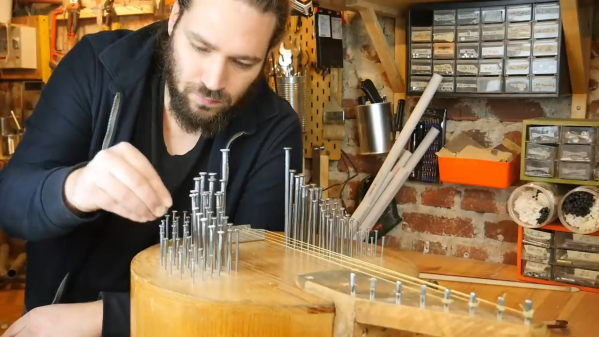
Circuit Sculpture was one of our most anticipated workshops of Hackaday Remoticon 2020, and now it’s ready for those who missed it to enjoy. A beginning circuit sculptor could hardly ask for more than this workshop, which highlights three different approaches to building firefly circuit sculptures and is led by some of the most prominent people to ever bend brass and components to their will — Jiří Praus, Mohit Bhoite, & Kelly Heaton.

For starters, you’ll learn the different tools and techniques that each of them uses to create their sculptures. For instance, Kelly likes to use water-based clay to hold components in specific orientations while forming the sculpture and soldering it all together. Jiří and Mohit on the other hand tend to use tape. The point is that there is no right or wrong way, but to instead have all of these tips and tricks under your belt as you sculpt. And that’s what this workshop is really about.

Continue reading “Remoticon Video: Circuit Sculpture Workshop”

Escape Tunnel In Your Living Room: A Different Take On The Infinity Mirror

Most infinity mirrors are just minor variations on the same old recipe. Take a frame, add a normal mirror in the back, a one-way mirror on the front, and put some LEDs between them. [Stevens Workshop] took a slightly different approach and built an escape tunnel coffee table that really caught our attention.

To create the tunnel and ladder illusion, [Steven] kept the mirrors, but made a deeper wood frame, installed a light bulb in an industrial-looking socket instead of the usual LEDs, and added a single ladder rung. The end result makes for a very interesting conversation piece, and some of us prefer it to the multicolored LED look. Though he added his own touches, the idea was actually borrowed from from [asthhvdrt36] and [BreezleSprouts] on Reddit who used slightly different light and ladder designs.

While there’s nothing groundbreaking here, it’s certainly a case of “why didn’t I think of that”. Sometimes the old and familiar just needs a different perspective to create something fascinating. One of the advantages of the classic infinity mirror is the thin profile, which we’ve seen integrated into everything from guitars to coasters.

Prism Lighting – The Art Of Steering Daylight

The incandescent light bulb was one of the first early applications of electricity, and it’s hard to underestimate its importance. But before the electric light, people didn’t live in darkness — they thought of ways to redirect sunlight to brighten up interior spaces. This was made possible through the understanding of the basic principles of optics and the work of skilled glassmakers who constructed prism tiles, deck prisms, and vault lights. These century-old techniques are still being applied today for the diffusion of LEDs or for increasing the brightness of LCD displays.

Semantics First!

People in optics are a bit sloppy when it comes to the definition of a prism. While many of them are certainly not geometric prisms, Wikipedia defines it as a transparent optical element with flat, polished surfaces of which at least one is angled. As can be seen in the pictures below some of the prisms here do not even stick to this definition. Browsing the catalog of your favorite optics supplier you will find a large variety of prisms used to reflect, invert, rotate, disperse, steer, and collimate light. It is important to point out that we are not so much interested in dispersive prisms that split a beam of white light into its spectrum of colors, although they make great album covers. The important property of prisms in this article is their ability to redirect light through refraction and reflection.

A Safe Way to Bring Light Under Deck

A collection of deck lights used to direct sunlight below deck in ships. Credit: glassian.org

One of the most important uses of prism lighting was on board ships. Open flames could have disastrous consequences aboard a wooden ship, so deck prisms were installed as a means to direct sunlight into the areas below decks. One of the first patents for deck lights “THE GREAT AND DURABLE INCREASE OF LIGHT BY EXTRAORDINARY GLASSES AND LAMPS” was filed by Edward Wyndus as early as 1684. Deck prisms had typical sizes of 10 to 15 centimeters. The flat top was installed flush with the deck and the sunlight was refracted and directed downward from the prism point. Because of the reversibility of light paths (“If I can see you, you can see me”) deck prisms also helped to spot fires under deck. Continue reading “Prism Lighting – The Art Of Steering Daylight”

Sharpie Mount Brings Some Color To Your 3D Prints

The average cost of a desktop 3D printer has dropped like a stone over the last few years. They went from a piece of equipment you had to wait your turn to use at the hackerspace to something you can pick up on Prime Day, which has definitely been a good thing for our community. But to get the price down, these printers are almost exclusively running single extruder setups with no provision for multi-material printing other than swapping the filament manually.

From a practical standpoint, that’s not much of a problem. But wanting to add a little visual flair to his prints, [Devin Montes] came up with a simple 3D printed mount that holds the tip of up to three Sharpie permanent markers against the filament as it enters the top of the extruder. When used with white or translucent filaments, these markers can give the final print an interesting splash of color. Obviously it’s not true multi-color 3D printing, but it can certainly make for some attractive decorative objects.

The mount is designed for the Snapmaker 3-in-1 3D printer, which is relatively well suited to such a contraption as it has a direct drive extruder and there’s plenty of clearance for the markers to stick up. The concept could certainly be adapted to other printers, but it might be a little trickier in the case of a Bowden extruder or an i3 clone that has frame components running over the top. It sounds like [Devin] is working on a generic version of the marker holder that can work on other printers, so it should be interesting to see how he addresses these issues.

Technically this isn’t a new concept, as makers were pulling off similar tricks back in the earliest days of desktop 3D printing. But this is an especially well-implemented version of the idea, and if [Devin] can really come up with a mount that will work on a wider array of hardware, we could certainly see it becoming a popular way to make printed projects a bit more exciting.

The Clock Under The Dome

In what can only be described as a work of art, [suedbunker] has created a clock under a glass dome. Sporting Nixie tubes, a DS3223, BCD encoders, and MPSA43 transistors driven by an MCP23008 I/O expander it is truly a sight to behold. [suedbunker] has previously created the Circus Clock, a similar clock that celebrated a diversity of ways of displaying the time.

The dome clock represents a continuation of that idea. Reading the clock requires looking at the horizontal and vertical numbers separately. The hours are on the horizontal and minutes are on the vertical. Monday to Sunday is represented in the neon bulbs on the back. The power supply at the bottom provides a wide range of voltages including 5 V, 12 V, 24 V, 45 V, 90 V, 150 V, and -270 V for all the various types of lights. For safety, an optocoupler is used on the -270 volts to drive the clear seven-segment display.

An Arduino Nano controls the whole clock by communicating with the DS3232 real-time clock module and the port expanders via I2C. The soldering and wiring work, in particular, is tidy and beautiful. We look forward to future clocks by [suedbunker] and his wife.

Continue reading “The Clock Under The Dome”

Bonsai LED Matrix Has Chaotic Roots

Most people don’t hand solder their surface mount LED matrices these days, and they certainly don’t do it with RGB LEDs. [fruchti] isn’t most people, has managed to grow his electronic hobby into the art form know as Bonsai.

The organic shapes of miniature trees grown over the course of decades is the ultimate indicator of patience and persistence. For those who prefer bending copper to their will rather than saplings, producing an LED tree that looks and functions this well is an accomplishment that signals clever planning and patient fabrication. The animated result is a masterpiece that took about eighteen months to complete.

There are 128 enamel-coated wires that twist into branches holding 32 RGB light-emitting diodes. Tapping into each at the base of the tree is a chaotic mess made a bit easier by a cleverly designed circuit board.

A circular petal pattern was laid out in Inkscape that includes a hole at the center for the “trunk” to pass through. The LED matrix is designed with 8 rows and 12 columns, but 24 pads were laid out so that only four wires would need to be soldered to each copper petal. Even so, look at the alligator clip holding up this PCB to get an idea of the scale of this job!

The angular base is itself made of copper clad board soldered on the inside of the seams and painted black on the outside. This hides the “petal” PCB, as well as a breakout board for an STM32 microcontroller and a power management circuit that lets you use your choice of USB or a lithium battery.

We wonder if [fruchti] has thought about adding some interactivity to his sapling. While we haven’t seen such a beautiful, tiny, creation as this, we have seen an LED tree whose lights can be blown out like birthday candles. Wouldn’t this be an excellent entry in our Circuit Sculpture challenge? There’s still a few weeks left!

Receipt Printers End It All In Moving Art Piece

Art is something that is always hard to classify, but by and large is most celebrated when it stimulates an emotional response for the intended audience. We’d say [Alexander Miller] achieved that in spades, with his elegant piece The Emergence and Decay of Computation.

An installation piece done for The School for Poetic Computation’s 2019 spring showcase, it consists of a series of receipt printers suspended from a height by their own paper. The thermal printers output a pattern from a cellular automata — a mathematical simulation that generates patterns that emerge from initial conditions, of which Conway’s Game of Life is perhaps the most popular. Fed data by an attached Raspberry Pi, as printing continues, the printers gradually lower themselves into a tank of water, permanently killing the hardware.

Watching a proud, brave printer slowly work itself into a watery grave is a sobering experience to any lover of stout commercial hardware, and one we won’t soon forget. What a shame to see them sacrificed so. We love a good art piece around these parts, after all. Especially when the hardware can be used in another project once the excitement of this one has waned. Video after the break. Continue reading “Receipt Printers End It All In Moving Art Piece”