Can You Remembrandt Where This Is From?

A group of researchers have built an algorithm for finding hidden connections in artwork.

The team, comprised of computer scientists from MIT’s Computer Science and Artificial Intelligence Laboratory (CSAIL) and Microsoft, used paintings from the Metropolitan Museum of Art and Amsterdam’s Rijksmuseum to demonstrate these hidden connections, which link artwork that shares similar styles, such as Francisco de Zurbarán’s The Martyrdom of Saint Serapion (above left) and Jan Asselijn’s The Threatened Swan (above right). They were initially inspired by the “Rembrandt and Velazquez” exhibition in the Rijksmuseum, which demonstrated similarities between the artists’ work despite the former hailing from the Protestant Netherlands and the latter from Catholic Spain.

The algorithm, dubbed “MosAIc”, differs from probabilistic generative adversarial network (GAN)-based projects that generate artwork since it focuses on image retrieval instead. Rather than focusing solely on obvious factors such as color and style, the algorithm also tries to uncover meaning and theme. It does this by constructing a data structure called a conditional k-nearest neighbor (KNN) tree, which provides a tree-like structure where branches off a central image indicate similarity to the image. In order to query the data structure, these branches are followed until the closest match to an image in a dataset is found. In further iterations, it prunes unpromising branches in order to improve its time for new queries.

Some results from running the algorithm against museum collections were finding similarities between the Dutch Double Face Banyan and a Chinese ceramic figurine, traced to the flow of porcelain and iconography from the Chinese to the Dutch in the 16th to 20th centuries.

A surprising result of this study was discovering that the approach could also be applied to find problems with deep nerual networks, which are used for creating deepfakes. While GANs can often have blind spots in their models, struggling to recreate certain classes of photos, MosAIc was able to overcome these shortcomings and accurately reproduce realistic images.

While the team admits that their implementation isn’t the most optimized version of KNN, their main objective was to present a broad conditioning scheme that is simple but effective for applications. Their hope is to inspire related researchers to consider multi-disciplinary applications for algorithms.

Springs And Things Wrap Into A Polyhedron Of Interactive LED Art

Any resemblance between The Wobble Sphere and a certain virus making the rounds these days is purely coincidental. Although as yet another project undertaken during the COVID-19 lockdowns, we can see where the inspiration came from.

Wobble Sphere is another work of interactive art from the apparently spring-driven imagination of [Robin Baumgarten], whose Quantum Garden piece graced our pages last year. The earlier, flatter version used a collection of spring door stops — the kind that sound awesome when plucked by a passing foot — each of which is surrounded by a Neopixel ring. The springs act as touch sensors that change the patterns and colors on the LED rings in endlessly fascinating ways.

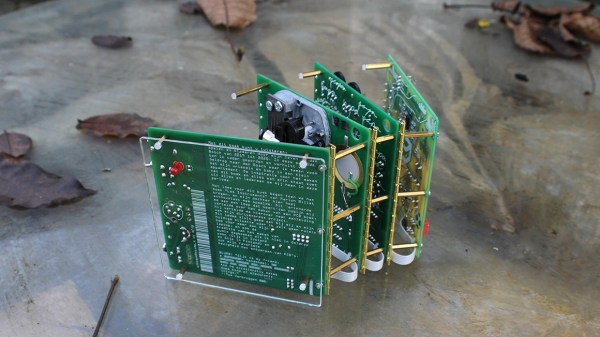
For Wobble Sphere, [Robin] took the same spring and LED units, broke them into a collection of hexagonal and pentagonal PCBs, and wrapped the whole thing up into a 72-sided polyhedron. There’s some impressive mechanical and electrical engineering involved in the transition from 2D to 3D space, not least of which is solving the problem of how to connect everything while providing pluck-friendly structural support. The former was accomplished with a ton of ribbon cables, while the latter was taken care of with a combination of a 3D-printed skeleton and solder connections between adjacent PCBs. The result is a display that invites touch and rewards it with beautiful patterns of light chasing around the sphere. See it in action in the video after the break.

Lest anyone think springs are the only tool in [Robin]’s box, we mustn’t forget that he once set a knife-wielding Arduino-powered game on an unsuspecting public. Check it out; it’s way more fun than it sounds.

Continue reading “Springs And Things Wrap Into A Polyhedron Of Interactive LED Art”

Art Piece Builds Up Images With Dots On Thread

Hackers being as a rule practical people, we sometimes get a little guff when we run a story on an art installation, on the grounds of not being sufficiently hacky. We understand that, but sometimes the way an artist weaves technology into their pieces is just too cool to pass us, as with this thread-printing art piece entitled On Framing Textile Ambiguities.

We’ll leave criticism of the artistic statement that [Nathalie Gebert]’s installation makes to others more qualified, and instead concentrate on its technical aspects. The piece has four frames made mainly from brass rods. Three of the frames have vertical rods that are connected to stepper motors and around which is wrapped a single thread. The thread weaves back and forth over the rods on one frame, forming a flat surface that constantly changes as the rods rotate, before heading off to do the same on the others. The fourth frame has a platen that the thread passes over with a pen positioned right above it. As the thread pauses in its endless loop, the pen clicks down onto it, making a dot of color. The dots then wend their way through the frame, occasionally making patterns that are just shy of recognizable before morphing into something new. The video below shows it better than it can be easily described.

Love it or hate it, you’ve got to admit that it has some interesting potential as a display. And it sort of reminds us of this thread-art polar robot, although this one has the advantage of being far simpler.

Continue reading “Art Piece Builds Up Images With Dots On Thread”

Playing The Pixelflut

Every hacker gathering needs as many pixels as its hackers can get their hands on. Get a group together and you’ll be blinded by the amount of light on display. (We propose “a blinkenlights” as the taxonomic name for such a group.) At a large gathering, what better way to show of your elite hacking ability than a “competition” over who can paint an LED canvas the best? Enter Pixelflut, the multiplayer drawing canvas.

Pixelflut has been around since at least 2012, but it came to this author’s attention after editor [Jenny List] noted it in her review of SHA 2017. What was that beguiling display behind the central bar? It turns out it was a display driven by a server running Pixelflut. A Pixelflut server exposes a display which can be drawn on by sending commands over the network in an extremely simple protocol. There are just four ASCII commands supported by every server — essentially get pixel, set pixel, screen size, and help — so implementing either a client or server is a snap, and that’s sort of the point.

While the original implementations appear to be written by [defnull] at the link at the top, in some sense Pixelflut is more of a common protocol than an implementation. In a sense, one “plays” one of a variety of Pixelflut minigames. When there is a display in a shared space the game is who can control the most area by drawing the fastest, either by being clever or by consuming as much bandwidth as possible.

Then there is the game of who can write the fastest more battle-hardened server possible in order to handle all that traffic without collapsing. To give a sense of scale, one installation at 36c3 reported that a truly gargantuan 0.5 petabytes of data were spent at a peak of rate of more than 30 gigabits/second, just painting pixels! That’s bound to bog down all but the most lithe server implementation. (“Flut” is “flood” in German.)

While hacker camps may be on pause for the foreseeable future, writing a performant Pixelflut client or server seems like an excellent way to sharpen one’s skills while we wait for their return. For a video example check out the embed after the break. Have a favorite implementation? Tell us about it in the comments!

Continue reading “Playing The Pixelflut”

How Many Of You Are There, Really?

We’re now accustomed to hearing, “We’re all special in our own unique ways.” But what if we weren’t really aren’t all that unique? Many people think there are no more than two political opinions, maybe a handful of religious beliefs, and certainly no more than one way to characterize a hack. But despite this controversy in other aspects as life, at least we can all rely on the uniqueness of our individual names. Or can you?

You ever thought there were too many people named [insert name here]? Well, [Nicole] thought there were too many people who shared her name in her home country of Belgium and decided to make an art piece out of it.

She was able to find data on the first names of people in Belgium and wrote a Python script…er…used Excel to find the number of Nicoles in each zip code. She then created a 3D map of Belgium divided into each province with the height of each province proportional to the number of Nicoles in that area. A pretty simple print job that any standard 3D printer can probably do these days.

Not much of a “do something” hack, but could make for a cool demotivational ornament that will constantly remind us just how unique we really are.

Happy hacking!

Continue reading “How Many Of You Are There, Really?”

Art Generated From The Dubious Comments Section

[8BitsAndAByte] are back, and this time they’re taking on the comments section with art. They wondered whether or not they can take something as dubious as the comments section and redeem it into something more appealing like art.

They started by using remo.tv, a tool they’ve used in other projects, to read comments from their video live feeds and extract random phrases. The phrases are then analyzed by text to speech, and a publicly available artificial intelligence algorithm that generates an image from a text description. They can then specify art styles like modern, abstract, cubism, etc to give their image a unique appeal. They then send the image back to the original commenter, crediting them for their comment, ensuring some level of transparency.

We were a bit surprised that the phrase dog with a funny hat generated an image of a cat, so I think it’s fair to say that their AI engine could use a bit of work. But really, we could probably say that about AI as a whole.

Continue reading “Art Generated From The Dubious Comments Section”

Bringing Back The Fidget Toy Craze With The Magic Microcontroller Cube

[Rickysisodia] had a few dead ATmega128 chips laying around that he didn’t want to just throw away, so he decided to turn them into his own light-up fidget toy. The toy is in the form of a six-sided die so small that you can hang it on a keychain. He soldered an ATmega128 on each side of the cube and added a few dot circles to give his toy the look of a functional dice. We were pretty amazed by his impressive level of dexterity. Soldering those 0.8 mm-pitch leads together seems pretty tedious if you ask us.

Then he wired a simple, battery-powered tilt switch LED circuit on perfboard that he was able to sneakily place inside the cube. He used a mercury switch, which, as you may figure, uses a small amount of mercury to short two metal contacts inside the switch, completing the circuit and lighting the LED. We would suggest going with the non-mercury variety of tilt switches just to avoid any possible contamination. You know us, anything to mitigate unnecessary disasters is kind of a good route. But anyway, the die lights up a different color LED based on the orientation of the cube and it even blinks.

This is a pretty cool hack for wowing your friends at your next PCB art meet-up. We’ll probably put this in the electronics art category, so it doesn’t get lumped in with those other ever-beloved fidget toys.

Continue reading “Bringing Back The Fidget Toy Craze With The Magic Microcontroller Cube”