Replica Marshmello Helmet Is A Tidy Halloween Build

As the saying goes – you don’t need a stylized, bedazzled helmet to have a successful career in EDM, but it helps. Marshmello is the latest in a long line of musicians to sport bespoke headgear, and [MikeTheSuperDad] undertook the construction of a replica for Halloween.

The build starts with a piece of concrete form tube as the base of the helmet. This is combined with 3D printed components to create a grid in which to place WS2812B LED strings. These are controlled by an Arduino Pro Mini, which is responsible for handling the animations. Further 3D printed parts are used as templates to cut out the characteristic eyes and mouth, as well as to cover the top. Plastic sheeting is then used over the top of everything to diffuse the LEDs and provide the final look, with black mesh behind the eyes and mouth making them properly stand out.

Marshmello should be lauded for creating a helmet with a distinctive visual style, while remaining easy to replicate, unlike popular Daft Punk builds of years past. Building a replica could serve as good practice before starting out on your own unique build. Video after the break.

Continue reading “Replica Marshmello Helmet Is A Tidy Halloween Build”

Add A Bit Of PCB Badge Glamour To Your Boring ID Badge

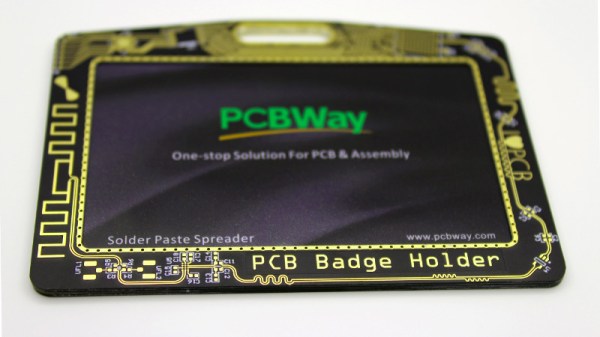
When we talk about badges and printed circuit boards, it is usually in the context of the infinite creativity of the Badgelife scene, our community’s own art form of electronic conference badges. It’s easy to forget when homing in on those badges that there are other types of badge, and thus [Saimon]’s PCB badge holder is an entertaining deviation from our norm. His workplace requires employees to carry their credit-card-sized ID pass with them at all times, but the plastic holder that came with his had broken. So he did what any self-respecting engineer would do, and designed his own holder using PCBs.

It’s a three-way sandwich with identical front and back PCBs featuring a nice design, but the clever bit is the middle PCB. It is U-shaped to slide the card in from the side, but to retain the card it has a couple of springy milled PCB arms each with a small retaining tooth on the end. This is an ingenious solution, with just enough give to bend, but not so much as to break.

The three boards are glued together, it seems his original aim was to reflow solder them but this was not successful. The result is an attractive and functional badge holder, which if Hackaday required us to have a corporate ID you can be sure we’d be eyeing up for ourselves.

Mechanical Seven-Segment Display Mixes Art With Hacking

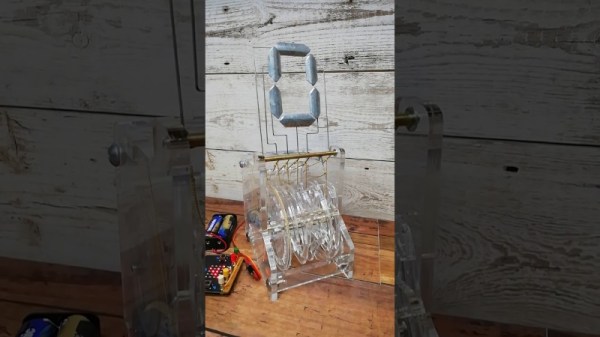
We’re not sure what to call this one. Is it a circuit sculpture? Sort of, but it moves, so perhaps it’s a kinetic circuit sculpture. Creator [Tomohiro Tsuchita] calls it “something beautiful but totally useless,” which we find a tad harsh. But whatever you call it, we think this mechanical seven-segment display is really, really cool.

Before anyone gets to thinking that this is something like the other mechanical seven-segment displays we’ve seen lately, think again. This one is not addressable; it simply goes through the ten digits in order. So you won’t be building a clock from it, although we suppose the mechanism could be modified to allow that. Then again, looking at that drive train of laser-cut acrylic cams, maybe not. Each segment has its own cam with lobes or valleys for each segment. A cam follower lowers and raises the segments as the cams rotate on a common shaft. A full-rotation servo powers the display under the control of a Micro:bit; the microcontroller is overkill for now but will be used in version two, which will allow the speed to change in response to sensors.

Watching this display change at its stately pace is strangely soothing. We love the look of this, but then again, we’re partial to objets d’art-circuit. After all, we ran a circuit sculpture contest earlier in the year, and just wrapped up a Hack Chat dedicated to the subject.

Continue reading “Mechanical Seven-Segment Display Mixes Art With Hacking”

Faux Cow Munches Faux Grass On A Faux Roomba

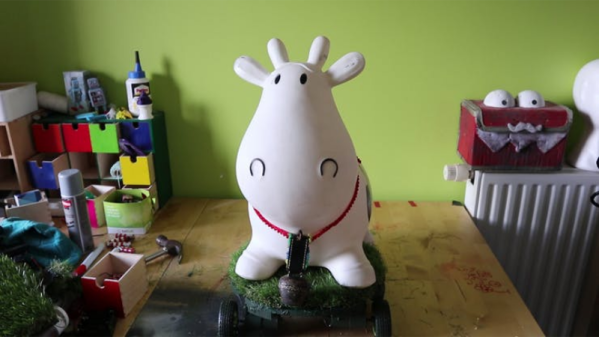
Out in the countryside, having a cow or to two wouldn’t be a big deal. You can have a cattle shed full of them, and no one will bat an eyelid. But what if you’re living in the big city and have no need of pet dogs or cats, but a pet cow. It wouldn’t be easy getting it to ride in the elevator, and you’d have a high chance of being very, very unpopular in the neighbourhood. [Dane & Nicole], aka [8 Bits and a Byte] were undaunted though, and built the Moomba – the Cow Roomba to keep them company in their small city apartment.

The main platform is built from a few pieces of lumber and since it needs to look like a Roomba, cut in a circular shape. Locomotion comes from two DC geared motors, and a third swivel free wheel, all attached directly to the wooden frame. The motors get their 12V juice from eight “AA” batteries. The free range bovine also needs some smarts to allow it to roam at will. For this, it uses a Raspberry Pi powered by a power bank. The Pi drives a 2-channel relay board which controls the voltage applied to the two motors. Unfortunately, this prevents the Moomba from backing out if it gets stuck at a dead end. For anyone else trying to build this it should be easy enough to fix with an electronic speed controller or even by adding a second 2-channel relay board which can reverse the voltage applied to the motors. The Moomba needs to “Moo” when it feels like, so the Raspberry Pi streams a prerecorded mp3 audio clip to a pair of USB speakers.

If you see the video after the break, you’ll notice that making the Moomba sentient is a simple matter of doing “ctrl+C” and “ctrl+V” and you’re good to go. The python code is straight forward, doing one of four actions – move forward, turn left, turn right or play audio. The code picks a random number from 0 to 3, and then performs the action associated with that number. Finally, as an added bonus, the Moomba gets a lush carpet of artificial green grass and it’s free to roam the range.

At first sight, many may quip “where’s the hack” ? But simple, easy to execute projects like these are ideal for getting younglings started down the path to hacking, with adult supervision. The final result may appear frivolous, but it’ll excite young minds as they learn from watching.

Continue reading “Faux Cow Munches Faux Grass On A Faux Roomba”

Portrait Painter Turns G-Code Into Artworks

Portrait painting is, by and large, a human endeavour. But, like any and all skills, there are machines ready and willing to take a crack at it. [Jose Salatino] has built just such a machine, and the results are impressive.

Samples of the artwork created by [Jose’s] portrait painter.
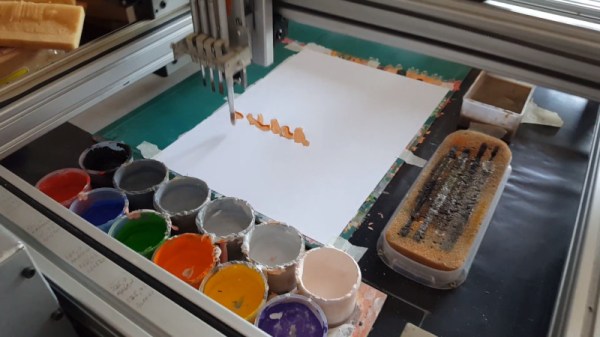
[Jose’s] portrait painter relies on a Cartesian CNC setup, with an X-Y gantry fitted with a retractable brush carrier. The carrier holds four brushes, allowing the device to paint with different sized strokes as per the artistic requirements. An algorithm is used to turn images into a series of brushstrokes, which are then turned into G-code to drive the system. Colors are mixed just like a human painter would, with the brush dipping into a series of paint pots. Using the hue-saturation-brightness (HSB) color system makes this easy.

While it’s much slower than your average printer, the goal here isn’t to create photorealistic images, but to create something with artistic appeal. The artworks painted by the ‘bot have a remarkable likeness to oil paintings by human artists, thanks to using similar techniques. We’re sure [Jose’s] experience as an oil painter helped out here, too.

We’ve seen other ‘bots produce custom artworks before, too. Video after the break.

Continue reading “Portrait Painter Turns G-Code Into Artworks”

DIY Tiny Dovetail Cube Needs DIY Dovetail Cutter

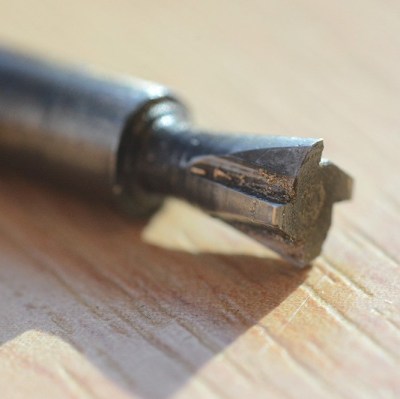
Dovetail cutter, made from a 5 mm drill rod.

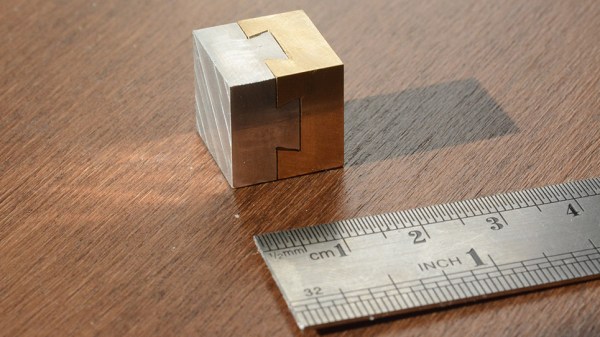
There’s a trinket called a dovetail cube, and [mitxela] thought it would make a fine birthday present. As you can see from the image, he was successful in creating a tiny version out of aluminum and brass. That’s not to say there weren’t challenges in the process, and doing it [mitxela] style means:

  • Make it tiny! 15 mm sides ought to do it.
  • Don’t have a tiny dovetail bit on hand, so make that as well.
  • Of course, do it all without CNC in free-machining style.
  • Whoops the brass stock is smaller than expected, so find a clever solution.
  • That birthday? It’s tomorrow, by the way.

The project was a success, and a few small learning experiences presented themselves. One is that the shape of a dovetail plays tricks on the human eye. Geometrically speaking, the two halves are even but it seems as though one side is slightly larger than the other. [mitxela] says that if he were to do it again, he’d make the aluminum side slightly larger to compensate for this visual effect. Also, deburring with a knife edge on such a small piece flattened the edges ever so slightly, causing the fit to appear less precise than it actually is.

Still, it was a success and a learning experience. Need more evidence that [mitxela] thrives on challenge? Take a look at his incredible vector game console project.

When Engineering, Fine Art, And ASMR Collide

The success that [Julian Baumgartner] has found on YouTube is a perfect example of all that’s weird and wonderful about the platform. His videos, which show in utterly engrossing detail the painstaking work that goes into restoring and conserving pieces of fine art, have been boosted in popularity by YouTube’s Autonomous Sensory Meridian Response (ASMR) subculture thanks to his soft spoken narration. But his latest video came as something of a surprise to lovers of oil paintings and “tingles” alike, as it revealed that he’s also more than capable of scratch building his own equipment.

Anyone who’s been following his incredible restorations will be familiar with his heated suction table, which is used to treat various maladies a canvas may be suffering from. For example, by holding it at a sufficiently high temperature for days on end, moisture can be driven out as the piece is simultaneously smoothed and flattened by the force of the vacuum. But as [Julian] explains in the video after the break, the heated suction table he’s been using up to this point had been built years ago by his late father and was starting to show its age. After a recent failure had left him temporarily without this important tool, he decided to design and build his own fault-tolerant replacement.

The table itself is built with a material well known to the readers of Hackaday: aluminum extrusion. As [Julian] constructs the twelve legged behemoth, he extols the many virtues of working with 4040 extrusion compared to something like wood. He then moves on to plotting out and creating the control panel for the table with the sort of zeal and attention to detail that you’d expect from a literal artist. With the skeleton of the panel complete, he then begins wiring everything up.

Underneath the table’s 10 foot long surface of 6061 aluminum are 6 silicone heat pads, each rated for 1,500 watts. These are arranged into three separate “zones” for redundancy, each powered by a Crydom CKRD2420 solid state relay connected to a Autonics TC4M-14R temperature controller. Each zone also gets its own thermocouple, which [Julian] carefully bonds to the aluminum bed with thermally conductive epoxy. Finally, a Gast 0523-V4-G588NDX vacuum pump is modified so it can be activated with the flick of a switch on the control panel.

What we like most about this project is that it’s more than just a piece of equipment that [Julian] will use in his videos. He’s also released the wiring diagram and Bill of Materials for the table on his website, which combined with the comprehensive build video, means this table can be replicated by other conservators. Whether it’s restoring the fine details on Matchbox cars or recreating woodworking tools from the 18th century, we’re always excited to see people put their heart into something they’re truly passionate about.

Continue reading “When Engineering, Fine Art, And ASMR Collide”