Preserving Precious Laptop Stickers

Stickers belong on laptops. That’s not just because all developers are issued a 2015 MacBook Pro at birth to zealously hold and cherish for the rest of their careers, and the vast uniformity of laptop models in the workplace makes each individual’s laptop indistinguishable from anyone else’s. No, stickers belong on laptops because that ‘RUN GCC’ sticker is just so good. But how do you keep a laptop stickered up while not hurting the resale value or worrying about sticky residue left behind? That’s the question [Graham] answered, and the answer may surprise you.

The problem is such: there mus be a way to apply stickers to a MacBook that is invisible, removable, and leaves no trace after being removed, even after years of enjoying a bestickerd’ laptop. The first thought turned to old-style screen protectors for a phone, but this had problems: they’re glossy, and sourcing a large sheet of screen protectors proved difficult.

After some research, it turned out there was a market with similar requirements: car wraps. Yes, you can wrap your car in vinyl that’s any color you want, including whatever Apple is calling their plain aluminum finish these days. As far as a protector for an aluminum MacBook, it looks good: it doesn’t leave any residue behind, it’s strong enough to survive on a car, so it’s probably good enough for a laptop on a desk, and it’s easy to apply.

With some stickers applied to this larger sticker, everything looked good and lived up to a few months of abuse. Then came the real test: could this MacBook wrap be removed with all the other stickers intact? Yes, and you can frame the result. While this is only a test of the aluminum-colored MacBook, vehicle wraps come in nearly every color imaginable. There is apparently a vinyl that looks like Space Gray, and if you want Thinkpad Black, you can get that wrap, too.

Lessons Learned From An Art Installation Build

Art installations are an interesting business, which more and more often tend to include electronic or mechanical aspects to their creation. Compared to more mainstream engineering, things in this space are often done quite a bit differently. [Jan Enning-Kleinejan] worked on an installation called Prendre la parole, and shared the lessons learned from the experience.

The installation consisted of a series of individual statues, each with an LED light fitted. Additionally, each statue was fitted with a module that was to play a sound when it detected visitors in proximity. Initial designs used mains power, however for this particular install battery power would be required.

Arduinos, USB power banks and ultrasonic rangefinders were all thrown into the mix to get the job done. DFplayer modules were used to run sound, and Grove System parts were used to enable everything to be hooked up quickly and easily. While this would be a strange choice for a production design, it is common for art projects to lean heavily on rapid prototyping tools. They enable inexperienced users to quickly and effectively whip up a project that works well and at low cost.

[Jan] does a great job of explaining some of the pitfalls faced in the project, as well as reporting that the installation functioned near-flawlessly for 6 months, running 8 hours a day. We love to see a good art piece around these parts, and we’ve likely got something to your tastes – whether you’re into harmonicas, fungus, or Markov chains.

The Battery Is Part Of The Art

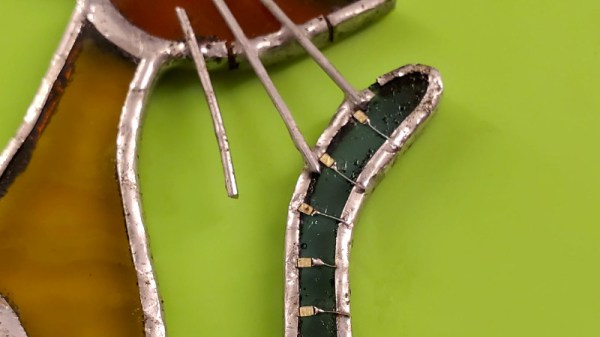
A work of art is appreciated for its own sake and we will never tire of seeing stunning circuits from microscopic dead-bugs to ornate brass sculptures. We also adore projects that share the tricks to use in our own work. Such is the case with [Jiří Praus] who made some jewelry and shared his templates so we try this out ourselves.

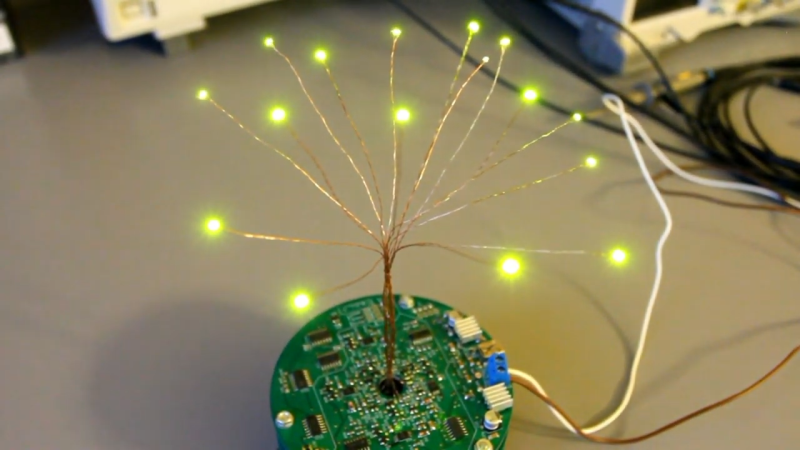
The materials include brass wire, solder, and surface-mount LEDs. Template design expects a 1206 light, so if you step outside that footprint, plan accordingly. The printable templates are intuitive and leverage basic wire jewelry making skills. Some good news is that flashing LEDs are available in that size so you can have an array of blinkenlights that appears random due to drifting circuits. Please be wary with RGB lights or mixing colors because red LEDs generally run at a lower voltage and they will siphon a significant chunk of a coin-cell’s power from a competing green or blue. How else can these be personalized?

[Jiří]’s charms are just the latest of circuits that capture our eyes and tickle our ears.

AI And Art Appreciation

In 2019, using AI to evaluate artwork is finally more productive than foolish. We all hope that someday soon our Roomba will judge our living habits and give unsolicited advice on how we could spruce things up with a few pictures and some natural light. There is already an extensive amount of Deep Learning dedicated to photo recognition but a team in Croatia is adapting them for use on fine art. It makes sense that everything is geared toward cameras since most of us have a vast photographic portfolio but fine art takes longer to render. Even so, the collection on Wikiart.org is vast and already a hotbed for computer classification work, so they set to work there.

As they modify existing convolutional neural networks, they check themselves by comparing results with human ratings to keep what works and discard what flops. Fortunately, fine art has a lot of existing studies and commentary, whereas the majority of photographs in the public domain have nothing more than a file name and maybe some EXIF data. The difference here is that photograph-parsing AI can say, “That is a STOP sign,” while the fine art AI can say, “That is a memorable painting of a sign.” Continue reading “AI And Art Appreciation”

Art Project Analyzes Every Public Recording Of Facebook’s CEO Since 2004

[Benjamin Grosser] had a simple question: “What does Mark Zuckerberg think about?” The resulting art project is named ORDER OF MAGNITUDE and to create it he researched archives of every public utterance the founder and CEO of the world’s largest social media network has made, going as far back as 2004.

The end product is a nearly fifty-minute film consisting entirely of cuts centered around what [Benjamin] says are three of the Facebook CEO’s most favored and often-used terms:

  • The word “more”
  • The word “grow”
  • Metrics such as “ninety-nine percent”, “two million”, and terms of that nature.

The idea is that the resulting video provides insight into what Mark Zuckerberg thinks about, has focused on, and how that has (or has not) changed between 2004 and now.  How well does ORDER OF MAGNITUDE do that? Watch the video below, and judge for yourself.

Continue reading “Art Project Analyzes Every Public Recording Of Facebook’s CEO Since 2004”

Dead Bug Arduino Is Lively And Shield-Compatible

Microcontroller demo boards such as the Arduino UNO are ubiquitous on Hackaday as the brains of many a project which inevitably does something impressive or unusual. Sometime someone builds a particularly tiny demo board, or an impressively large one. In the case of the board featured here, the Arduino is a gorgeous labor of love which can’t really be called a board since there is no PCB. Instead of the traditional fiberglass, [Jiří Praus] formed brass bars into the circuitry and held it together with solder.

This kind of dedication to a project leaves an impression. His notes show he saw the barest way to operate an ATMega328, built it, tested, and moved on to the power supply to make it self-sustaining, then onto the communication circuit, and finally the lights. The video below shows a fully-functional Arduino happily running the blink program. He plans to encase the brass portion in resin to toughen it up and presumably keep every bump from causing a short circuit. The components are in the same position due to a custom jig which means a standard shield will fit right into place.

The Arduino started far less flashy yet nearly as fragile, and it has grown. And shrunk.

Continue reading “Dead Bug Arduino Is Lively And Shield-Compatible”

Artistic Attempt To Send Digital Signals Via Fungus

Art projects can fundamentally be anything you like, as long as you say they’re art at the end of it all. They don’t always work, or work well, but they often explore new ideas. Often, artists working on installations fall back on similar tools and techniques used by the maker community. [Julian] is no exception, and his Biotic Explorers work has many touchstones that will be familiar to the Hackaday set.

The device attempted to send signals via Mycellium fungus.

The Biotic Explorers Research Group is a broad art project, involving the creation of a fictitious scientific association. [Julian] created imaginary scientists, reports, and research to flesh out this world. The project culminates in the development of a prototype communications system, which uses pH sensors at either end of a fungal network in soil to send messages.

Liquids are applied to change the pH of the system, which can be picked up at the other end of the soil bed. The pH levels are read as digital signals, with pH levels either side of neutral reading as high and low bits. pH sensors can be expensive, so [Julian] chose the cheapest available, and tapped into their LCD display lines to read their output into an microcontroller. The system displays data using commonly available OLED displays, and hobby servo motors are used to control the dispensing of liquid.

Due to time constraints, [Julian] was unable to get the system fully functional. Sending data as pH levels through fungus proved unreliable and slow, but we suspect with further development, the system could be improved. Regardless, the project serves as an excellent example of the work that goes into a functional art installation. The thesis sheds further detail on the development of the project.

We’re no strangers to an art installation here – whether it’s Markov chains or glowing balloons.