Conductive Gel Has Potential

There are some technologies first imagined in the Star Trek universe have already come to exist in the modern day. Communicators, tablet computers, and computer voice recognition are nearly as good as seen in the future, and other things like replicators and universal translators are well on their way. Star Trek: Voyager introduced a somewhat ignored piece of futuristic technology, the bio-neural gel pack. Supposedly, the use of an organic gel improved the computer processing power on the starship. This wasn’t explored too much on the series, but [Tom] is nonetheless taking the first steps to recreating this futuristic technology by building circuitry using conductive gel.

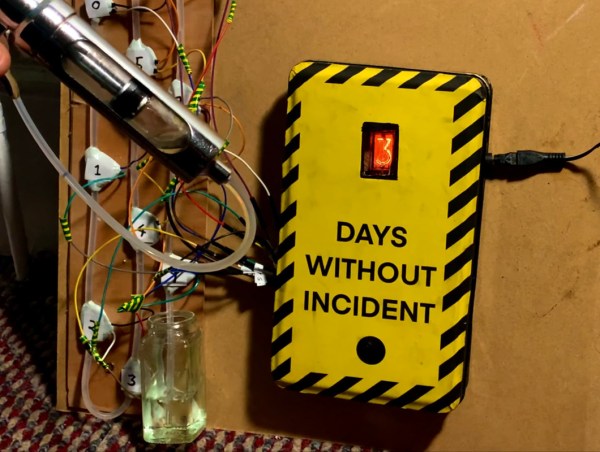
[Tom]’s circuitry relies on the fact that salts in a solution can conduct electricity, so in theory filling a pipe or tube with a saline solution should function similarly to a wire. He’s also using xanthan gum to increase viscosity. While the gel mixture doesn’t have quite the conductivity of copper, with a slight increase in the supplied voltage to the circuit it’s easily able to be used to light LEDs. Unlike copper, however, these conductive gel-filled tubes have some unique properties. For example, filling a portion of the tube with conductive gel and the rest with non-conductive mineral oil and pushing and pulling the mixture through the tube allows the gel to move around and engage various parts of a circuit in a way that a simple copper wire wouldn’t be able to do.

In this build specifically, [Tom] is using a long tube with a number of leads inserted into it, each of which correspond to a number on a nixie tube. By moving the conductive gel, surrounded by mineral oil, back and forth through the tube at precise intervals each of the numbers on the nixie tube can be selected for. It’s not yet quite as good as the computer imagined in Voyager but it’s an interesting concept nonetheless, not unlike this working replica of a communicator badge.
Continue reading “Conductive Gel Has Potential”

High School Student Builds Inexpensive Centrifuge

Having a chemistry lab fully stocked with all necessary equipment is the dream of students, teachers, and professors alike, but a lot of that equipment can be prohibitively expensive. Even in universities, labs are often left using old or worn-out equipment due to cost. So one could imagine that in high schools this is even a more pronounced problem. High school student [Aidan Miller] has solved this problem with at least one piece of lab equipment, bringing the cost for a centrifuge down to around $10 USD.

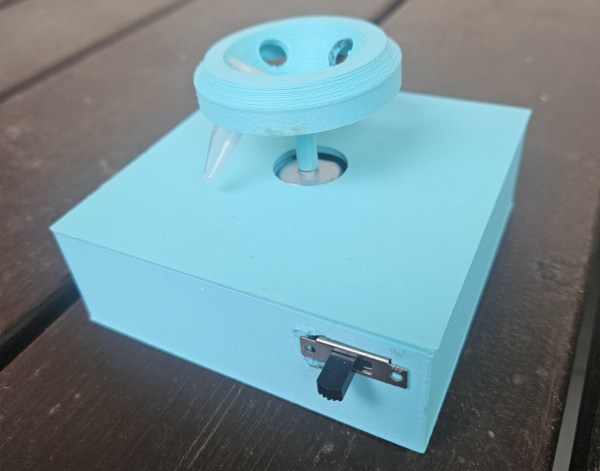
Part of the savings is due to the fact that [Aidan] has put together a smaller sized centrifuge, known as a micro-centrifuge. The function is still the same though, spinning samples to separate them out the constituents by weight. The 3D printed base of the centrifuge houses a switch and 9 V battery and also holds a small motor which spins the rotor. The rotor itself is also 3D printed, and needed to be a very specific shape to ensure that it could hold the samples properly at high RPM and maintain reasonable balance while spinning.

As a project it’s fairly simple and straightforward to build, but the more impressive thing here is how much it brings down the cost of lab equipment especially for high school labs that might otherwise struggle for funding. Of course it requires the use of a 3D printer but the costs of those have been coming down significantly as well, especially for things like this portable 3D printer which was also built by a high school student.

Continue reading “High School Student Builds Inexpensive Centrifuge”

Stirring Up 3D-Printed Lab Equipment

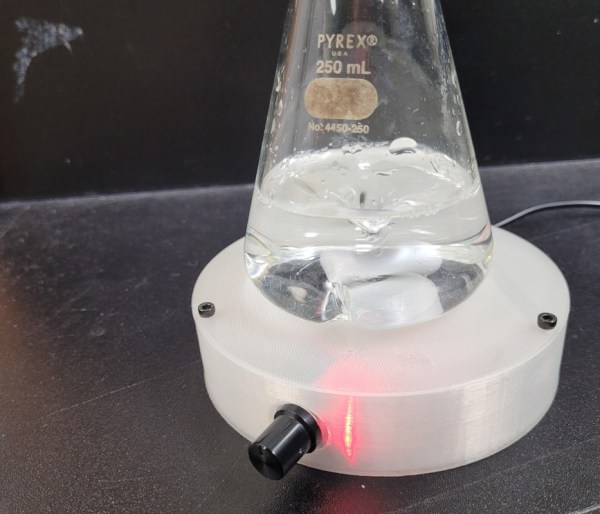
Magnetic stirrers are a core part of many chemistry labs. They offer many advantages for ensuring the effective mixing of solutions compared to other methods of stirring, including consistency, precise control, operation within closed systems, and of course, hands-free automatic operation. With so many reasons for employing a magnetic stirrer, it’s not too surprising that [Joey] would want one. He built his using 3D-printed parts rather than purchasing it.

The magnetic stirrer uses a 3D-printed enclosure for the base. Inside is a PWM controller which sends power to a small DC motor. A 3D-printed arm is attached to the motor, which hosts a pair of magnets. As the arm spins inside the enclosure, the magnetic fields from the magnet couple with the stir bar inside the mixture, allowing it to spin without any mechanical link to the stirring device and without any input from the user. [Joey] has also made all the 3D-printed parts for this build available on Printables.

While magnetic stirrers aren’t the most complicated of devices (or the most expensive), building tools like this anyway often has other advantages, such as using parts already on hand, the ability to add in features and customizations that commercial offerings don’t have, or acting as a teaching aid during construction and use. It’s also a great way to put the 3D printer to work, along with this other piece of 3D-printed lab equipment designed for agitating cell cultures instead.

Cooling Paint You Can Actually Make

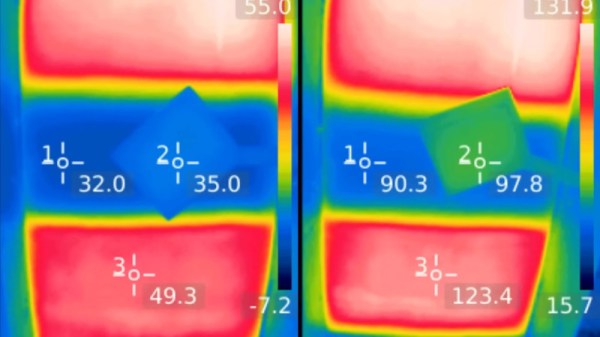
[NightHawkInLight] has been working on radiative sky paint. (Video, embedded below.) That’s a coating that radiates heat in the infrared spectrum at a wavelength that isn’t readily absorbed or reflected by the atmosphere. The result is a passive system that keeps materials a few degrees cooler in direct sunlight than an untreated piece in the shade. That sounds a bit like magic, but apparently the math checks out.

Continue reading “Cooling Paint You Can Actually Make”

Get Your Leafy Meats

Some of us jokingly refer to our hobbies as “mad science,” but [Justin] from The Thought Emporium could be one Igor away from living up to the jibe. The latest project to come out of the YouTube channel, video also after the break, outlines a map for creating an artificial organism in their new lab. The purpose is to test how far a citizen scientist can push the boundary of bioengineering. The stated goal is to create a swimming entity with a skeleton. The Thought Emporium also has a neuron project in the works, hinting at a potential crossover.

The artifishal [sic] organism has themes at the micro and macro scale. [Justin] says, “Cells are like little nano-robots. Mainly in the sense that they just follow their built-in instructions to the best of their ability.” At the multi-cellular level, the goal is to program something to actuate muscle tissue rhythmically to sustain locomotion. The method for creating living parts is decellularization and recellularization, a technique we heard about at Hackaday Belgrade.

The Thought Emporium is improving upon its protocol which removes cells from their “scaffolding” to repopulate it with the desired type, muscle in this case. Cellular scaffolds retain the shape of whatever they were, so whatever grows on them determines what they become. Once the technique of turning a leaf into muscle fibers is mastered, the next step will be creating bones with a different cell line that will mineralize the scaffold. Optimizing the processes and combining the results may show the world what is possible with the dedication of citizen bioengineers.

Regenerative medicine is looking at replacement human-parts with similar techniques. We are eager to see fish that digest plastic.

Continue reading “Get Your Leafy Meats”

Forgotten Chemical Photography

Much to the chagrin of Eastman Kodak, the world has moved on from chemical photography into the realm of digital, thanks to the ease of use and high quality of modern digital cameras. There are a few photographers here and there still using darkrooms and various chemical processes to develop film, and the most common of these use some type of chemistry based on silver to transfer images to paper. There are plenty of alternatives to silver, though, each with their unique style and benefits, like this rarely-used process that develops film using platinum.

This process, notable for its wide tonal range, delicate highlights, and rich blacks, produces only black and white photographs. But unlike its silver analog, it actually embeds the image into the paper itself rather than holding the image above the paper. This means that photographs developed in this manner are much more resilient and can last for much longer. There are some downsides to this method though, namely that it requires a large format camera and the negatives can’t be modified to produce various sized images in the same ways that other methods allow for. Still, the results of the method are striking for anyone who has seen one of these images in person.

As to why this method isn’t more common, [Matt Locke] describes a somewhat complicated history involving the use of platinum to create commercial fertilizers, which is an identical process to that of the creation of explosives, which were needed in great numbers at the same time this photographic method was gaining in popularity. While the amount of research and development that goes into creating weapons arguably generates some ancillary benefit for society, the effects of war can also serve to divert resources away from things like this.

2023 Hackaday Prize: The Primordial Soup’s On With This Modified Miller-Urey Experiment

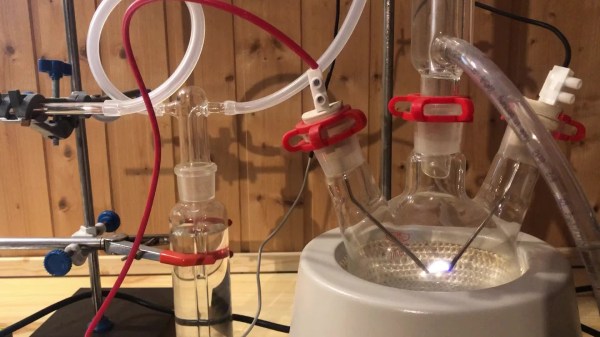
It’s a pretty sure bet that anyone who survived high school biology has heard about the Miller-Urey experiment that supported the hypothesis that the chemistry of life could arise from Earth’s primordial atmosphere. It was literally “lightning in a bottle,” with a mix of gases like methane, ammonia, hydrogen, and water in a closed-loop glass apparatus and a pair of electrodes to provide a spark to simulate lightning lancing across the early prebiotic sky. [Miller] and [Urey] showed that amino acids, the building blocks of protein, could be cooked up under conditions that existed before life began.

Fast forward 70 years, and Miller-Urey is still relevant, perhaps more so as we’ve extended our reach into space and found places with conditions similar to those on early Earth. This modified version of Miller-Urey is a citizen science effort to update the classic experiment to keep up with those observations, plus perhaps just enjoy the fact that it’s possible to whip up the chemistry of life from practically nothing, right in your own garage. Continue reading “2023 Hackaday Prize: The Primordial Soup’s On With This Modified Miller-Urey Experiment”