Never Twice The Same Color: Why NTSC Is So Weird

Ever wonder why analog TV in North America is so weird from a technical standpoint? [standupmaths] did, so he did a little poking into the history of the universally hated NTSC standard for color television and the result is not only an explanation for how American TV standards came to be, but also a lesson in how engineers sometimes have to make inelegant design compromises.

Before we get into a huge NTSC versus PAL fracas in the comments, as a resident of the US we’ll stipulate that our analog color television standards were lousy. But as [standupmaths] explores in some depth, there’s a method to the madness. His chief gripe centers around the National Television System Committee’s decision to use a frame rate of 29.97 fps rather than the more sensible (for the 60 Hz AC power grid) 30 fps. We’ll leave the details to the video below, but suffice it to say that like many design decisions, this one had to do with keeping multiple constituencies happy. Or at least equally miserable. In the end [standupmaths] makes it easy to see why the least worst decision was to derate the refresh speed slightly from 30 fps.

Given the constraints they were working with, that fact that NTSC works as well as it does is pretty impressive, and quite an epic hack. And apparently inspiring, too; we’ve seen quite a few analog TV posts here lately, like using an SDR to transit PAL signals or NTSC from a microcontroller.

Continue reading “Never Twice The Same Color: Why NTSC Is So Weird”
Glitching USB Firmware For Fun

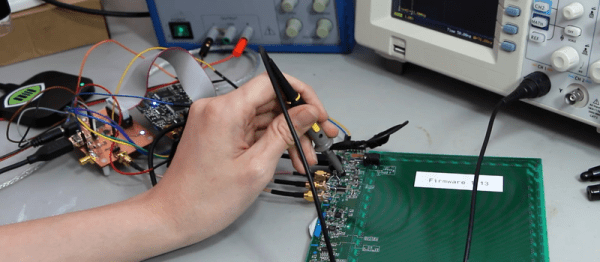
[Micah Elizabeth Scott], aka [scanlime], has been playing around with USB drawing tablets, and got to the point that she wanted with the firmware — to reverse engineer, see what’s going on, and who knows what else. Wacom didn’t design the devices to be user-updateable, so there aren’t copies of the ROMs floating around the web, and the tablet’s microcontroller seems to be locked down to boot.

With the easy avenues turning up dead ends, that means building some custom hardware to get it done and making a very detailed video documenting the project (embedded below). If you’re interested in chip power glitching attacks, and if you don’t suffer from short attention span, watch it, it’s a phenomenal introduction.

Continue reading “Glitching USB Firmware For Fun”

An Atari 600XL Talks Composite Video

When we write about the 8-bit era of home computers there is a list of manufacturers whose names are frequently mentioned. Apple, Commodore, Texas Instruments, maybe Acorn and Sinclair if you are British, and of course Atari. But when we mention the last of those names it is invariably in reference to their iconic 2600 games console, it almost passes unnoticed that they also produced a line of 8-bit home computers based upon that success.

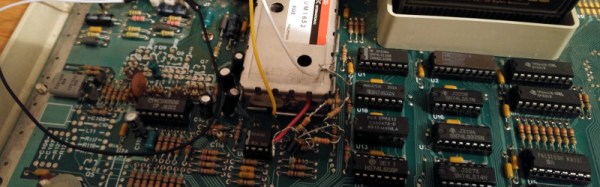
[ModPurist] was lucky enough to secure one of the Atari 8-bit computers through bartering with a local game store, an Atari 600XL from around 1983 or 1984, complete with its original box, manuals, cartridges, and a data cassette recorder. But on powering the system up and connecting to a TV a problem emerged. There was something there, but through a lot of noise and very blurry indeed. The solution after a bit of investigation turned out to be quite simple, to bypass the Astec video modulator and apply a composite video modification. Further investigation revealed that the original problem had in part been caused by the unit’s 5V power supply falling short of its voltage, so a further modification was to make a USB lead to allow it to be powered from a modern 5V charger.

This is a relatively simple piece of work, so you might be asking “Where’s the hack?”. The answer lies not in the mod itself, but in the detailed look [ModPurist] gives us at the inner workings of the 600XL, since it’s not a machine we see very often. Having the benefit of 30 years of hindsight and knowing the Atari’s competition quite well, we’d say that compared to some other machines of the era it’s a surprisingly well-designed computer both aesthetically and mechanically.

If your appetite for old Ataris has been whetted by this mod, can we draw your attention to this Atari 800 laptop? Or how about this 800 whose 6502 has been replaced with a 6809?

A Reproduction Vintage Sound Card

Before the AdLib sound card, sound on PCs was in a terrible shape. Since the dawn of IBM, all PCs included a speaker, but this PC speaker was only capable of sounding one note at a time. Chords on the PC speaker produced a weird ‘bubbling’ effect. Just a few years later, 8-bit sound could be created with the Covox Speech Thing, effectively a resistor ladder, with the parallel port on one side, and an 1/8″ plug on the other. These solutions for PC sound sucked.

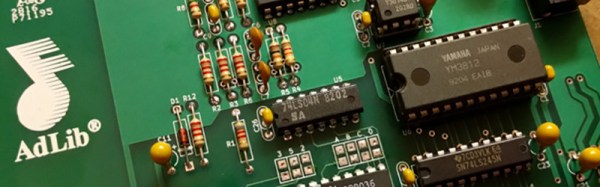
It wasn’t until the first AdLib cards that superior sound showed up on the PC. Recently, [eric] had been fixing up an old IBM XT and quickly realized the original AdLib sound cards were collector’s items and far too expensive for what they were. He decided to build a reproduction Ad Lib. completely compatible and nearly identical to the original 1990 version of the best sound card on the market.

The first Ad Lib sound card is a relatively simple circuit based on the Yamaha YM3012 (OPL2) and YM3014B chips. These chips are frequently available on eBay, and [Sergey] already has a complete circuit for turning these chips into an ISA sound card. While this modern card is compatible with the AdLib Music Synthesizer Card, it doesn’t look like one. [eric] wanted a card that looked like the real thing, and sounded like one, too.

PCB design has come a long way in a generation, and where the AdLib card was once a wonder of modern technology, anyone with enough patience can now design an identical board, send the file off to China, and receive a reproduction of the first successful sound card. All the files are up on Github should you want to build your own. Now all we need is someone making modern 486 motherboards.


Stacking Voltage References To High Voltage Extremes

As children, we all probably had our ideal career paths. As an adult do you still harbor a secret desire to be an astronaut, or to drive a railroad train? Or have holders of other jobs become the people you envy?

As a Hackaday writer it’s probably not too controversial to admit a sneaking envy for the writers of semiconductor application notes. True, often their work consists of dry demonstrations of conventional uses for the products in question, but every once in a while they produce something off the wall and outside the device’s intended use, so out of the ordinary that you envy them their access for experimentation to the resources of a large semiconductor company.

Take Texas Instruments’ Application Report SBAA203, from May 2013. “Stacking the REF50xx for High-Voltage References” (PDF). A laboratory specialising in accurate measurement of high voltages had the problem that the stacks of Zener or avalanche diodes they were using as voltage references lacked both precision and stability, so investigated the properties of the REF5010 10V precision voltage reference.

You'll never be satisfied with a mere Zener diode again.
You’ll never be satisfied with a mere Zener diode again.

They found that by ignoring the device’s data sheet and directly connecting its output pin to its power pin, the REF5010 became equivalent to an ideal Zener diode. In this mode multiple references could be stacked in the same way as a real Zener diode, and very stable and high-precision voltage references could be created with very high voltages. They made a PCB with ten stacked REF5010s for a 100V reference, and then stacked ten of them for a 1000V reference. Leaving it for 24 hours to settle, they achieved a precision of +/- 2.5ppm, and after 3.5 months their average reading for the ten 1000V references they built was 1000.022V.

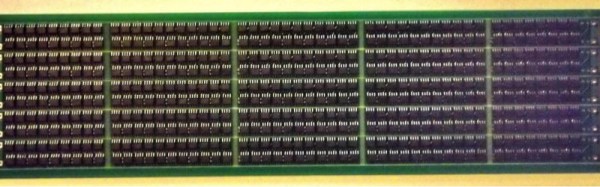
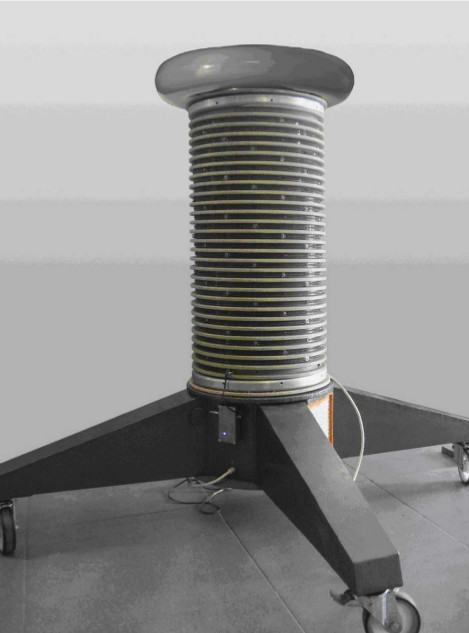
The 1000V reference would be impressive enough, but they weren’t finished. They built a series of boards holding 500 REF5010s for a 5KV reference, and stacked 20 of them to make a 100KV reference. These boards were mounted in a tower looking not unlike the Tesla coils we sometimes feature here. They note that it probably hits the record of simultaneous use of TI parts in a single device.

This may well be the first extremely high voltage precision reference to feature here at Hackaday, but we’ve certainly had our share of HV articles. Earlier this year we had a trio from [Steven Dufresne]: A conucopia of high voltage sources looking at ways to make your EHT, High voltage please, but don’t forget the current looking at selecting the right HV power supply for an application, and Wrangling high voltage looking at construction techniques.

Thanks [Nathan] for the tip.

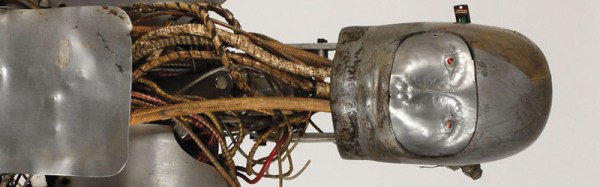
Retrotechtacular: Power Driven Articulated Dummy

If any of you have ever made a piece of clothing, you’ll know some of the challenges involved. Ensuring a decent and comfortable fit for the wearer, because few real people conform exactly to commercial sizes. It’s as much a matter of style as it is of practicality, because while ill-fitting clothing might be a sartorial fail, it’s hardly serious.

When the piece of clothing is a space suit though, it is a different matter. You are not so much making a piece of clothing as a habitat, and one that will operate in an environment in which a quick change to slip into something more comfortable is not possible. If you get it wrong at best your astronaut will be uncomfortable and at worst their life could be threatened.

Continue reading “Retrotechtacular: Power Driven Articulated Dummy”

Now Is The Golden Age Of Artisanal, Non-Traditional Tube Amps

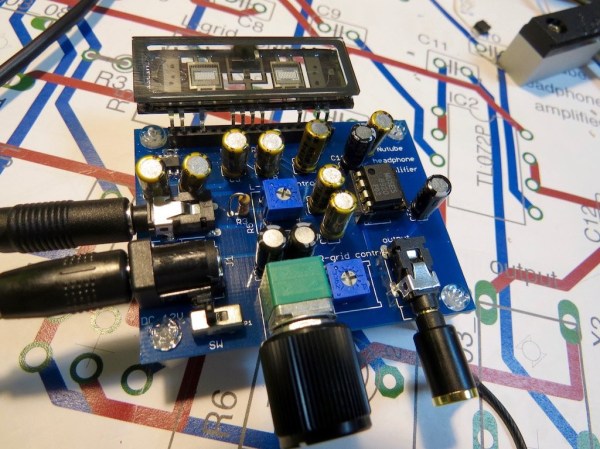
Earlier in the month, [Elliot Williams] quipped that it had been far too long since we saw a VFD-based amplifier build. Well, that dry spell is over. This week, [kodera2t] started showing off his design for a VFD headphone amp.

Here’s the thing, this isn’t using old surplus vacuum fluorescent displays. This is actually a new part. We first covered it about 18 months ago when Korg and Noritake announced the NuTube. It’s the VFD form factor you would find in old stereo and lab equipment, but housed in the familiar glass case is a triode specifically designed for that purpose.

Check out [kodera2t’s] video below where he walks through the schematic for his amplifier. Since making that video he has populated the boards and taken it for a spin — no video of that yet but we’re going to keep a watchful eye for a follow-up. Since these parts can be reliably sourced he’s even planning to sell it in his Tindie store. If you want to play around with this new tube that’s a pretty easy way to get the tube and support hardware all in one shot. This is not a hack, it’s being used for exactly what Korg and Noritake designed it to do, but we hope to see a few of these kits hacked for specific tastes in amp design. If you do that (or any other VFD hacking) we want to hear about it!

And now for the litany of non-traditional VFD amps we’ve grown to love. There is the Nixie amp where [Elliot] made the quip I mentioned above, here’s an old radio VFD amp project, in this one a VCR was the donor, and this from wayback that gives a great background on how this all works.

Continue reading “Now Is The Golden Age Of Artisanal, Non-Traditional Tube Amps”