Bend It Like Bhoite: Circuit Sculptures Shatter The Bounds Of Flatland

As electronics hobbyists, we live in a somewhat two-dimensional world. Our craft is so centered around the printed circuit board that our design tools are specifically geared to spit out files tailored to the board house, who can then ship us a study in fiberglass and copper. We daub on flux and solder, add components, apply heat, and like magic, our circuits come to life, all within a few millimeters above and below the PCB.

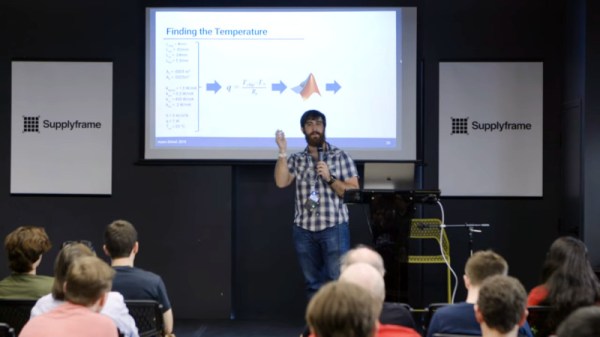
Breaking out of this self-imposed Flatland can be therapeutic. At least that’s how Mohit Bhoite sees his free-form circuit sculptures, which he spoke about at length at the Hackaday Superconference this year. By way of disclosure, I have to admit to being a longtime fan of Mohit’s work, both at his day job as a designer at Particle, and with his spare time hobby of creating sculptures from electronic components and brass wire which can be followed on his Twitter feed. He ended up joining us for a circuit sculpture Hack Chat just before heading to Supercon, too, so not only was I looking forward to meeting him, I was sure his talk would reveal the secrets of his art and give me the inspiration to start doing some of my own. I wasn’t disappointed on either score.

Continue reading “Bend It Like Bhoite: Circuit Sculptures Shatter The Bounds Of Flatland”

Supercon Talk: Emily Velasco Wants You To Work Weird

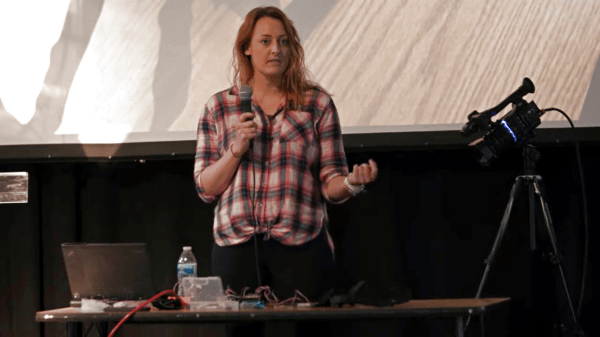
Emily Velasco seems to absolutely delight in the weird, and we think that is wonderful. Weird brings us together. If you can be weird with someone else, you’ll have a special bond for life. In her inspiring 2019 Supercon talk (embedded below), Emily explains why she is drawn to weird things, and why you should be, too. Her enthusiasm is both palpable and infectious, so don’t be surprised if you suddenly want to drop everything to accompany her on a treasure hunt adventure and spend the rest of the day making things.

Emily doesn’t try to push making weird things on to you, but her reasons for working in weird are quite compelling. Weird things catch the eye and interrupt the tedium of our lives. They give us pause and invite us to look again. You can choose to turn away if you want. But if you look closer, you might find that ugly, weird, and annoying things begin to charm you.

Emily says the formative force that pulled her toward the weird was the gang of mutant toys that the villainous Sid made in Toy Story. They force you to look closer and to consider them. But Emily is far from mean-spirited — she builds her creations with love, and not to act out or to spite her little sister. They’re not what you expect, and even if someone finds them off-putting at first, they are undeniably interesting.

Continue reading “Supercon Talk: Emily Velasco Wants You To Work Weird”

Hackaday Is Going To The 36th Chaos Communication Congress

It’s that time of year again here in Germany. The mulled wine flows all night long at the Christmas markets, the Krampus runs wild in the streets, and hackers are perched frantically behind their keyboards and soldering irons, trying to get their last minute projects “finished” for the 36th annual Chaos Communication Congress (36C3) in Leipzig.

We’ll have an assembly for all fans and friends of the Jolly Wrencher, so if you’re coming to Congress, you can come join us or at least stop by and say hi. [Elliot] and [Sven] and a number of Hackaday.io luminaries will be on hand. (Ask us about secret stickers and an as-yet unannounced upcoming Hackaday conference.)

Even if you’re not able to make it, you should keep your eyes on Hackaday from the 27th to the 30th, because we’ll be reporting on the best of Congress. But you don’t have to take our word for it: the Chaos Computer Club makes all of the talks available on livestream during the event, many with simultaneous translation, and final edited versions often appearing just a few hours afterwards.

We’ve looked through the schedule, and it’s going to be a hum-dinger! Gather ’round the glowing box with your friends at your own local hackerspace, or call in sick from work and make yourself some popcorn. This is must-see nerd TV.

Whether you’ve been naughty or nice, swing by our assembly if you’re going to be in Leipzig for the last few days of 2019. See you there!

Kerry Scharfglass Secures Your IoT Things

We’ve all seen the IoT device security trainwrecks: those gadgets that fail so spectacularly that the comment section lights up with calls of “were they even thinking about the most basic security?” No, they probably weren’t. Are you?

Hackaday Contributor and all around good guy Kerry Scharfglass thinks about basic security for a living, and his talk is pitched at the newcomer to device security. (Embedded below.) Of course “security” isn’t a one-size-fits-all proposition; you need to think about what threats you’re worried about, which you can ignore, and defend against what matters. But if you’ve never worked through such an exercise, you’re in for a treat here. You need to think like a maker, think like a breaker, and surprisingly, think like an accountant in defining what constitutes acceptable risks. Continue reading “Kerry Scharfglass Secures Your IoT Things”

Hackaday Superconference: Nick Poole On Boggling The Boardhouse

By now we are all used to the role of the printed circuit board in artwork, because of the burgeoning creativity in the conference and unofficial #BadgeLife electronic badge scenes. When the masters of electronic design tools turn their hand to producing for aesthetic rather than technical reasons, the results were always going to be something rather special.

Nick Poole is an ace wrangler of electrons working for SparkFun, and as such is someone with an impressive pedigree when it comes to PCB design. Coming on stage sporting a beret with an awesome cap badge, his talk at the recent Hackaday Superconference concerned his experience in pushing the boundaries of what is possible in PCB manufacture. It was a primer in the techniques required to create special work in the medium of printed circuit boards, and it should be essential viewing for anybody with an interest in this field.

Though he starts with the basics of importing graphics into a PCB design package, the meat of his talk lies in going beyond the mere two dimensions of a single PCB into the third dimension either by creating PCBs that interlock, or by stacking boards.

Continue reading “Hackaday Superconference: Nick Poole On Boggling The Boardhouse”

Kelly Heaton’s Artwork Blurs The Line Between Traditional And Electronic

Digital electronics are all well and good, but it’s hard to ignore the organic, living qualities of the analog realm. It’s these circuits that Kelly Heaton spends her time with, building artistic creations that meld the fine arts with classic analog hardware to speak to the relationship between electronics and nature. During her talk at the 2019 Hackaday Superconference, Kelly shared the story of her journey toward what she calls Electronic Naturalism, and what the future might bring.

The Pool of Reflection Loop was one of Kelly’s early electronic installation pieces.

Kelly got her start like many in the maker scene. Hers was a journey that began by taking things apart, with the original Furby being a particular inspiration. After understanding the makeup of the device, she began to experiment, leading to the creation of the Reflection Loop sculpture in 2001, with the engineering assistance of Steven Grey. Featuring 400 reprogrammed Furbys, the device was just the beginning of Kelly’s artistic experimentation. With an interest in electronics that mimicked life, Kelly then moved on to the Tickle Me Elmo. Live Pelt (2003) put 64 of the shaking Muppets into a wearable coat, that no doubt became unnerving to wear for extended periods.

Analog electronics parallel living organisms while programmable logic merely simulates life.

Forrest Mims

Wanting to create art with a strong relationship to organic processes, Kelly focused on working with discrete components and analog circuitry. Basic building blocks such as the astable multivibrator became key tools that were used in different combinations to produce the desired effects. Through chaining several oscillators together, along with analog sequencers, circuits could be created that mimicked the sound of crickets in a backyard, or a Carolina wren singing in a tree.

Continue reading “Kelly Heaton’s Artwork Blurs The Line Between Traditional And Electronic”

Interview: FieldKit Team The Morning After Winning The 2019 Hackaday Prize

We caught up with Shah Selbe and Jacob Lewallen the morning after their project, FieldKit, won the Hackaday Prize. FieldKit is an open-source field-based research data collection platform. Which is basically a lot of fancy words for saying it’s a system for collecting sensor data in the field without being snagged by the myriad of problems associated with putting electronics in remote locations. It’s a core project of Conservify, a non-profit organization that seeks to empower conservation research.

As grand prize winner the FieldKit project was awarded a $125,000 cash prize, which Shah and Jacob say is transformative for a non-profit pursuing technology research and development. It seems the grant process has not evolved to embrace developing electronics, while opportunities for research projects have begun to involve recording large data sets in order to test a hypothesis. This is where FieldKit truly shines. Their vision is to provide a low-cost and extensible system that other researchers can use to collect data while making their own grant dollar go much further.

Continue reading “Interview: FieldKit Team The Morning After Winning The 2019 Hackaday Prize”