LED Tree Brings Gravity To Christmas

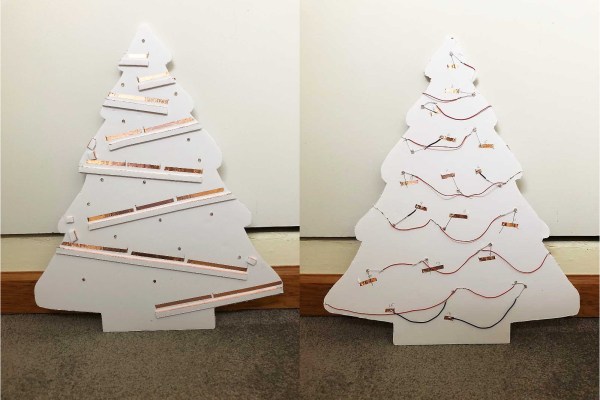
Here’s a fun entry into our coin cell challenge. The power source is the actuating force in [Frank]’s blinky LED Christmas tree, which takes advantage of the physical structure of coin cells and our old pal gravity to roll out some holiday cheer. Talk about forward voltage!

We love the concept, and the circuit couldn’t be more simple. A coin cell is released at the top of the tree and rolls down a series of angled foam board railings covered with 1/4″ copper tape. As the coin cell travels, the negative terminal shimmies along the face of the tree, which has corresponding ground rail tapes. There’s no microcontroller here—all that’s needed for blinks are breaks in the negative rail tape.

The challenging part of a project like this is the execution. Getting a coin cell to ride the rails without falling off required angle experimentation prior to and during the build. Now that it’s done, keeping the tree tilted back against the wall is key. [Frank] explored several options for returning the coin cell to the top using a camera motor and the gear assembly from an old inkjet, but for now, his six-year-old does the job without complaint. Check out his work ethic after the break.


Continue reading “LED Tree Brings Gravity To Christmas”

BrewBuddy Is A Home Brewer’s Best Friend

Whether coffee, tea, or beer is your jam, brewing is a delicate pas de deux of time and temperature. Proper brewing of any of these beverages can elevate the experience from average to amazing. With this in mind, [Marcelo] created a time and temperature tool to dial in his beer-brewing process.

BrewBuddy is a complex application-specific timer with an integrated thermometer. It lets him program time and temperature profiles for both the mashing process and the boiling process and store up to 10 steps for each. BrewBuddy doesn’t control the brewing temperature, but it does unify temperature-taking and time-marking into one convenient device that can last about 20 hours on a single CR2032.

The system is based on an STM32 and an LMT86 analog temperature sensor which has been modified to sit inside a stainless steel tube. There are four directional buttons to navigate through intuitive menus to set the desired times and temperatures. As each step completes, the status LED lights up and BrewBuddy waits for confirmation via button push before moving on to the next step. If there’s a problem, the timer can be paused and resumed using the up/down buttons. [Marcelo] is working to perfect the case design, but he already has the board files and firmware up on GitHub. Open up a cold one and check out the demo videos after the break.

After boiling and cooling comes fermentation, and that requires careful monitoring of the sugar content. Here’s a tool for that.

Continue reading “BrewBuddy Is A Home Brewer’s Best Friend”

This Is The Last Weekend For The Coin Cell Challenge

This is it. This is the last weekend you’ll have to work on the most explosive battery-powered contest in recent memory. This is the Coin Cell Challenge, and it’s all ending this Monday. You have less than 48 hours to create the most amazing thing powered by a coin cell battery.

Joseph Primmer slapped a coin cell on a piezo and rickrolled a university

Right now, we’re looking at the entries to the Coin Cell Challenge, and there are some real gems here. Did you know the Rickroll Throwie maddeningly distributed around the dorms at Cornell is an entry? Yes, with just a coin cell, an ATtiny85, and a piezo, you can rickroll people for an entire year.

Need some more inspiration? Anthropomorphized pool noodles need love. CES is coming up next weekend, which means you too can get kicked out for life, just like Gizmodo reportersThe Northeast is suffering through a cold snap right now, so let’s try jumpstarting a car with a coin cell battery. There are a million and one things you can do with a coin cell battery, and we want to see what you can do with them.

The top twenty projects for this contest will each receive $100 in Tindie credit to pick up some fancy kits and cool gear. The three top winners will each receive a $500 cash prize. We’re looking for three things specifically — a Lifetime Award that keeps a project going longest, a Supernova Award that drains a coin cell in the blink of an eye, and a Heavy Lifting Award that demonstrates what shouldn’t be possible with a simple coin cell.

This is your last weekend to submit a project, and the contest ends Monday afternoon, Pacific time. Enter now!

Take The Coin Cell Challenge This Weekend!

The year is drawing to a close, and we have a weekend project for you to while away the remaining hours. Take the Coin Cell Challenge!

The point of the challenge is to do something interesting with a coin cell. That’s it! It’s a challenge that can be as simple or as involved as you want. Low power is where it’s at these days, so if you’ve never used the hardware sleep modes in your favorite microcontroller, that would make an excellent challenge entry. Show us what you’re able to do with short wake periods, and talk about when and why that wake happens. Or go a completely different route and build your own cell!

[Ben Krasnow] makes the most of a tiny power source
The top twenty entries will each receive a $100 Tindie credit so they can score some excellent gear. Three top winners in some special areas who will each be awarded a $500 cash prize. We’re looking for something interesting that demonstrates longest life (Lifetime Award), something that burns through that coin cell as if it’s going out of style (Supernova Award), and something that fills us with disbelief (Heavy Lifting Award) because it shouldn’t be possible with “just a coin cell”.

One of our biggest inspirations for this contest was [Ben Krasnow] who managed to squeeze enough juice out of a miniscule coin cell to power his Flashing Light Prize entry, only because he reduced internal resistance by heating the cell with an air gun (here’s the Hackaday coverage of that project). And [Elliot Williams] wrote a great guide on what kind of juice you can expect to get out of a cell. Take these to heart and do something interesting this weekend. Enter now!

Environmentally Aware Jewelry Gets Attention

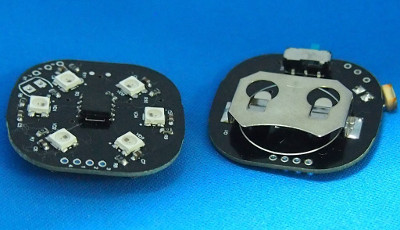
We didn’t include a “Most Ornate” category in this year’s Coin Cell Challenge, but if we had, the environmentally reactive jewelry created by [Maxim Krentovskiy] would certainly be the one to beat. Combining traditional jewelry materials with an Arduino-compatible microcontroller, RGB LEDs, and environmental sensors; the pieces are able to glow and change color based on environmental factors. Sort of like a “mood ring” for the microcontroller generation.

[Maxim] originally looked for a turn-key solution for his reactive jewelry project, but found that everything out there wasn’t quite what he was looking for. It was all either too big or too complicated. His list of requirements was relatively short and existing MCU boards were simply designed for more than what he needed.

On his 30 x 30 mm PCB [Maxim] has included the bare essentials to get an environmentally aware wearable up and running. Alongside the ATtiny85 MCU is a handful of RGB LEDs (with expansion capability to add more), as well as analog light and temperature sensors. With data from the sensors, the ATtiny85 can come up with different colors and blink frequencies for the LEDs, ranging from a randomized light show to a useful interpretation of the local environment.

It’s not much of a stretch to imagine practical applications for this technology. Consider a bracelet that starts flashing red when the wearer’s body temperature gets too high. Making assistive technology visually appealing is always a challenge, and there’s undoubtedly a market for pieces of jewelry that can communicate a person’s physical condition even when they themselves may be unable to.

Form or function, life saving or complete novelty, there’s still time to enter your own project in the 2017 Coin Cell Challenge.

LiquidWatch Is Dripping With Style

Some of the entries for the 2017 Coin Cell Challenge have already redefined what most would have considered possible just a month ago. From starting cars to welding metal, coin cells are being pushed way outside of their comfort zone with some very clever engineering. But not every entry has to drag a coin cell kicking and screaming into a task it was never intended for; some are hoping to make their mark on the Challenge with elegance rather than brute strength.

A perfect example is the LiquidWatch by [CF]. There’s no fancy high voltage circuitry here, no wireless telemetry. For this entry, a coin cell is simply doing what it’s arguably best known for: powering a wrist watch. But it’s doing it with style.

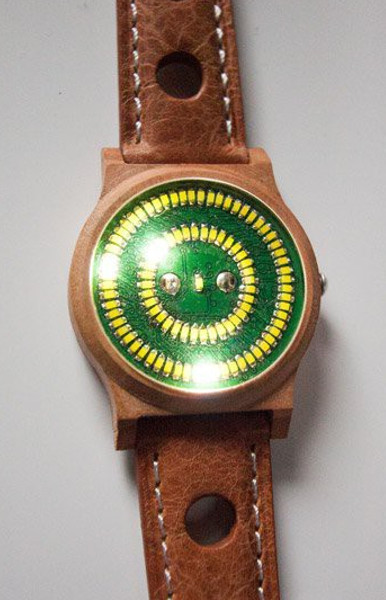
The LiquidWatch is powered by an Arduino-compatible Atmega328 and uses two concentric rings of LEDs to display the time. Minutes and seconds are represented by the outer ring of 60 LEDs, and the 36 LEDs of the inner ring show hours. The hours ring might sound counter-intuitive with 36 positions, but the idea is to think of the ring as the hour hand of an analog watch rather than a direct representation of the hour. Having 36 LEDs for the hour allows for finer graduation than simply having one LED for each hour of the day. Plus it looks cool, so there’s that.

Square and round versions of the LiquidWatch’s are in development, with some nice production images of [CF] laser cutting the square version out of some apple wood. The wooden case and leather band give the LiquidWatch a very organic vibe which contrasts nicely with the high-tech look of the exposed PCB display. Even if you are one of the legion that are no longer inclined to wear a timepiece on their wrist, you’ve got to admit this one is pretty slick.

Whether you’re looking to break new ground or simply refine a classic, there’s still plenty of time to enter your project in the 2017 Coin Cell Challenge.

Coin Cells: The Mythical Milliamp-Hour

Just how much metaphorical juice is in a coin cell battery? It turns out that this seemingly simple question is impossible to answer — at least without a lot of additional information. The problem is that the total usable energy in a battery depends on how you try to get that energy out, and that is especially true of coin cells.

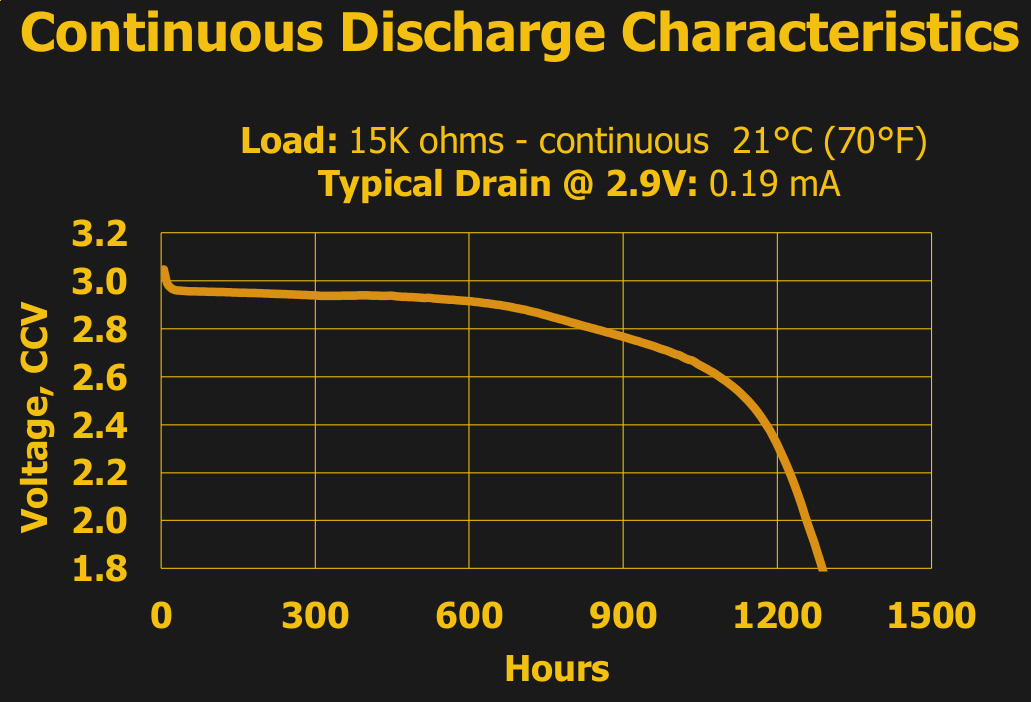
Energizer specs its 2032s at 0.2 mA

For instance, ask any manufacturer of the common 3 V lithium 2032 batteries, and they’ll tell you that it’s got 230 mAh. That figure is essentially constant across brands and across individual cells, and if you pull a constant 0.2 mA from the battery, at room temperature and pressure, you’ll get a bit more than the expected 1,150 hours before it dips below the arbitrary voltage threshold of 2.0 V. Just as it says on the tin.

What if you want to do anything else with a coin cell? Run an LED for a decade? Pull all the energy out right now and attempt to start a car? We had these sorts of extreme antics in mind when we created the Coin Cell Challenge, but even if you just want to do something mundane like run a low-power radio sensor node for more than a day, you’re going to need to learn something about the way coin cells behave in the real world. And to do that, you’re going to need to get beyond the milliamp hour rating. Let’s see how deep this rabbit hole goes.

Continue reading “Coin Cells: The Mythical Milliamp-Hour”