Welding Batteries With Batteries

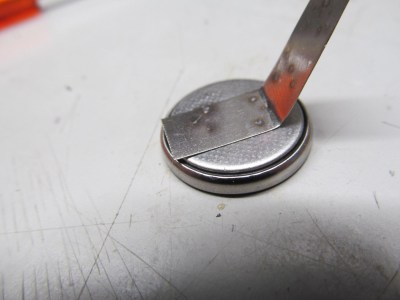
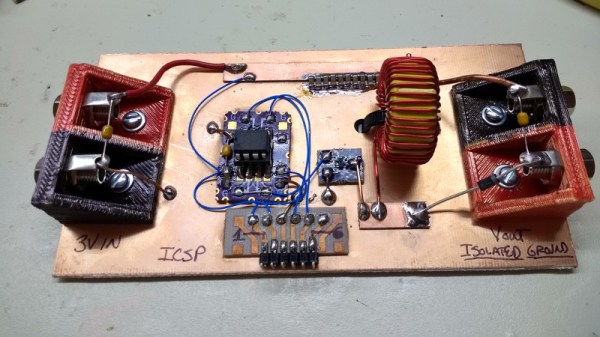
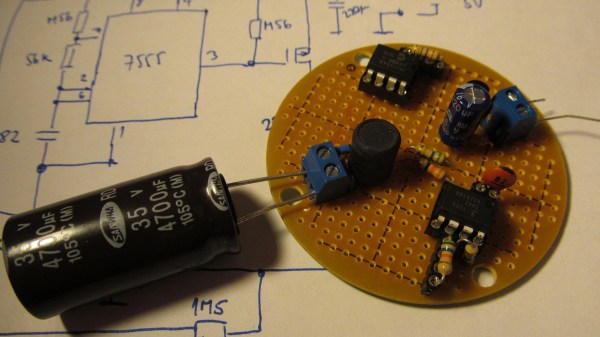
Welding equipment is always expensive and bulky, right? Heavens no! [Jaromir Sukuba] is making a welder for battery tabs which can fit in a pocket and gets its power from a coin cell. It may be expensive to power compared to a mains welder, but for the sake of portability this is quite the hack. Not only that, but it uses 555 timers in the charging circuit.

His entry for the 2017 Coin Cell Challenge saps every bit of power from a coin cell and stores it up in a 100F supercapacitor bank. All that stored energy takes a long time to get into the supercapacitors but it comes out in a flash. In fact, it can take 12 hours to fully charge. For the convenience of size, we have to trade the convenience of speed. This should be a strong contestant for the Supernova and Heavy Lifting categories.

We see a quick demonstration of a successfully welded tab which shows that using coin cells to weld metal to coin cells is equally ironic and apropos. Other welders on Hackaday feature a quicker way to control your battery tab welding, safety-rich spot welding, or just go off the rails completely and use an arc welder to make a coil gun.

Coin Cell Challenge: Jump Starting A Car

Clearly a believer in the old adage, “Go Big or Go Home”, [Ted Yapo] has decided to do something that seems impossible at first glance: starting his car with a CR2477 battery. He’s done the math and it looks promising, though it’s yet to be seen if the real world will be as accommodating. At the very least, [Ted] found a video by [ElectroBOOM] claiming to have started a car with a super capacitor, so it isn’t completely without precedent.

Doing some research, [Ted] found it takes approximately 2,000 W to 3,000 W at 14 V to start the average car engine. This is obviously far in excess of what a coin cell can put out instantaneously, but the key is in the surprising amount of potential energy stored in one of these batteries. If the cell is rated for 1000 mAh at 3 V, [Ted] shows the math to find the stored energy in Joules:

According to the video by [ElectroBOOM], he was able to start his car with only 6,527 J, and [Ted] calculates it should only take about 9,000 J on the high side from his research. So as long as he can come up with a boost converter that can charge a capacitor with high enough efficiency, this one should be in the bag.

[Ted] has started putting together some early hardware, and has even posted the source code he’s using on a PIC12LF1571 to drive the converter. He notes the current charge efficiency is around half of what’s needed according to his calculations, but he does mention it was an early test and improvements can be made. Will it start? If it does, this is some awesome Heavy Lifting.

Coin Cell Challenge: Use Coin Cell, Win Prizes

Today, we’re calling all hackers to do the most with a single coin cell. It’s the Coin Cell Challenge, and we’re looking for everything from the most low-power electronics to a supernova in a button cell battery.

Electronics are sucking down fewer and fewer amps every year. Low power is the future, and we’re wondering how far we can push the capabilities of those tiny discs full of power. The Coin Cell Challenge is your chance to plumb the depths of what can be done with the humble coin cell.

This is a contest, and as with the tradition of the Open 7400 Logic Competition and the recent Flashing Light Prize, we want to see what the community can come up with. The idea is simple: do something cool with a single coin cell and you’ll secure your fifteen minutes of fame and win a prize.

Three Challenges

To kick this contest off, we’re opening up three challenges to all contenders to the world heavyweight champion of button cell exploits. The first, the Lifetime Award, will go to whoever can run something interesting the longest amount of time on a coin cell. The Supernova Award is the opposite – what is the most exciting thing you can do with a button cell battery, lifetime be damned? The Heavy Lifting Award will go to the project that is the most unbelievable. If you think you can’t do that with a coin cell battery — lifting a piano or starting a car, for example — odds are you probably can. We want to see it.

Prizes and Rules

All Hackaday hardware hacking challenges need prizes, and for this one, we’re rolling out the red carpet. We’re offering up cash prizes for the top coin cell hacks. There are three $500 USD cash prizes, one for each winner of the Lifetime, Supernova, and Heavy Lifting awards. We’re not stopping there, because the top twenty builds overall will each receive $100 in Tindie credit, where the winners can cash in on some artisanal electronics sold by the people who design them.

What do you have to do to get in on this action? First, you need to build something. This something must be powered by nothing more than a single coin cell battery and must include some type of electronics. We also want this to be Open Source, and you’ll need to start a project on hackaday.io. The full rules are available over here, but don’t wait — the deadline for entry is January 8th, 2018.

We’re excited to see what the community comes up with, and who will find a production coin cell that’s the size of a dinner plate. This is going to be a great contest with overheating coin cells and tiny bits of metal flying across the room. This is going to be a contest filled with blinkies and wireless devices that run for far, far too long. Someone is going to misread the rules and tape together a meter tall pile of coin cells. It’s going to be awesome, so start your project now.

Tiny Light Bulb Flasher Vies For World’s Record

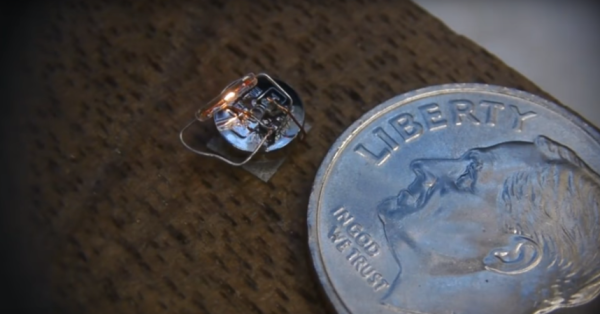
We’re going to go out on a limb here and declare this minuscule incandescent light flasher the smallest such circuit in the world. After all, when you need a microscope to see it work, you’ve probably succeeded in making the world’s smallest something.

Even if it’s not record breaking, [Ben Krasnow]’s diminutive entry in the 2017 Flashing Light Contest, which we recently covered, is still pretty keen. For those not familiar with the contest, it’s an informal challenge to build something that electrically switches an incandescent light on and off in the most interesting way possible for the chance to win £200. [Ben] says he’ll donate the prize money to a STEM charity if he wins, and we’d say he has a good chance with this flea-sized entry.

The incandescent lamp he chose is a specialty item for model makers and scale railroad enthusiasts; we’d heard of “grain of wheat” bulbs before, but this thing is ridiculous. The bulb makes the 4.6 mm diameter SR416 hearing aid battery that powers the flasher look enormous. The driver is a clever Schmitt trigger inverter with a tiny RC network to flash the bulb at about 1 Hz. The video below shows the flasher working and details the development and the build, which featured spot welding to the battery. [Ben] has even spec’d precisely how many Joules of energy will rupture the thing steel cases on these cells — we suspect involuntarily through trial and error.

[Ben]’s entry in the contest is now our favorite, and not just because he’s been a great friend to Hackaday with such classic hacks as watching a phonograph needle with an electron microscope and a homebrew CT scanner. This circuit is genuinely fascinating, and we hope it inspires you to try to top it. There’s a little less than a month left in the contest, so get to it.

Continue reading “Tiny Light Bulb Flasher Vies For World’s Record”

Flash A Light Bulb, Win A Prize

How many geeks does it take to flash a lightbulb? Judging from the list of entries in the 2017 Flashing Light Prize, so far only seven. But we suspect Hackaday readers can add to that total.

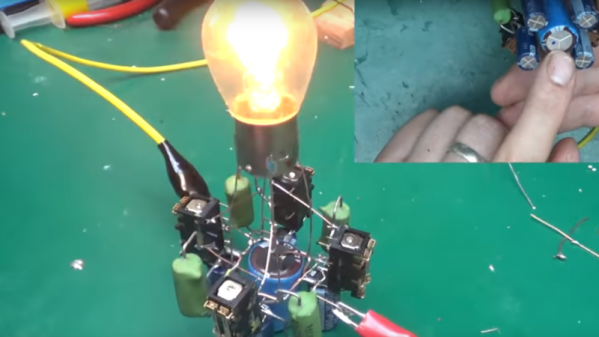
The goal is almost as simple as possible: build something that can flash an incandescent light bulb for at least five minutes. The system actually has to power the bulb’s filament, so no mechanical shutters are allowed. Other than that, the sky is the limit — any voltage, any wattage, any frequency and duty cycle, and any circuit. Some of the obvious circuits, like an RC network on a relay, have been tried. But we assume there will be points for style, in which case this sculptural cascading relay flasher might have a chance. Rube Goldberg mechanical approaches are encouraged, as in this motor, thread, stick and switch contraption. But our fave thus far is the 1000-watt bulb with solar cell feedback by Hackaday regular [mikeselectricstuff].

Get your entry in before August 1st and you’ll be on your way to glory and riches — if your definition of rich is the £200 prize. What the heck, your chances are great right now, and it’s enough for a few pints with your mates. Just don’t let it distract you from working on your 2017 Hackaday Prize entry — we’re currently in the “Wheels, Wings, and Walkers” phase, so maybe there’ll be a little crossover that you can leverage for your flasher.

Continue reading “Flash A Light Bulb, Win A Prize”

Show Us Your Internet Of Useful Things By Monday

Don’t forget to get your connected device entered in the Hackaday Prize by Monday morning. The current challenge is IuT ! IoT, a clever tilt at the Internet of Things, which is so hot right now. We don’t just want things to connect, we want that connection to be useful, so save your Internet Toasters and Twittering Toilets for another round.

So what are we looking for here? Any device that communicates with something else and thereby performs a service that has meaningful value. The Hackaday Prize is about building something that matters.

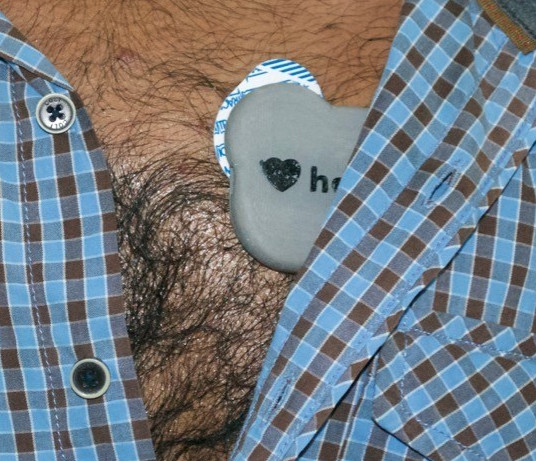
We’ve been covering a lot of great entries. HeartyPatch is an open source heart rate monitor and ECG that communicates through a smart phone. We’ve seen an affordable water level measuring station to help track when water levels are rising dangerously fast in flood prone areas. And the heads-up display for multimeters seeks to make work safer for those dealing with high voltages. Get inspired by all of the IuT ! IoT entries.

There’s $20,000 at stake in this challenge alone, as twenty IuT projects will be named finalists, awarded $1000 each, and move on to compete for the top prizes in the finals.

If you don’t have your project up on Hackaday.io yet, now’s the time. Once your project is published, entering is as easy as using the dropdown box on the left sidebar of your project page. [Shulie] even put together a quick video showing how to submit your entry. Check to make sure “Internet of Useful Things” is listed on your project’s sidebar and if not, use that dropdown to add it.

U.S Air Force Is Going To Get Hacked

[HackerOne] has announced that US Dept of Defense (DoD) has decided to run their biggest bug bounty program ever, Hack the Air force.

You may remember last year there was the Hack the Pentagon bug bounty program, Well this year on the coattails of last year’s success the DoD has decided to run an even bigger program this year: Hack The Air force. Anyone from “The Five Eyes” countries (Australia, Canada, New Zealand, the United Kingdom and of course the United States) can take part. This is a change in format from the Pentagon challenge which was only open to U.S citizens and paid out a total of around $75,000 in bug bounties.

Now obviously there are rules. You can’t just hack The Air Force no matter how much you want “All their base are belong to you”. The DoD want computer hackers to find bugs in their public facing web services and are not so much interested in you penetration testing their weapons systems or any other critical infrastructure. Try that and you may end up with a lovely never-ending tour of Guantanamo Bay Naval Base.