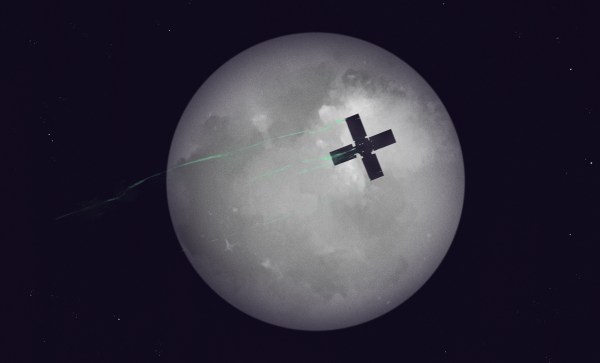
NASA Lunar Probe Finds Out It’s Not Easy Being Green

If you’re a space fan, these are very exciting days. There’s so much happening overhead that sometimes it can be difficult to keep up with the latest news. Artemis I just got back from the Moon, the International Space Station crew are dealing with a busted Soyuz, SpaceX is making incredible progress with their Starship architecture, CubeSats are being flung all over the solar system, and it seems like every month a new company is unveiling their own commercially-developed launch vehicle.
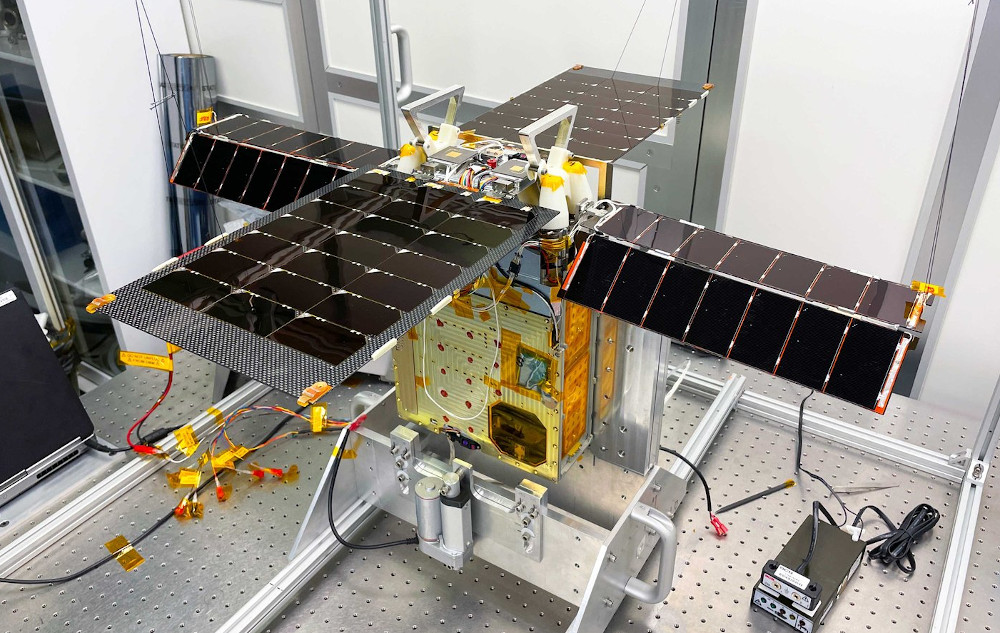
Lunar Flashlight

So with everything going on, we wouldn’t be surprised if you haven’t heard about NASA’s Lunar Flashlight mission. The briefcase-sized spacecraft was launched aboard a special “rideshare” flight of SpaceX’s Falcon 9 rocket back on December 11th — tagging along with two other craft heading to our nearest celestial neighbor, the Japanese Hakuto-R lander, and a small rover developed by the United Arab Emirates. There was a time when a launch like that would have been big news, but being that it was only the second of seven launches that SpaceX performed in December alone, it didn’t make many headlines.

But recently, that’s started to change. There’s a growing buzz around Lunar Flashlight, though unfortunately, not for the reasons we’d usually hope. It seems the diminutive explorer has run into some trouble with its cutting-edge “green” propellant system, and unless the issue can be resolved soon, the promising mission could come to an end before it even had a chance to start.

Continue reading “NASA Lunar Probe Finds Out It’s Not Easy Being Green” →
Machining With Electricity Explored In The Hack Chat

As a Hackaday reader, it’s safe to assume you’ve got a better than average understanding of electricity. There’s also an excellent chance you’re familiar with machining, and may even have a lathe or old mill in the workshop. But combining the two, and actually machining a piece of metal with electricity, isn’t something that many home gamers can boast first-hand experience with.

Daniel Herrington

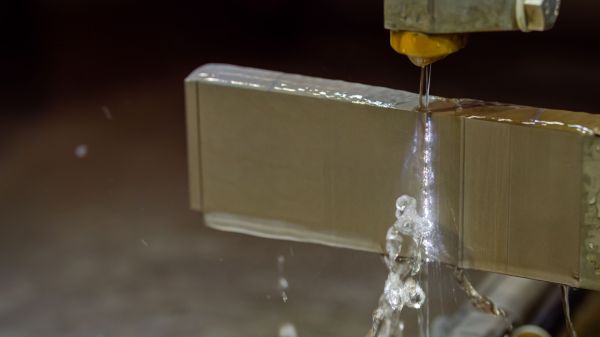
Of course, that doesn’t mean there isn’t an interest. To help answer the burning (or at least, sparking) questions from the community, CEO and founder of Voxel Innovations Daniel Herrington stopped by this week’s Hack Chat to talk about the cutting edge of both electric discharge machining (EDM) and the closely related field of electrochemical machining (ECM). While his company uses the technology to produce components at incredible scales, Daniel got his start tinkering in the garage like so many of us, enabling him to provide both a professional and hobbyist prospective on the technologies.

Naturally, the first big question to be addressed was the difference between EDM and ECM. Put simply, electric discharge machining uses high-voltage to literally blast away material from the workpiece. The resulting finish is generally rough, and progress through the material tends to be slow, but it’s relatively simple to implement.

In contrast electrochemical machining could be thought of as a sort of reverse electroplating process, as the material being removed from the workpiece is dissolved and transferred to the cathode — though in practice the flow of pressurized electrolyte keeps it from actually plating the negatively charged tool. ECM is a faster process than EDM and allows for an exceptionally smooth surface finish, but is considerably more challenging from a technical perspective. Continue reading “Machining With Electricity Explored In The Hack Chat” →

New Study Tells Us Where To Hide When The Nukes Are Coming

Geopolitics is a funny thing. Decades can go by with little concern, only for old grudges to suddenly boil to the surface and get the sabers a-rattlin’. When those sabers happen to be nuclear weapons, it can be enough to have you mulling the value of a bomb shelter in your own backyard.

Yes, every time the world takes a turn for the worse, we start contemplating what we’d do in the event of a nuclear attack. It’s already common knowledge that stout reinforced concrete buildings offer more protection than other flimsier structures. However, a new study has used computer modelling to highlight the best places to hide within such a building to maximise your chances of survival.

Continue reading “New Study Tells Us Where To Hide When The Nukes Are Coming” →

Punycodes Explained

When you’re restricted to ASCII, how can you represent more complex things like emojis or non-Latin characters? One answer is Punycode, which is a way to represent Unicode characters in ASCII. However, while you could technically encode the raw bits of Unicode into characters, like Base64, there’s a snag. The Domain Name System (DNS) generally requires that hostnames are case-insensitive, so whether you type in HACKADAY.com, HackADay.com, or just hackaday.com, it all goes to the same place.

[A. Costello] at the University of California, Berkley proposed the idea of Punycode in RFC 3492 in March 2003. It outlines a simple algorithm where all regular ASCII characters are pulled out and stuck on one side with a separator in between, in this case, a hyphen. Then the Unicode characters are encoded and stuck on the end of the string.

First, the numeric codepoint and position in the string are multiplied together. Then the number is encoded as a Base-36 (a-z and 0-9) variable-length integer. For example, a greeting and the Greek for thanks, “Hey, ευχαριστώ” becomes “Hey, -mxahn5algcq2″. Similarly, the beautiful city of München becomes mnchen-3ya. Continue reading “Punycodes Explained” →

Supercon 2022: All Aboard The SS MAPR With Sherry Chen

How do you figure out what is in a moving body of water over a mile wide? For those in charge of assessing the water quality of the Delaware river, this is a real problem. Collecting the data required to evaluate the water quality was expensive and time-consuming, taking over six years. Even then, the data was relatively sparse, with just a few water quality stations and only one surface sample for every six miles of river.

Sherry Chen, Quinn Wu, Vanessa Howell, Eunice Lee, Mia Mansour, and Frank Fan teamed up to create a solution, and the SS MAPR was the result. At Hackaday Supercon 2022, Sherry outlined the mission, why it was necessary, and their journey toward an autonomous robot boat. What follows is a fantastic guide and story of a massive project coming together. There are plans, evaluations, and tests for each component.

Sherry and the team first started by defining what was needed. It needed to be cheap, easy to use, and able to sample from various depths in a well-confined bounding box. It needed to run for four hours, be operated by a single person, and take ten samples across a 1-mile (2 km) section of the river. Some of the commercial solutions were evaluated, but they found none of them met the requirements, even ignoring their high costs. They selected a multi-hull style boat with off-the-shelf pontoons for stability and cost reasons.
Continue reading “Supercon 2022: All Aboard The SS MAPR With Sherry Chen” →

A Medieval Gothic Monastery Built Using CAD / CAM

Just because you’re a monk doesn’t mean you can’t use CAD. The Carmelite monks of Wyoming are building a grandiose Gothic Monastery, and it’s awe inspiring how they are managing to build it.

The Carmelite monks needed a new, larger monastery to house their growing numbers, and found a parcel of land near Meeteetse Creek in Wyoming. The design of their new Gothic monastery was outsourced to an architectural firm. Gothic architecture is characterised by key architectural elements such as pointed arches, large stained glass windows, rib vaults, flying buttresses, pinnacles and spires, elaborate entry portals, and ornate decoration.

After some research, the monks settled on using Kansas Silverdale limestone for the monastery. Cutting and carving the elaborate stone pieces required for such a project, within time and cost constraints, could only be achieved using CNC machines. Hand carving was ruled out as it was a very slow process, would cost a whole lot more, and it wouldn’t be easy to find the artisans for the job. So when it came to shortlisting vendors for the vast amount of stone cutting and carving required for construction, the monks found themselves alarmed at how prohibitively expensive it would turn out to be.

Continue reading “A Medieval Gothic Monastery Built Using CAD / CAM” →

AI-Controlled Twitch V-Tuber Has More Followers Than You

Surely we have all at least heard of Twitch by now. For the as-yet uninitiated: imagine you had your own TV channel. What would you do on it? Although Twitch really got going as a place for gamers to stream the action, there are almost as many people jamming out on their guitars, or building guitars, or just talking about guitars. And that’s just the example that uses guitars — if you can think of it, someone is probably doing it live on Twitch, within the Terms of Service, of course.

Along with the legions of people showing their faces and singing their hearts out, you have people in partial disguise, and then you have v-tubers. That stands for virtual tubers, and it just means that the person is using an anime avatar to convey themselves.

Now that you’re all caught up, let’s digest the following item together: there’s a v-tuber on Twitch that’s controlled entirely by AI. Let me run that by you again: there’s a person called [Vedal] who operates a Twitch channel. Rather than stream themselves building Mad Max-style vehicles and fighting them in a post-apocalyptic wasteland, or singing Joni Mitchell tunes, [Vedal] pulls the strings of an AI they created, which is represented by an animated character cleverly named Neuro-sama. Not only does Neuro-sama know how to play Minecraft and osu!, she speaks gamer and interacts regularly with chat in snarky, 21st century fashion. And that really is the key behind Twitch success — interacting with chat in a meaningful way.

Continue reading “AI-Controlled Twitch V-Tuber Has More Followers Than You” →