Ventilators 101: What They Do And How They Work

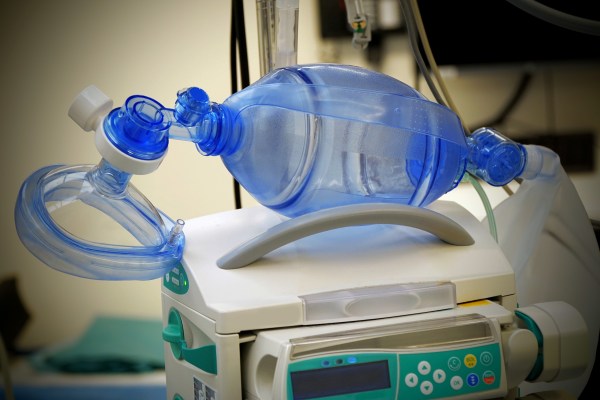
Treating the most serious cases of COVID-19 calls for the use of ventilators. We’ve all heard this, and also that there is a shortage of these devices. But there is not one single type of ventilator, and that type of machine is not the only option when it comes to assisted breathing being used in treatment. Information is power and having better grasp on this topic will help us all better understand the situation.

We recently wrote about a Facebook group focused on open source ventilators and other technology that could assist in the COVID-19 pandemic. There was an outpouring of support, and while the community is great when it comes to building things, it’s clear we all need more information about the problems doctors are currently dealing with, and how existing equipment was designed to address them.

It’s a long and complicated topic, though, so go get what’s left of your quarantine snacks and let’s dig in.

Continue reading “Ventilators 101: What They Do And How They Work”

Coronavirus Testing: Just The Facts

The news these days is dominated by the one big story: the COVID-19 pandemic. Since the first reports of infection surfaced in China sometime in late 2019, the novel coronavirus that causes the disease, bloodlessly dubbed SARS-CoV-19, has swept around the globe destroying lives, livelihoods, and economies. Getting a handle on the disease has required drastic actions by governments and sacrifices by citizens as we try to slow the rate of infection

As with all infectious diseases, getting ahead of COVID-19 is a numbers game. To fight the spread of the virus, we need to know who has it, where they are, where they’ve been, and whom they’ve had contact with. If we are unable to gather the information needed to isolate potential carriers, all that we can do is impose mass quarantines and hope for the best. Hence the need for mass COVID-19 testing, and the understandable hue and cry about its slow pace and the limited availability of test kits.

But what exactly do these test kits contain? What makes mass testing so difficult to implement? As we shall see, COVID-19 testing is anything but simple, even if the underlying technology, PCR, is well-understood and readily available. A lot of the bottlenecks are, as usual, bureaucratic, but there are technical limits too. Luckily, there are clever ways around those restrictions, but understanding the basics of COVID-19 testing is the best place to start.

Continue reading “Coronavirus Testing: Just The Facts”

The New Xbox: Just How Fast Is 12 TeraFLOPS?

Microsoft’s new Xbox Series X, formerly known as Project Scarlet, is slated for release in the holiday period of 2020. Like any new console release, it promises better graphics, more immersive gameplay, and all manner of other superlatives in the press releases. In a sharp change from previous generations, however, suddenly everybody is talking about FLOPS. Let’s dive in and explore what this means, and what bearing it has on performance.

Continue reading “The New Xbox: Just How Fast Is 12 TeraFLOPS?”

Ask Hackaday: What Should We Be Doing During Coronavirus Lockdown?

There’s a lot of good in the world and that includes you. Humanity has a way of coming together at crucial moments and we have certainly reached that with the outbreak and spread of the novel coronavirus. At this point, most people’s daily lives have been turned upside down. We can all have an impact on how this plays out.

It’s scary, it’s real, but we will get through this. What we need to focus on now is how we can behave that will lead to the best outcomes for the largest number of people. The real question is, how can we help? If you’re stuck at home it’s easy to feel powerless to help but that’s not true. Let’s cover a few examples, then open up the discussion in the comments so we can hear what has been working for you.

Continue reading “Ask Hackaday: What Should We Be Doing During Coronavirus Lockdown?”

Linux Fu: Mapping Files

If you use C or C++, you have probably learned how to open a file and read data from it. Usually, we read a character or a line at a time. At least, it seems that way. The reality is there are usually quite a number of buffers between you and the hard drive, so your request for a character might trigger a read for 2,048 characters and then your subsequent calls return from the buffer. There may even be layers of buffers feeding buffers.

A modern computer can do so much better than reading using things using old calls like fgetc. Given that your program has a huge virtual address space and that your computer has a perfectly good memory management unit within it, you can ask the operating system to simply map the file into your memory space. Then you can treat it like any other array of characters and let the OS do the rest.

The operating system doesn’t necessarily read the entire file in at one time, it just reserves space for you. Any time you hit a page that isn’t in memory, the operating system grabs it for you invisibly. Pages that you don’t use very often may be discarded and reloaded later. Behind the scenes, the OS does a lot so you can work on very large files with no real effort. The call that does it all is mmap.

Continue reading “Linux Fu: Mapping Files”

Prusa Advises On Printed Medical Devices, Releases Face Shield

Like everyone else, hackers and makers want to do something to help control the spread of COVID-19. The recent posts on Hackaday dealing with DIY and open source approaches to respirators, ventilators, and masks have been some of the most widely read and commented on in recent memory. But it’s important to remember that the majority of us aren’t medical professionals, and that even the most well-meaning efforts can end up making things worse if they aren’t done correctly.

Which is exactly what [Josef Průša] wanted to make clear about 3D printed medical equipment in his latest blog post. Like us, he’s thrilled to see all the energy the maker community is putting into brainstorming ways we can put our unique skills and capabilities to use during this global pandemic, but he also urged caution. Printing out an untested design in a material that was never intended for this sort of application could end up being more dangerous than doing nothing at all.

The nested design lends itself to mass production.

To say that he and his team are authorities in the realm of fused deposition modeling (FDM) would be something of an understatement. They know better than most what the technology is and is not capable of, and they’re of the opinion that using printed parts in respirators and other breathing devices isn’t viable until more research and testing is done

For example, how can we ensure the porous plastic parts are sterilized and not just serving as a breeding ground for bacteria? It’s hardly a new concern; the debate about printed objects in food contact applications has been going on for years.

The safest option is to only use printed parts for structural components that don’t need to be sterile. To that end, [Josef] used the post to announce a newly published design of a printable face shield for medical professionals. Starting with an existing open source design, the Prusa Research team used their experience to optimize the headband for faster and easier printing. They can produce four headbands at once on each of the printers in their farm, which will allow them to make as many as 800 shields per day without impacting their normal business operations. The bottleneck on production is actually how quickly they can cut out the clear visors with their in-house laser, not the time it takes to print the frames.

It’s easy to get excited when success stories featuring 3D printed medical devices are in the news, but that doesn’t mean you should be cranking out lifesaving devices with that roll of bargain PLA you’ve had sitting around the shop. As difficult as it may be for some of us to admit, the safest thing might be to let our spare CPU cycles do battle with COVID-19 instead.

Continue reading “Prusa Advises On Printed Medical Devices, Releases Face Shield”

Thousands Of Internet-Connected Satellites Above Us, What Could Possibly Go Wrong!

Our skies are full of satellites, more full than they have been, that is, because SpaceX’s Starlink and a bevvy of other soon-to-launch operators plan to fill them with thousands of small low-earth-orbit craft to blanket the Earth with satellite Internet coverage. Astronomers are horrified at such an assault on their clear skies, space-watchers are fascinated by the latest developments, and in some quarters they’re causing a bit of concern about the security risk they might present. With a lot of regrettable overuse use of the word “hacker”, the concern is that such a large number of craft in the heavens might present an irresistible target for bad actors, who would proceed to steer them into each other can cause chaos.

Invest in undersea cables, folks, the Kessler Syndrome is upon us, we’re doomed!

Continue reading “Thousands Of Internet-Connected Satellites Above Us, What Could Possibly Go Wrong!”