Love Songs To The Microphone

A biographer of Frank Sinatra once commented that for singers like Sinatra, their instrument is the microphone. We tend to think of microphones as ideal transducers, picking up sound faithfully. But like most electronic components, microphones are imperfect. They have a varying frequency response. They pick up popping noises when we say words like “popcorn” that are normally lost to someone listening live.

[Cheddar] has an interesting video (see below) that covers how performers like Sinatra, Bing Crosby, and Billie Holiday learned to use the microphone to their advantage. They suggest that the microphone changed the way humans sing, and they are right.

Continue reading “Love Songs To The Microphone”

EF50: The Tube That Changed Everything

From today’s perspective, vacuum tubes are pretty low tech. But for a while they were the pinnacle of high tech, and heavy research followed the promise shown by early vacuum tubes in transmission and computing. Indeed, as time progressed, tubes became very sophisticated and difficult to manufacture. After all, they were as ubiquitous as ICs are today, so it is hardly surprising that they got a lot of R&D.

Prior to 1938, for example, tubes were built as if they were light bulbs. As the demands on them grew more sophisticated, the traditional light bulb design wasn’t sufficient. For one, the wire leads’ parasitic inductance and capacitance would limit the use of the tube in high-frequency applications. Even the time it took electrons to get from one part of the tube to another was a bottleneck.

There were several attempts to speed tubes up, including RCA’s acorn tubes, lighthouse tubes, and Telefunken’s Stahlröhre designs. These generally tried to keep leads short and tubes small. The Philips company started attacking the problem in 1934 because they were anticipating demand for television receivers that would operate at higher frequencies.

Dr. Hans Jonker was the primary developer of the proposed solution and published his design in an internal technical note describing an all-glass tube that was easier to manufacture than other solutions. Now all they needed was an actual application. While they initially thought the killer app would be television, the E50 would end up helping the Allies win the war.

Continue reading “EF50: The Tube That Changed Everything”

Security Engineering: Inside The Scooter Startups

A year ago, ridesharing scooter startups were gearing up for launch. Workers at Bird, Lime, Skip, and Spin were busy improving their app, retrofitting scooters, and most importantly, figuring out the logistics of distributing thousands of electronic scooters along the sidewalks of the Bay Area. These companies were gearing up for a launch in early summer, but one company — nobody can remember exactly who — decided to launch early. First mover advantage, and all. Overnight, these scooter companies burst into overdrive, chucking scooters out of panel vans onto the sidewalk simply to keep up with the competition.

The thing about San Francisco, and California in general, is that it’s a very direct democracy masquerading as a representative government. Yes, there are city council members and a state legislature, but the will of the people will rule. No one liked tripping over the scooters littering the sidewalks, so the scooters ended up at the bottom of a lake. Or in trees. Or in the trash. In time, city permits were issued, just like a hot dog cart or any other business operating on a public sidewalk, and the piles of electric scooters disappeared. Not before hundreds of scooters were vandalized, that is.

It’s still early in the electric scooter rental startup space, but if there’s one company leading the pack, It’s Bird. they’re getting the most press, the CEO was formerly at Lyft and Uber (which explains the press), and they’ve raised nearly a half Billion dollars in funding (which explains the press). Bird is valued at two Billion dollars, and it’s one of four major ridesharing scooter startups. Pets.com had nothing on this.

Despite how overvalued you think a scooter startup might be, they’re still a business, and they’re ruled by the bottom line. Bird has grown a lot in the past year, and with that comes engineering challenges. The Bird scooters must be more resistant to vandalism. The Bird scooters must be harder to steal. Above all else, they must remain in service longer. This is the teardown of how Bird managed to improve their bottom line and engineer a better scooter.

Continue reading “Security Engineering: Inside The Scooter Startups”

Automate The Freight: Amazon Tackles The Last Mile Problem On Wheels

We’ve been occasionally exploring examples of what could be the killer application for self-driving vehicles: autonomous freight deliveries, both long-haul and local, as well as some special use cases. Some, like UAV delivery of blood and medical supplies in Kenya, have taken off and are becoming both profitable and potentially life-saving. Others, like driverless long-haul trucking, made an initial splash but appear to have gone quiet since then. This is to be expected, as the marketplace picks winners and losers in a neverending quest to maximize return on investment. But the whole field seems to have gotten a bit sleepy lately, with no big news of note for quite a while.

That changed last week with Amazon’s announcement of Scout, their autonomous delivery vehicle. Announced first on Amazon’s blog and later picked up by the popular and tech press who repeated the Amazon material almost verbatim, Scout appears at first glance to be a serious attempt by Amazon to own the “last mile” of delivery – the local routes that are currently plied by the likes of UPS, FedEx, and various postal services. Or is it?

Continue reading “Automate The Freight: Amazon Tackles The Last Mile Problem On Wheels”

The Deep Space Energy Crisis Could Soon Be Over

On the face of it, powering most spacecraft would appear to be a straightforward engineering problem. After all, with no clouds to obscure the sun, adorning a satellite with enough solar panels to supply its electrical needs seems like a no-brainer. Finding a way to support photovoltaic (PV) arrays of the proper size and making sure they’re properly oriented to maximize the amount of power harvested can be tricky, but having essentially unlimited energy streaming out from the sun greatly simplifies the overall problem.

Unfortunately, this really only holds for spacecraft operating relatively close to the sun. The tyranny of the inverse square law can’t be escaped, and out much beyond the orbit of Mars, the size that a PV array needs to be to capture useful amounts of the sun’s energy starts to make them prohibitive. That’s where radioisotope thermoelectric generators (RTGs) begin to make sense.

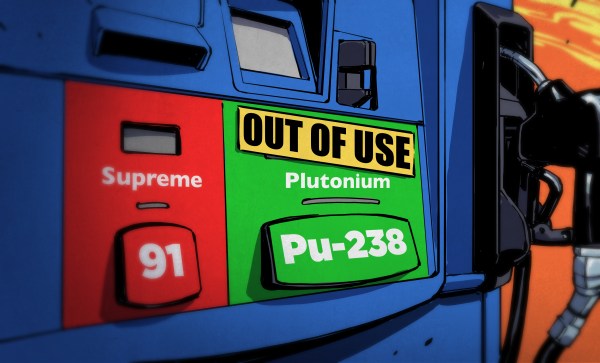
RTGs use the heat of decaying radioisotopes to generate electricity with thermocouples, and have powered spacecraft on missions to deep space for decades. Plutonium-238 has long been the fuel of choice for RTGs, but in the early 1990s, the Cold War-era stockpile of fuel was being depleted faster than it could be replenished. The lack of Pu-238 severely limited the number of deep space and planetary missions that NASA was able to support. Thankfully, recent developments at the Oak Ridge National Laboratory (ORNL) appear to have broken the bottleneck that had limited Pu-238 production. If it pays off, the deep space energy crisis may finally be over, and science far in the dark recesses of the solar system and beyond may be back on the table.

Continue reading “The Deep Space Energy Crisis Could Soon Be Over”

Eight Years Of Partmaking: A Love Story For Parts

Over my many years of many side-projects, getting mechanical parts has always been a creative misadventure. Sure, I’d shop for them. But I’d also turn them up from dumpsters, turn them down from aluminum, cut them with lasers, or ooze them out of plastic. My adventures making parts first took root when I jumped into college. Back-in-the-day, I wanted to learn how to build robots. I quickly learned that “robot building” meant learning how to make their constituent parts.

Today I want to take you on a personal journey in my own mechanical “partmaking.” It’s a story told in schools, machine shops, and garages of a young adulthood spent making parts. It’s a story of learning how to run by crawling through e-waste dumps. Throughout my journey, my venues would change, and so would the tools at-hand. But that hunger to make projects and, by extension, parts, was always there.

Dear partmakers, this is my love letter to you.

Continue reading “Eight Years Of Partmaking: A Love Story For Parts”

Oops… Britain Launched A Satellite, But Who Remembers It?

Did you know Britain launched its first satellite after the program had already been given the axe? Me neither, until some stories of my dad’s involvement in aerospace efforts came out and I dug a little deeper into the story.

I grew up on a small farm with a workshop next to the house, that housed my dad’s blacksmith business. In front of the workshop was a yard with a greenhouse beyond it, along one edge of which there lay a long gas cylinder about a foot (300mm) in diameter. To us kids it looked like a torpedo, and I remember my dad describing the scene when a similar cylinder fell off the side of a truck and fractured its valve, setting off at speed under the force of ejected liquid across a former WW2 airfield as its pressurised contents escaped.

Everybody’s parents have a past from before their children arrived, and after leaving the RAF my dad had spent a considerable part of the 1950s as a technician, a very small cog in the huge state-financed machine working on the UK’s rocket programme for nuclear and space launches. There were other tales, of long overnight drives to the test range in the north of England, and of narrowly averted industrial accidents that seem horrific from our health-and-safety obsessed viewpoint. Sometimes they came out of the blue, such as the one about a lake of  highly dangerous liquid oxidiser-fuel mix ejected from an engine that failed to ignite and which was quietly left to evaporate, which he told me about after dealing with a cylinder spewing liquid propane when somebody reversed a tractor into a grain dryer.

Bringing Home A Piece Of History

The remains of the Black Arrow first and second stages, taken from the Skyrora promotional video.

My dad’s tales from his youth came to mind recently with the news that a privately-owned Scottish space launch company is bringing back to the UK the remains of the rocket that made the first British satellite launch from where they had lain in Australia since crashing to earth in 1971. What makes this news special is that not only was it the first successful such launch, it was also the only one. Because here in good old Blighty we hold the dubious honour of being the only country in the world to have developed a space launch capability of our own before promptly abandoning it. Behind that launch lies a fascinating succession of forgotten projects that deserve a run-through of their own, they provide a window into both the technological and geopolitical history of that period of the Cold War.

Continue reading “Oops… Britain Launched A Satellite, But Who Remembers It?”