The Hacker Village Of Supercon

I’m utterly exhausted and still in a state of awe. The Hackaday Superconference has grown in so many ways, but one thing remains the same: the spirit of the Hacker Village — an intangible feeling that grows up around all who attend — is bliss to take part in.

There’s really no substitute for having been there in person. I’ll go into detail below and try to share the experience as best I can. But the gist of the atmosphere is this: everyone at Supercon is the type of person you’d want to be stuck in a rowboat with, or partnered with on an engineering project, or to have next to you while trying to save the world. There are no looky-loos at Supercon. It turns out we are all stuck in a rowboat together, we are all working on engineering projects, and we are all trying to save the world. And when we all get together it feels like a drug our pragmatic minds never knew existed. This is the recharge for that sense of urgency that keeps you going all year long.

So yes, you really missed it. But start now. Become friends with all of these people over the next year. Begin building your Supercon community now and it’ll feel like a reunion when it rolls around again next November.


Continue reading “The Hacker Village Of Supercon”

The Perils Of Developing The Hackaday Superconference Badge

In case you haven’t heard, the best hardware conference in the world was last weekend. The Hackaday Superconference was three days of hardware hacking, soldering irons, and an epic hardware badge. Throw in two stages for talk, two workshop areas, the amazing hallwaycon and the best, most chill attendees you can imagine, and you have the ultimate hardware conference.

Already we’ve gone over the gory details of what this badge does, and now it’s time to talk about the perils of building large numbers of an electronic conference badge. This is the hardware demoscene, artisanal manufacturing, badgelife, and an exploration of exactly how far you can push a development schedule to get these badges out the door and into the hands of eager badge hackers and con attendees.

The good news is that we succeeded, and did so in time to put a completed badge in the hand of everyone who attended the conference (and we do have a few available if you didn’t make it to the con). Join me after the break to learn what it took to make it all happen and see the time lapse of the final kitting process.

Continue reading “The Perils Of Developing The Hackaday Superconference Badge”

Maria Goeppert-Mayer: The Other Nobel Prize Winner

Maria Goeppert-Mayer was one of only two women to win the Nobel prize for physics thus far, the other being Marie Curie. And yet her name isn’t anywhere near as well known as Marie Curie’s. She also worked on the Manhattan Project and spent time during her long career with Enrico Fermi, Max Born, Edward Teller, and many other physics luminaries.

She was “other” in another way too. She followed her husband from university to university, and due to prevailing rules against hiring both husband and wife, often had to take a non-faculty position, sometimes even with no salary. Yet being the other, or plus-one, seemed to give her what every pure scientist desires, the freedom to explore. And explore she did, widely. She was always on the cutting edge, and all the time working with the leading luminaries of physics. For a scientist, her story reads like it’s too good to be true, which is what makes it so delightful to read about.

Continue reading “Maria Goeppert-Mayer: The Other Nobel Prize Winner”

Organizing Teams With Collective Fictions

There is often an observable difference between what is considered the right thing to do, and what actually is being done.

Terry Pratchett said it best when he made Death declare mercy and justice nonexistent: “TAKE THE UNIVERSE AND GRIND IT DOWN TO THE FINEST POWDER AND SIEVE IT THROUGH THE FINEST SIEVE AND THEN SHOW ME ONE ATOM OF JUSTICE, ONE MOLECULE OF MERCY.” (Note that Death is not shouting, he simply speaks upper case.)

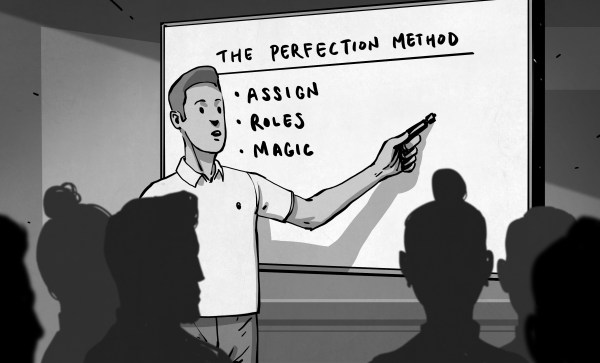
We can’t measure justice and mercy. These are collective fictions — things we agree to believe to enable us to get along — and finding consensus on the immeasurable extends to political systems, religion, and most of economics. In a recent article [zwischenzugs] makes the point that methodologies in software development fall into the same category. Like collective societal fictions, methodologies tend to elicit strong emotional responses among those dealing with them.

A software development methodology is a playbook for getting from nothing to something. It’s a control system for how people working on the project spend their time. And there are a lot of these prescribed methods, from Agile to Waterfall, and any combination of letters is likely to turn an abbreviation for a methodology. An interesting game when hanging out in groups of software engineers is to start the “Have you ever tried the…” conversation. Just don’t expect to move to another topic anytime soon.

One disheartening aspect of methodologies is their resistance to scientific scrutiny. Two samples of development teams will differ wildly in so many characteristics that a meaningful comparison of the way they organize their work is not possible. Which will leaves us with anecdotes and opinions when discussing these things.

Current opinions regarding the impact of methodologies on the success of a project range from ‘marginal’ to ‘essential’. The latter position is mainly propagated by consultants selling agile certifications, so you may want to take it with a grain of salt. Whether a team adheres strongly to the methodology or adopts it in name only, it’s obvious they serve a purpose — but that purpose may not match the face value of the method.

Continue reading “Organizing Teams With Collective Fictions”

Shockingly, DARPA’s Brain Stimulator Might Not Be Complete Nonsense

Where does your mind jump when you hear the mention of electroshock therapy? The use of electrical current to treat various medical conditions has a long and controversial history. Our fascination with the medical applications of electricity have produced everything from the most alarming of patent medicines to life-saving devices like pacemakers and the Automatic External Defibrillator.

The oldest reference I could find is the use of the torpedo fish to allegedly cure headaches, gout, and so on in 43 CE. Incidentally, Torpedo torpedo is an awesome species name.

Dosage: Apply live fish as needed to face? Source

Much more recently, there has been interest in transcranial direct current stimulation (tDCS). In essence, it’s a technique by which you pass an electrical current (typically about 2 milliamps) between strategically positioned electrodes on your head. The precise reason to do this is a bit unclear; different journal articles have suggested improvements in cognition, learning, and/or the potential treatment of various diseases.

I think most of us here spend a lot of time studying. The idea that a simple, noninvasive device can accelerate that is very attractive. We’ve covered a few people building their own such devices.

Unfortunately, what we want to be true is irrelevant. Superficially, this looks like a DARPA-funded panacea with no clearly established mechanism of action. Various commercial products are being sold that imply (but as usual, don’t directly state) that tDCS is useful for treating pretty much everything, with ample use of ‘testimonials’.

While tDCS can be prescribed by a physician in some countries to complement a stroke rehabilitation regime, for off-label purposes you may as well just go apply a fish to your face. Let’s dig into the literature and products that are out there and see if we can find the promise hiding amidst the hype.

Continue reading “Shockingly, DARPA’s Brain Stimulator Might Not Be Complete Nonsense”

The Clutter Manifesto

My basement workshop is so crammed full of stuff I literally can’t use it. My workbench, a sturdy hardwood library table, is covered in junk to the point that I couldn’t find a square foot that didn’t have two layers of detritus on it — the top layer is big things like old projects that no longer work, boxes of stuff, fragile but light things perched on top. Underneath is the magma of bent resistors, snippets of LED strip, #4 screws, mystery fasteners I’ll never use, purple circuit boards from old versions of projects, and a surprising number of SparkFun and Adafruit breakouts that have filtered down from higher up in the heap.

When work on something I bring the parts up to the dining room and work on the table, which is great for many reasons — more space, better light, and superior noms access top the list. The down side is that I don’t devote any time to making my real shop into a viable working place, and it becomes a cluttered store room by default.

I am therefore focusing on a four-part plan to reclaim my work space from heaps of junk.

Continue reading “The Clutter Manifesto”

Hacking When It Counts: Prison Locksmithing

In 1978, Tim Jenkin was a man living on borrowed time, and he knew it. A white South African in his late 20s, he had been born into the apartheid system of brutally enforced racial segregation. By his own admission, he didn’t even realize in his youth that apartheid existed — it was just a part of his world. But while traveling abroad in the early 1970s he began to see the injustice of the South African political system, and spurred on by what he learned, he became an activist in the anti-apartheid underground.

Intent on righting the wrongs he saw in his homeland, he embarked on a year of training in London. He returned to South Africa as a propaganda agent with the mission to spread anti-apartheid news and information to black South Africans. His group’s distribution method of choice was a leaflet bomb, which used a small explosive charge to disperse African National Congress propaganda in public places. Given that the ANC was a banned organization, and that they were setting off explosives in a public place, even though they only had a few grams of gunpowder, it was inevitable that Jenkin would be caught. He and cohort Steven Lee were arrested, tried and convicted;  Jenkin was sentenced to 12 years in prison, while Lee got eight.

Continue reading “Hacking When It Counts: Prison Locksmithing”