Eclipse 2017: Was Einstein Right?

While most people who make the trek to the path of totality for the Great American Eclipse next week will fix their gazes skyward as the heavenly spectacle unfolds, we suspect many will attempt to post a duck-face selfie with the eclipsed sun in the background. But at least one man will be feverishly tending to an experiment.

On a lonely hilltop in Wyoming, Dr. Don Bruns will be attempting to replicate a famous experiment. If he succeeds, not only will he have pulled off something that’s only been done twice before, he’ll provide yet more evidence that Einstein was right.

Continue reading “Eclipse 2017: Was Einstein Right?”

Wideband Woes And The Junkbox Miata

As ever, I am fighting a marginally winning battle against my 1991 Mazda MX-5, and this is the story of how I came to install a wideband oxygen sensor in my Japanese thoroughbred. It came about as part of my ongoing project to build myself a viable racecar, and to figure out why my 1990s Japanese economy car engine runs more like a late 1970s Malaise-era boat anchor.

I’ve always considered myself unlucky. My taste for early 90s metal has meant I’ve never known the loving embrace of OBD-2 diagnostics, and I’ve had to make to do with whatever hokey system was implemented by manufacturers who were just starting to produce reliable fuel injection systems.

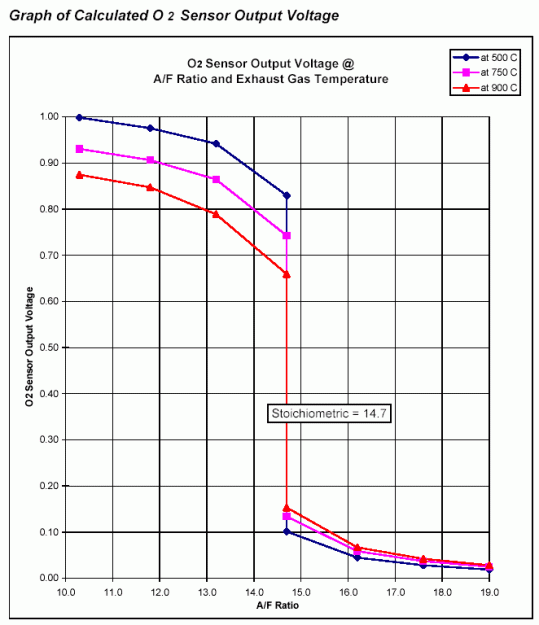
Narrowband oxygen sensor voltage output. The output is heavily dependent on sensor temperature and highly non-linear, making these sensors unsuitable for delivering a true AFR reading.

This generally involves putting in a wire jumper somewhere, attaching an LED, and watching it flash out the trouble codes. My Mazda was no exception, and after putting up with a car that was running rich enough to leave soot all over the rear bumper, I had to run the diagnostic.

It turned up three codes – one for the cam angle sensor, and two for the oxygen sensor. Now, a cam angle sensor (CAS) fault will normally prevent the car running at all, so it’s safe to assume that was an intermittent fault to keep an eye on.

The oxygen sensor, however, was clearly in need of attention. Its job is to allow the engine control unit (ECU) to monitor the fuel mixture in the exhaust, and make sure it’s not too rich or too lean. As my car was very obviously running too rich, and the diagnostic codes indicated an oxygen sensor failure, a repair was in order.

I priced up replacement sensors, and a new oxygen sensor could be had for under $100. However, it wasn’t exactly what I wanted, as not all oxygen sensors are created equal. Cars in the 80s and 90s typically shipped from the OEM fitted with what’s called a narrowband oxygen sensor. These almost always consist of a zirconia dioxide cell that outputs a voltage depending on the difference in oxygen concentration between the exhaust gas and the free air. These sensors generally sit at 0.45 V when the fuel mixture is stoichiometric, but rapidly change to 0.1 V in a lean condition and 0.9 V in a rich condition. The response is highly non-linear, and changes greatly with respect to temperature, and thus is only good for telling the ECU if it’s rich or lean, but not by how much. ECUs with narrowband sensors tend to hunt a lot when running in closed loop O2 control – you’ll see an engine at idle hunt either side of the magical 14.7 stoichiometric air fuel ratio, never able to quite dial in on the correct number.

As I intend to switch to an aftermarket ECU in the future, I’ll need to tune the car. This involves making sure the air/fuel ratios (AFRs) are correct, and for that I need to be able to properly measure them. Just knowing whether you’re rich or lean isn’t enough, as often it’s desirable to run the engine intentionally rich or lean at certain engine loads. To get a true AFR reading requires fitting a wideband oxygen sensor. These are a little more complicated.

Continue reading “Wideband Woes And The Junkbox Miata”

Product Development And Avoiding Stock Problems

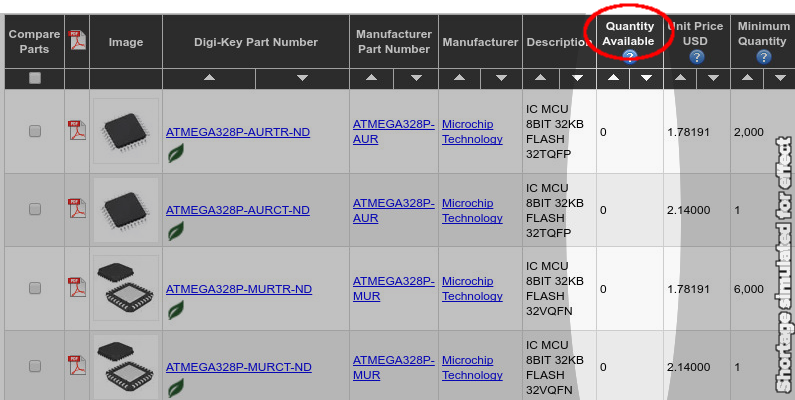
You’ve spent months developing your product, your Kickstarter just finished successfully, and now you’re ready to order all the parts. Unfortunately, your main component, an ATmega328P, is out of stock everywhere with a manufacturer lead time of 16 weeks. Now what?

When manufacturing things in large volumes, acquiring enough stock at the right time can be tricky. There can be seasonal shortages with companies trying to get products manufactured and available for Christmas. There can be natural disasters like floods of hard drive factories, or politically-related availability problems like tantalum for capacitors, or maybe new markets open up that increase demand or a new product sucks up all the available supply. The result is all the same; you have a harder time getting what you need. Fortunately, there are some ways to avoid this problem, or at least mitigate it.

Continue reading “Product Development And Avoiding Stock Problems”

Hands On With The SHACamp 2017 Badge

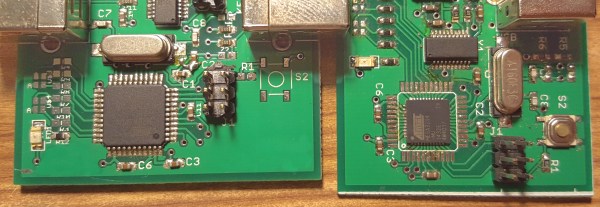
The badge has become one of the defining features of a modern hacker camp, a wearable electronic device that serves as both event computer and platform for some mild software and hardware hacking. Some events have had astoundingly sophisticated badges while others are more simple affairs, and the phenomenon has even spawned an ecosystem of unofficial badges which have nothing to do with the event in question.

The SHACamp 2017 badge is the latest to come the way of a Hackaday writer, and certainly contains enough to be taken as representative of the state of hacker camp badges in 2017. It doesn’t have a star turn like CCCCamp 2015’s software defined radio, instead it’s an extremely handy little computer in its own right.

Continue reading “Hands On With The SHACamp 2017 Badge”

Bibles You Should Read: PoC || GTFO

PASTOR LAPHROAIG ANNOUNCES THE PUBLICATION OF WHAT WILL TORMENT THE ACOLYTES OF THE CHURCH OF ROBOTRON! NO MAN SHALL BE SPARED AND THE INQUISITION WILL BEGIN PROMPTLY!

For the last few years, Pastor Manul Laphroaig and friends have been publishing the International Journal of PoC || GTFO. This is a collection of papers and exploits, submitted to the Tract Association of PoC || GTFO, each of which demonstrates an interesting exploit, technique, or software toy in the field of electronics. Imagine, if 2600 or Dr. Dobb’s Journal were a professional academic publication. Add some whiskey and you have PoC || GTFO.

This is something we’ve been waiting a while for. The International Journal of PoC || GTFO is now a real book bible published by No Starch Press. What’s the buy-in for this indulgence? $30 USD, or a bit less if you just want the Ebook version. The draw of the dead tree version of PoC includes a leatherette cover, gilt edges, and the ability to fit inside bible covers available through other fine retailers. There are no rumors of a children’s version with vegetable-based characters.

PoC || GTFO, in reality, is an almost tri-annual journal of reverse engineering, computer science, and other random electronic computational wizardry, with papers (the Proof of Concept) by Dan Kaminsky, Colin O’Flynn, Joe FitzPatrick, Micah Elisabeth Scott, Joe Grand, and other heroes of the hacker world. What does PoC || GTFO present itself as? Applied electrons in a religious tract publication. The tongue is planted firmly in the cheek here, and it’s awesome.

Continue reading “Bibles You Should Read: PoC || GTFO”

Testing Distance Sensors

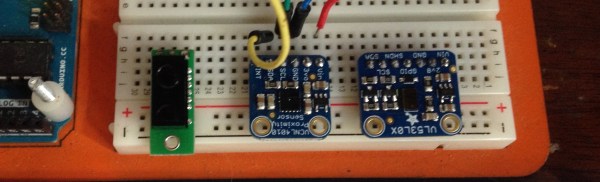
I’m working on a project involving the need to precisely move a tool based on the measured distance to an object. Okay, yeah, it’s a CNC mill. Anyway, I’d heard of time of fight sensors and decided to get one to test out, but also to be thorough I wanted to include other distance sensors as well: a Sharp digital distance sensor as well as a more sophisticated proximity/light sensor. I plugged them all into a breadboard and ran them through their paces, using a frame built from aluminum beams as a way of holding the target materials at a specific height.

Continue reading “Testing Distance Sensors”

Books You Should Read: IGNITION!

Isaac Asimov described the business of rocket fuel research as “playing footsie with liquids from Hell.” If that piques your interest even a little, even if you do nothing else today, read the first few pages of IGNITION! which is available online for free. I bet you won’t want to stop reading.

IGNITION! An Informal History of Liquid Rocket Propellants is about how modern liquid rocket fuel came to be. Written by John D. Clark and published in 1972, the title might at first glance make the book sound terribly dry — it’s not. Liquid rocket fuel made modern rocketry possible. But most of us have no involvement with it at all besides an awareness that it exists, and that makes it easy to take for granted.

Most of us lack any understanding of the fact that its development was the result of a whole lot of hard scientific work, and that work required brilliance (and bravery) and had many frustrating dead ends. It was also an amazingly dangerous business to be in. Isaac Asimov put it this way in the introduction:

“[A]nyone working with rocket fuels is outstandingly mad. I don’t mean garden-variety crazy or a merely raving lunatic. I mean a record-shattering exponent of far-out insanity.

There are, after all, some chemicals that explode shatteringly, some that flame ravenously, some that corrode hellishly, some that poison sneakily, and some that stink stenchily. As far as I know, though, only liquid rocket fuels have all these delightful properties combined into one delectable whole.”

At the time that the book was written and published, most of the work on liquid rocket fuels had been done in the 40’s, 50’s, and first half of the 60’s. There was plenty written about rocketry, but very little about the propellants themselves, and nothing at all written about why these specific substances and not something else were being used. John Clark — having run a laboratory doing propellant research for seventeen years — had a unique perspective of the whole business and took the time to write IGNITION! An Informal History of Liquid Rocket Propellants.

Liquid rocket propellant was in two parts: a fuel and an oxidizer. The combination is hypergolic; that is, the two spontaneously ignite and burn upon contact with each other. As an example of the kinds of details that mattered (i.e. all of them), the combustion process had to be rapid and complete. If the two liquids flow into the combustion chamber and ignite immediately, that’s good. If they form a small puddle and then ignite, that’s bad. There are myriad other considerations as well; the fuel must burn at a manageable temperature (so as not to destroy the motor), the energy density of the fuel must be high enough to be a practical fuel in the first place, and so on.

The actual process of discovering exactly what materials to use and how precisely to make them work in a rocket motor was the very essence of the phrase “the devil is in the details.” For every potential solution, there was a mountain of dead-end possibilities that tantalizingly, infuriatingly, almost worked.

The first reliable, workable propellant combination was Aniline and Red Fuming Nitric Acid (RFNA). “It had the one – but magnificent – virtue that it worked,” writes Clark. “Otherwise it was an abomination.” Aniline was difficult to procure, ferociously poisonous and rapidly absorbed through skin, and froze at an inconvenient -6.2 Celsius which limited it to warm weather only. RFNA was fantastically corrosive, and this alone went on to cause no end of problems. It couldn’t be left sitting in a rocket tank waiting to be used for too long, because after a while you wouldn’t have a tank left. It needed to be periodically vented while in storage. Pouring it gave off dense clouds of remarkably toxic gas. This propellant would go on to cause incredibly costly and dangerous problems, but it worked. Still, no one wanted to put up with any of it one moment longer than they absolutely had to. As a result, that combination was not much more than a first step in the whole process; there was plenty of work left to do.

By the mid-sixties, liquid rocket propellant was a solved problem and the propellant community had pretty much worked themselves out of a job. Happily, a result of that work was this book; it captures history and detail that otherwise would simply have disappeared.

Clark has a gift for writing, and the book is easy to read and full of amusing (and eye-widening) anecdotes. Clark doesn’t skimp on the scientific background, but always in an accessible way. It’s interesting, it’s relevant, it’s relatable, and there is plenty to learn about how hard scientific and engineering development actually gets done. Download the PDF onto your favorite device. You’ll find it well worth the handful of evenings it takes to read through it.