More than one hundred years ago, Henri Becquerel discovered that uranium emitted penetrating rays similar to those used by Wilhelm Röntgen to take the first X-ray image (of his wife’s hand), starting a new era of far-reaching applications. There are of course many dangers that come with the use of radioactivity, but there are also many beneficial uses for our society.
Curated76 Articles
Hackaday’s finest original content articles curated by the Hackaday editors
IuT ! IoT
Let’s build the Internet of USEFUL Things, not just the Internet of Things. IuT ! IoT
That’s what we’ll be doing over the next five weeks. The second challenge of the 2017 Hackaday Prize begins today. We’re looking for the best ideas we can find for useful connected devices. Twenty entries will recieve $1,000 and move on to the final round to vie for the top prizes ranging from $5,000 to $50,000.
There is no doubt that the future is connected. It has been our future since the advent of the telegraph, and we’re unarguably becoming more connected at a faster rate. The phone in your hand, pocket, or bag connects you to the bulk of human knowledge. But it doesn’t yet connect you to very many “things”. It won’t be that way for long.
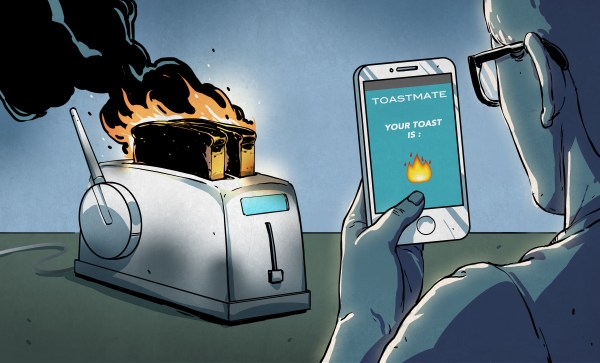
Already we’ve seen cameras (security, baby monitor, and everything in between) appear as some of the earliest connected devices, and they’ve brought with them all of the unintended consequences of poorly secured computer gear connected to the wider Internet. At least remote cameras have a purpose; there have been more than enough product launches for things that don’t. Our go-to counter-example is the Internet-connected toaster which is the topic of our wonderful art from Joe Kim this morning. Who needs to toast remotely? Nobody.
Let’s Invent the IoT
Here is our chance to do it right. How can Internet of Things make life better? What things become more meaningful when added to a network and what does that look like? How do we continue to connect our world while safeguarding privacy and being mindful of security. Finding answers to these questions will lead you to Build Something that Matters.

Another California Water Crisis
It’s no secret that a vast amount of American infrastructure is in great need of upgrades, repairs or replacements. The repairs that are desperately needed will come, and they will come in one of two ways. Either proactive repairs can be made when problems are first discovered, or repairs can be made at considerably greater cost after catastrophic failures have occurred. As was the case with the I-35 bridge collapse in Minnesota, we often pay in lives as well. Part of the problem is that infrastructure isn’t very exciting or newsworthy to many people outside of the civil engineering community which leads to complacency and apathy. As a result, it’s likely that you may not have heard about the latest struggle currently playing out in California even though it involves the largest dam in the United States and its potential failure.
Surprisingly enough, the largest dam in the US isn’t the famous Hoover Dam but the Oroville Dam at the base of the Sierra Nevada mountain range in California. At 235 meters, it is almost 15 meters taller than the Hoover Dam. It can store over four cubic kilometers of water but whether or not it will keep storing that water into the future is currently under question. In February of this year during a flood control operation damage was observed on the dam’s spillway where a massive hole had formed which only got larger as the dam was forced to continue releasing water. The hole quickly grew, and the floodwaters eroded much of the lower half of the spillway embankment, forming a canyon. Continue reading “Another California Water Crisis”
Fundamentals Of Fingerprint Scanning
Like most (if not all) Hackaday readers, I like to know how the technology I use works. I’m always amazed, for example, how many otherwise smart people have no idea how the cellphone network works other than “it’s a radio.” So now that I have two phones with fingerprint scanners on them, I decided I needed to know more about what’s going on in there.
Sure, I assumed the sensor was capacitive (but maybe not, I found out). Plus we all know some super glue, scotch tape, and gummy bears are all you need to fake one out. However, that’s been known for about 15 years and we are still seeing phones and other devices rolling out with the same scanners. So for now, put aside the debate about whether we should be using fingerprint scanners. Let’s talk about how those sensors work.
OSM (Pronounced Awesome) Hardware Makes DNA In Space
OSM stands for Oligonucleotide Synthesizer designed for use in Microgravity, meaning that it’s a device that makes arbitrary DNA strands (of moderate length) in space. Cool eh? I’ve been working on this project for the last eight months with a wonderful team of fellow hackers as part of the Stanford Student Space Initiative, and I’d like to share what we’re doing, what we’ve already done, and where we’re going.
Why space? Well, first of all, space is cool. But more seriously, access to arbitrary DNA in space could accelerate research in a plethora of fields, and the ability to genetically engineer bacteria to produce substances (say on a martian colony) could mean the difference between death and a life-saving shot. In short, it’s hard to predict the exact DNA one might need for research or practical use before hand.
First, as Hackaday tends to be a little light on biology terminology, we need to get a little vocabulary out of the way to grease the ways of communication. If you have a Ph.D. in synthetic biology, you might want to skip this section. Otherwise, here are five quick terms that will make your brain bigger so stay with me!
Continue reading “OSM (Pronounced Awesome) Hardware Makes DNA In Space”
Making A Solar-Cell Tester With Mecrisp-Stellaris Forth
In the last two articles on Forth, I’ve ranted about how it’s beautiful but strange, and then gotten you set up on a basic system and blinked some LEDs. And while I’ve pointed you at the multitasker, we haven’t made much real use of it yet. Getting started on a Forth system like this is about half the battle. Working inside the microcontroller is different from compiling for the microcontroller, and figuring out the workflow, how to approach problems, and where the useful resources are isn’t necessarily obvious. Plus, there’s some wonderful features of Mecrisp-Stellaris Forth that you might not notice until you’ve hacked on the system for a while.
Ideally, you’d peek over the shoulder of someone doing their thing, and you’d see some of how they work. That’s the aim of this piece. If you’ve already flashed in our version of Mecrisp-Stellaris-plus-Embello, you’re ready to follow along. If not, go back and do your homework real quick. We’ll still be here when you’re done. A lot of this article will be very specific to the Mecrisp-Stellaris flavor of Forth, but given that it runs on tons of ARM chips out there, this isn’t a bad place to be.
Continue reading “Making A Solar-Cell Tester With Mecrisp-Stellaris Forth”
Juicero: A Lesson On When To Engineer Less
Ben Einstein, a product designer and founder at Bolt, a hardware-based VC, recently got his hands on a Juicero press. This desktop juice press that only works with proprietary pouches filled with chopped fruits and vegetables is currently bandied in the tech press as evidence Silicon Valley has gone mad, there is no future in building hardware, and the Internet of Things is a pox on civilization. Hey, at least they got the last one right.
This iFixit-style tear down digs into the Juicero mixer in all its gory details. It’s beautiful, it’s a marvel of technology, and given the engineering that went into this machine, it was doomed to fail. Not because it didn’t accomplish the task at hand, but because it does so with a level of engineering overkill that’s delightful to look at but devastating to the production cost.
Continue reading “Juicero: A Lesson On When To Engineer Less”